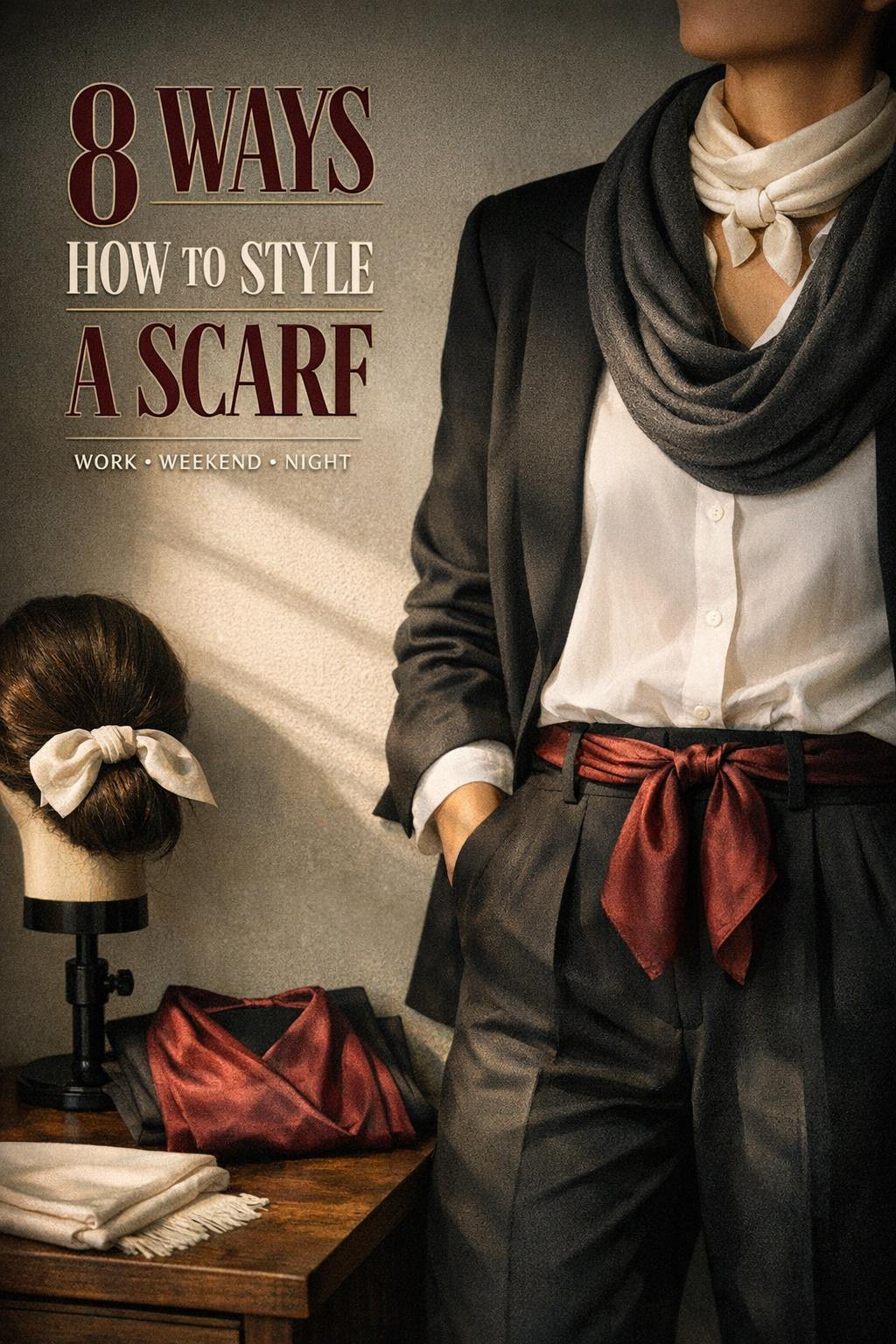
8 Ways: How to Style a Scarf for Work, Weekend & Night
How to Style a Scarf: A Practical Playbook for 20+ Looks
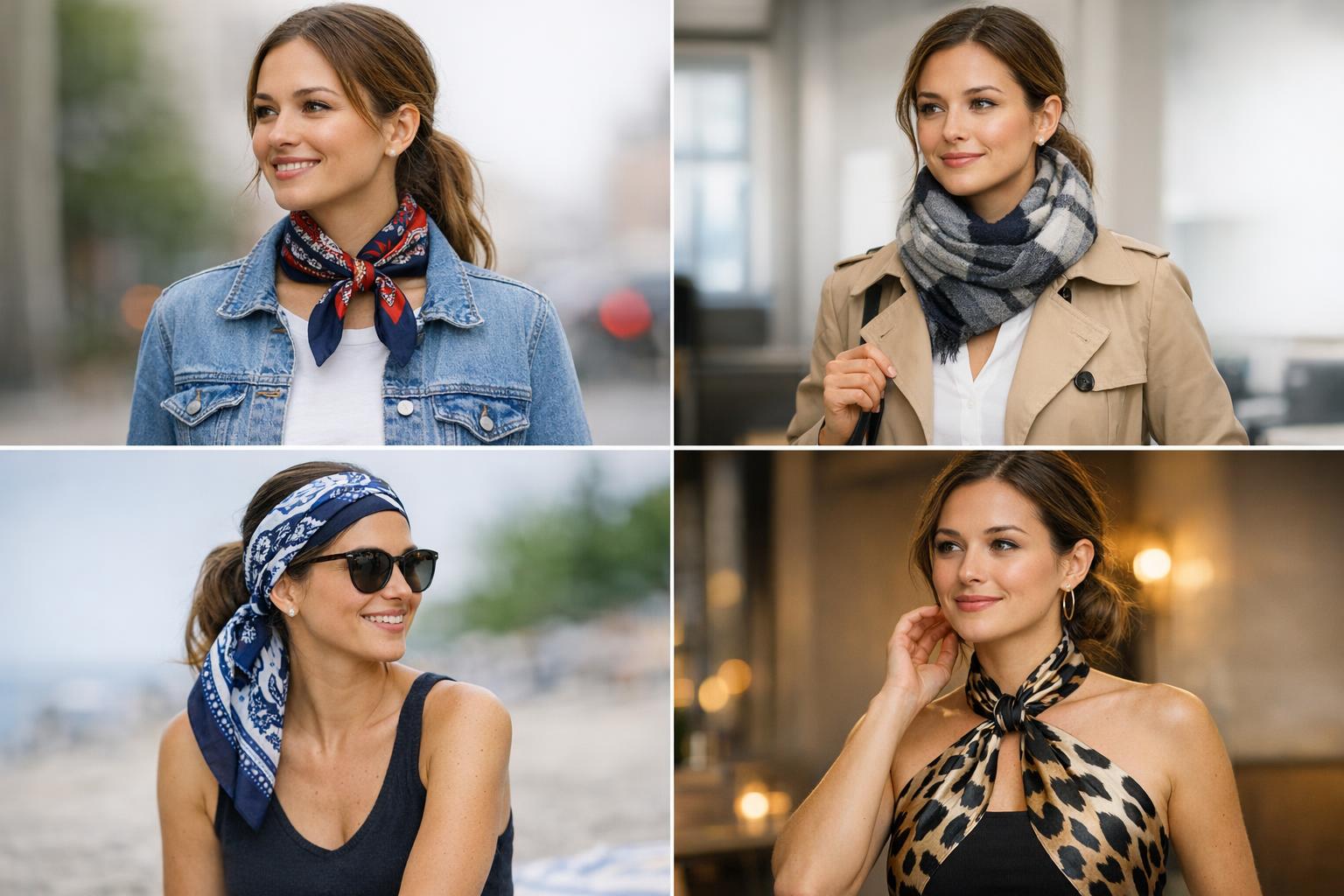
Learning how to style a scarf is one of the fastest ways to refresh outfits without changing your whole wardrobe. A single scarf can shift from polished to casual, from cold-weather layering to warm-weather styling, and from classic neck knots to headscarves, hair ties, belts, and even scarf tops. This guide walks you through versatile, repeatable techniques with clear steps, plus tips for choosing the right scarf type, fabric, and shape so each look feels intentional and comfortable.
Use this as a mix-and-match toolkit: pick a scarf shape (square or long/rectangular), choose a styling category (neck, top, head/hair, belt, layering), then follow the step-by-step method. If you’re a beginner, start with the classic neck knots and build from there.
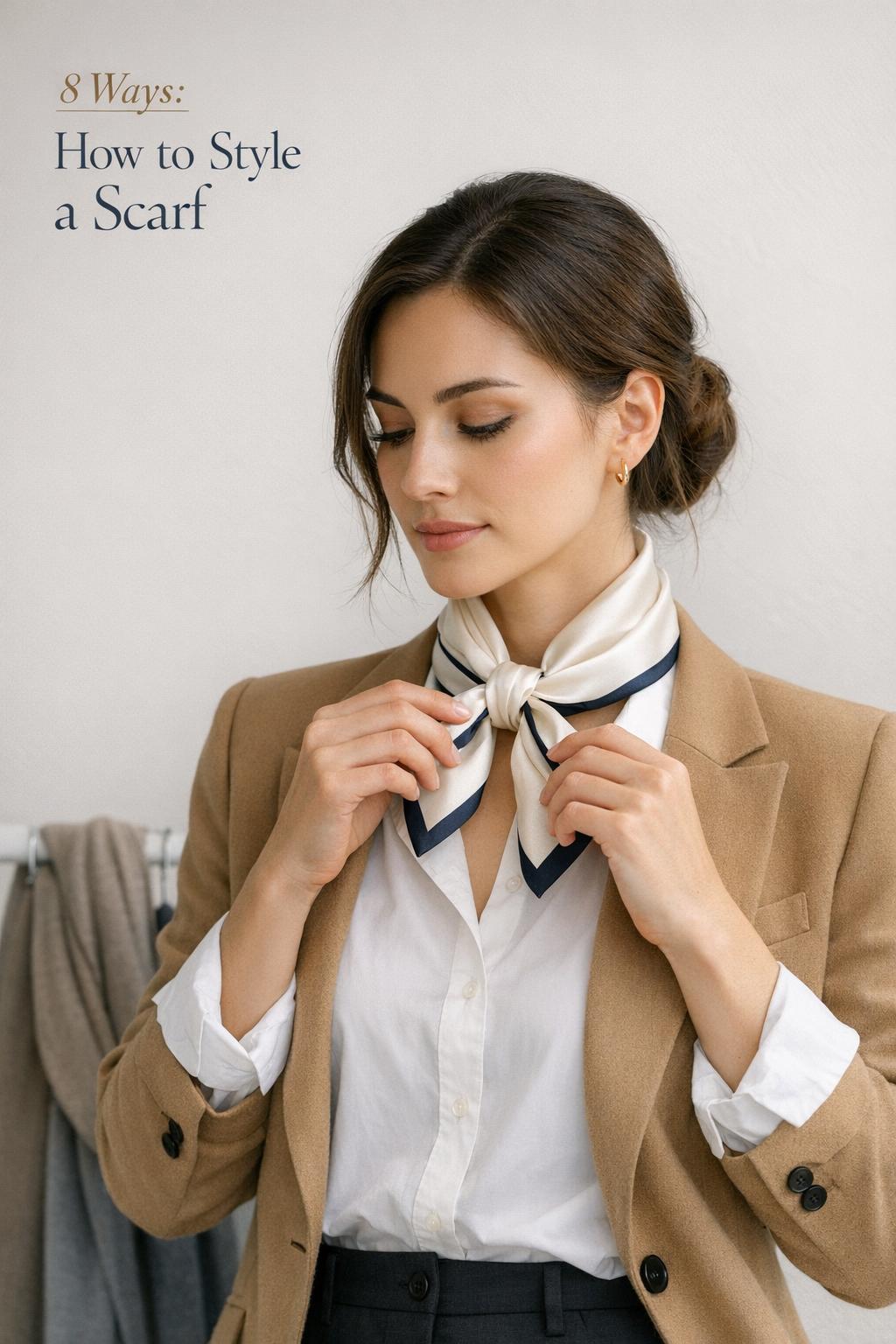
Scarf Basics: Choose the Right Scarf for the Look You Want
Great scarf styling starts with a quick decision about shape, size, and fabric. Most looks in this article work best with either a square scarf (often styled in a diamond or triangle fold) or a long rectangular scarf (ideal for wraps and knots). Fabric matters, too: a silk scarf behaves differently than wool or cotton, and that changes how well a knot holds, how much volume you get, and whether the scarf drapes or stands up.
Scarf types and shapes (and what they’re good for)
When in doubt, match the scarf to the job. Squares shine in crisp, face-framing styles and scarf-top folds, while longer scarves are easier for looping, wrapping, and layering with coats.
- Square scarf (often silk): Best for neckerchief looks, headscarves, ponytail ties, and scarf-as-top methods using triangle/diamond folds.
- Long rectangular scarf: Best for classic knots like the European loop and infinity-style looks, plus outerwear layering.
- Oversized rectangular styles: Useful when you want more volume and coverage for wraps and layered looks.
- Lightweight cotton: Often easier for warm weather, head wraps, and casual styling that doesn’t feel bulky.
- Wool scarf: Ideal for cold-weather warmth, structure, and layered outfits with coats.
- Pashmina-style scarf: Great for drape and coverage, especially when you want a softer, more fluid wrap.
Tips: a quick fit-and-proportion check
If a scarf look feels “off,” it’s often proportion rather than technique. For a cleaner finish, choose a slimmer scarf or fold a thicker scarf into a narrower band before tying. For more drama (or warmth), choose an oversized scarf and let the ends hang longer, then refine the shape by tucking ends under a loop.
Tip: Before you leave the house, do a comfort check. If the scarf pulls at your neck, rubs, or slides constantly, switch to a simpler wrap or adjust by loosening the knot and tucking ends more securely.
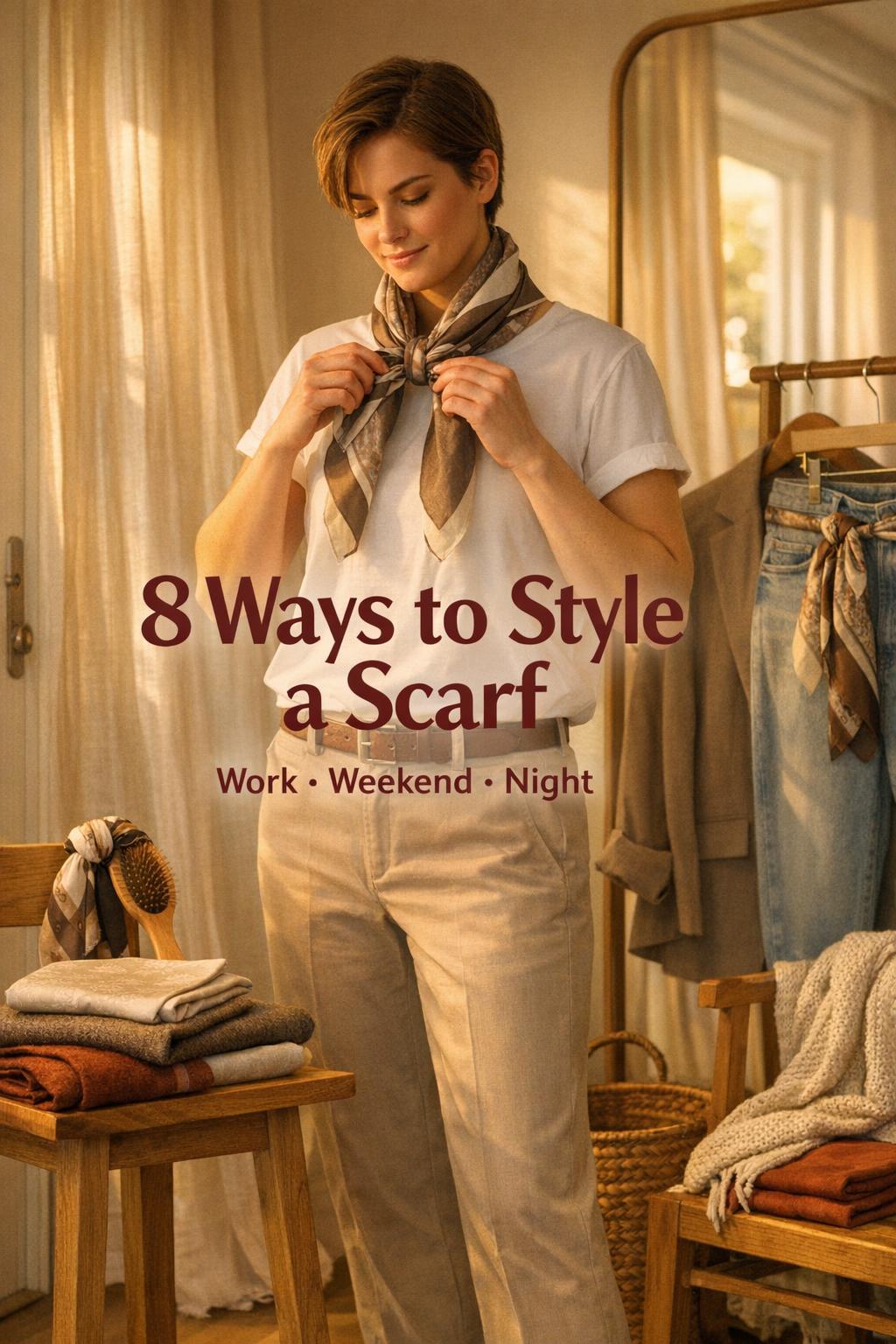
Neck Styles: Classic Knots That Always Work
Neck scarf knots are the foundation of scarf styling ideas because they’re versatile and easy to repeat. The goal is a secure knot that looks intentional and sits comfortably. The following scarf knot techniques are designed to work with everyday outfits, tailored looks, and outerwear.
The Simple Wrap (the easiest everyday method)
This is the quickest way to wear a scarf with a casual outfit or to add warmth without a bulky knot. It works best with a long rectangular scarf.
- Drape the scarf evenly around your neck with both ends hanging in front.
- Adjust the center so it sits comfortably at the back of your neck.
- Let the ends hang naturally, or lightly tuck them under your outer layer for a cleaner finish.
Tip: If the ends feel too long, fold the scarf lengthwise before draping so the ends don’t overwhelm your outfit.
The Classic European Knot (polished and balanced)
The European loop is a classic knot that looks put-together with tailored coats, blazers, and office outfits. It’s also one of the best “how to tie a scarf for beginners” options because it’s quick and secure.
- Fold a long rectangular scarf in half lengthwise.
- Drape it around your neck so the folded loop is on one side and the loose ends are on the other.
- Thread the loose ends through the loop.
- Slide and adjust the knot to sit at mid-chest or closer to the neck, depending on warmth and comfort.
Tip: For a softer look, don’t cinch the loop tightly; leave a small gap and fluff the scarf slightly so it reads intentional rather than restrictive.
The Classic Knot (simple, timeless, and adaptable)
When you want a familiar, tidy finish, use a classic knot. It can look casual or refined depending on how tight you tie it and how you style the ends.
- Drape the scarf around your neck with both ends in front.
- Cross one end over the other.
- Tie a single knot at the center of your chest.
- Adjust the ends to be even, or let one side hang slightly longer for a relaxed feel.
Tip: If the knot feels bulky, fold the scarf into a narrower band before tying so the knot sits flatter.
The Infinity Knot (clean loop with tucked ends)
The infinity knot creates a looped look that keeps ends from flapping and can look especially neat with coats. It’s a go-to when you want warmth and a streamlined silhouette.
- Drape a long scarf around your neck with both ends in front.
- Tie the ends together in a secure knot (a basic knot works).
- Rotate the joined scarf so the knot moves toward the back or side of your neck.
- Twist the loop once to form a figure-eight, then place the second loop over your head.
- Tuck the knot under a loop so it’s hidden.
Tip: If the loops feel too tight, loosen the joining knot slightly and redistribute fabric evenly around your neck before you twist and loop.
The French Knot (a neat, elevated finish)
A French knot is a classic, refined option when you want your scarf to look intentional rather than simply thrown on. It pairs well with structured outerwear and can be adapted to different scarf thicknesses.
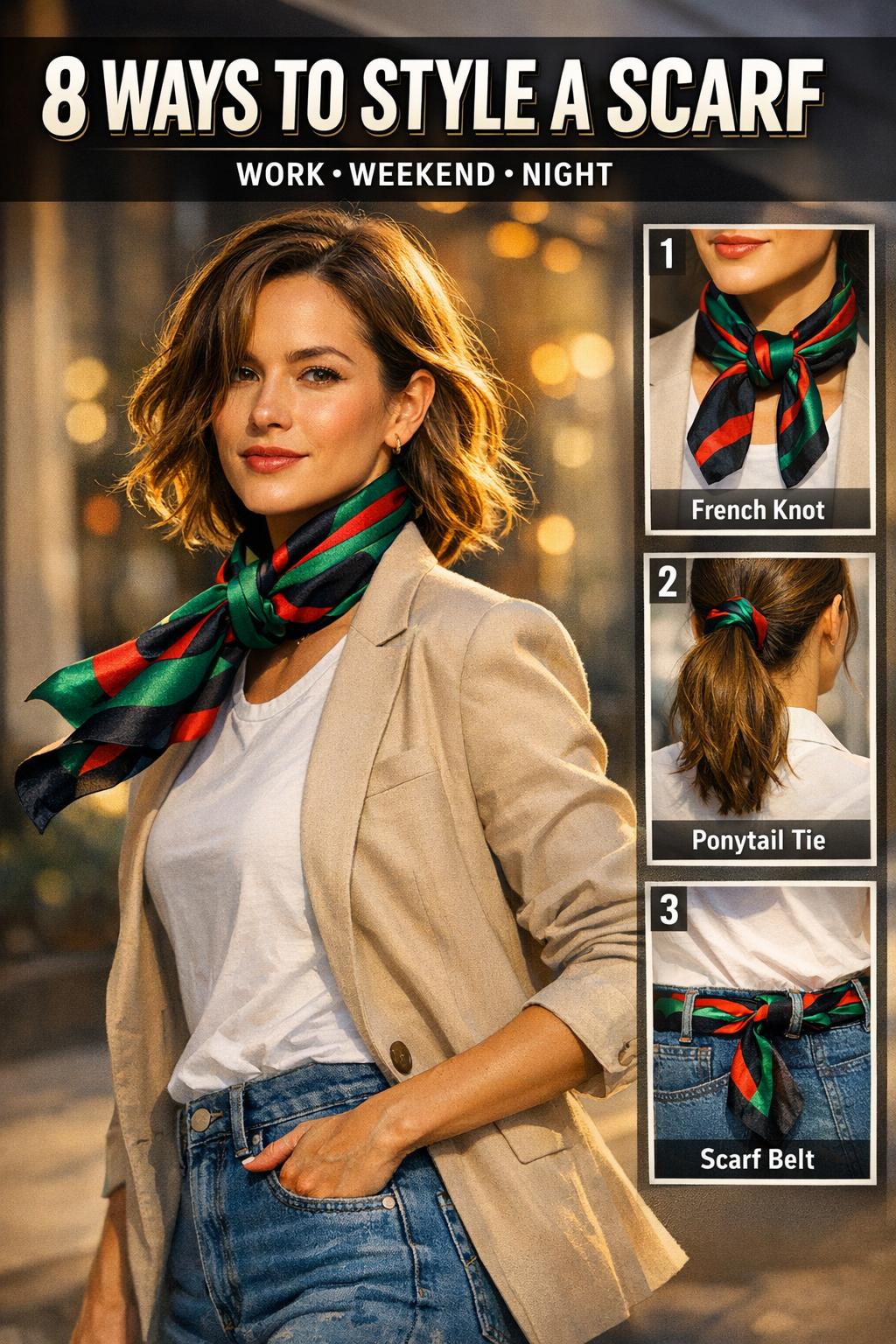
To create it, start by draping the scarf around your neck and crossing the ends in front. Wrap one end around the other, then guide it through to form a tidy knot. Adjust so the knot sits centered and the ends lie flat.
Tip: The most common issue is uneven ends. Before tightening, pull gently on both ends and re-center the knot so it doesn’t drift to one side.
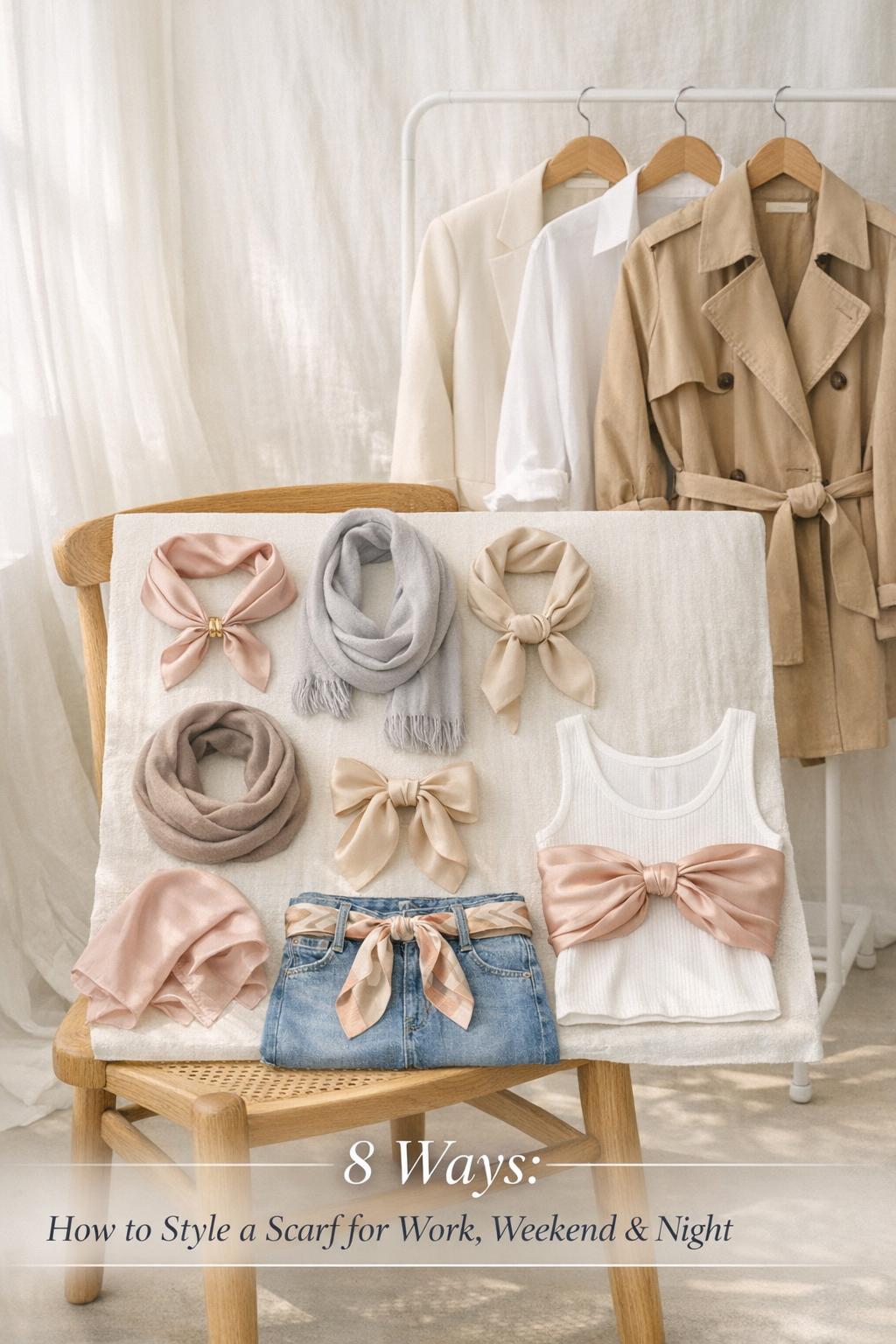
Scarves as Tops: Summer-to-Party Transitions
One of the biggest modern shifts in scarf styling is wearing a scarf as a top. These scarf top ideas are especially popular in warm weather and can be layered for added coverage. The key is using a scarf that’s large enough to fold securely and tie comfortably.
Silk Square Scarf as a Top (diamond fold)
This is the signature “how to wear a silk scarf as a top” method. A square scarf folded into a diamond creates a flattering front point and a secure tie.
- Lay the square scarf flat and fold it diagonally into a triangle.
- Rotate so the point faces downward (diamond/triangle front).
- Bring the two ends around your back and tie them securely.
- Adjust the front point so it sits centered and provides the coverage you want.
Tips: If you want more structure, fold a slightly wider band along the top edge of the triangle before tying. If you want extra security, layer the scarf top under an open shirt, blazer, or lightweight outer layer to “mask” the top while keeping the look fashion-forward.
Triangle-to-Tank Method (more coverage, easy styling)
If you like the scarf-top trend but want a bit more coverage, start with a larger scarf and build a more tank-like shape by folding into a wider band before tying. The idea is the same: create a stable front panel and a secure back tie.
To do it, fold your scarf into a triangle, then fold the long edge inward in small increments to create a wider band across the chest. Wrap the ends around your torso and tie at the back, then smooth and re-fold as needed until it feels secure and even.
Tip: For comfort, prioritize a snug-but-not-tight tie and keep the fold smooth. If the scarf shifts, re-tie and consider layering with a light outer layer to keep everything in place.
Layered scarf-top styling (coverage and versatility)
Layering is what makes scarf tops feel wearable beyond a beach or festival setting. You can treat a scarf top as a centerpiece and then balance it with simple, clean layers.
- Wear the scarf top under an open button-down for a relaxed daytime outfit.
- Add a blazer to shift the look toward dinner or an evening setting.
- Choose bottoms with a clean line so the scarf remains the focal point.
Tip: If you’re new to scarf tops, keep the rest of your outfit minimal so you can focus on fit and security first, then experiment with bolder combinations later.
Face-Framing and Hair Wraps: Headscarves and Hair Accessories
Headscarf styling can feel instantly elevated, whether you’re going for everyday glam or just want a practical way to keep hair neat. Hair scarf looks also translate well across seasons: lightweight scarves work in warmer months, while richer fabrics can complement cooler-weather outfits.
Headscarf for everyday glam (classic headscarf look)
A square scarf is the easiest entry point for headscarves. Fold it into a triangle, place the long edge along your hairline, and bring the ends down to tie under your hair at the nape (or tie slightly to the side for a softer frame). Adjust the triangle point at the back for coverage and comfort.
Tips: Keep the fold crisp along the front edge for a clean look, and avoid tying too tightly. If you’re wearing earrings or bold sunglasses, a simple headscarf tie can act as a streamlined backdrop.
Ponytail scarf tie (fast, flattering, and practical)
A ponytail scarf tie is one of the easiest ways to add color or pattern without changing your outfit. It works well with a narrow folded square scarf or a lightweight long scarf.
- Gather hair into a ponytail and secure it with an elastic.
- Fold the scarf into a narrow band.
- Wrap the scarf around the ponytail base and tie a knot or bow.
- Let the ends hang, or wrap them around again for a cleaner, shorter finish.
Tip: If the scarf slips on smooth hair, tie once, then double-knot lightly and fluff the ends so it still looks soft rather than overly tight.
Scarf around a bun (polished in under a minute)
For a quick, tidy style, wrap a folded scarf band around the base of a bun and tie a small knot or bow. Keep the knot slightly off-center for an effortless look, or center it for a more symmetrical finish.
Tip: If you want the scarf to be subtle, tuck the ends under the wrap after tying so the color peeks through without dangling ends.
Belted and Layered Looks: The Scarf as Accessory
Scarves aren’t limited to the neck and hair. Styling a scarf as an accessory—especially as a belt or layered element—can pull together an outfit and add a focal point. These methods are ideal when you want a fashion scarf moment without adding bulk around the neckline.
Scarf belt tutorial (an easy waist definition)
A scarf belt works best with a narrower scarf or a square scarf folded into a long band. It’s a clean way to add color to neutrals or make a simple dress feel styled.
- Fold the scarf into a long, even band.
- Thread it through belt loops, or wrap it around your waist over a dress or outer layer.
- Tie a knot at the front or slightly to the side.
- Adjust the ends so they hang evenly, or tuck them for a minimal finish.
Tip: If you’re wearing a patterned scarf, let it be the focal point by keeping the rest of your outfit streamlined. If your outfit is already bold, choose a scarf in a calmer color to avoid competing focal points.
Layering over outerwear (warmth plus structure)
Layering a scarf with a coat is one of the most reliable cold-weather moves. You can wear it as a simple wrap for a relaxed look or use a structured knot (like the European loop or an infinity knot) when you want a cleaner front and less movement.
Tips: If your coat has a strong collar or lapel, keep the scarf closer to the body with a looped style so it doesn’t fight the coat’s shape. If your coat is minimal, a bulkier wrap can add dimension and make the outfit feel complete.
Seasonal and Style Variants: Color, Pattern, and Outfit Balance
Scarves can be styled year-round by adjusting fabric weight, color coordination, and how you use pattern. Seasonal scarf styling doesn’t require a new closet—just small shifts in material and contrast. In general, lighter fabrics and simpler folds feel better in summer, while thicker fabrics and layered knots suit winter.
Matching with neutrals (the easiest way to look intentional)
Neutrals make scarf styling straightforward because the scarf can become the focal point. If you wear a neutral base outfit, you can choose a scarf that either blends smoothly (for a refined look) or stands out (for a statement).
Tip: When you want a scarf to look elevated rather than random, echo it somewhere else—your shoes, bag, or outer layer—so it feels integrated into the outfit.
Bold patterns and focal points (how to avoid visual clutter)
Patterned scarf styling works best when you decide what the scarf is doing: it’s either the focal point, or it’s supporting another statement piece. If it’s the focal point, keep the silhouette clean and the rest of the outfit relatively simple. If your outfit already has a bold element, use the scarf in a smaller way—like a ponytail tie or a scarf belt—to add cohesion without overwhelm.
Tip: If a patterned scarf feels “too loud” near your face, move it to your waist or hair instead. The same scarf can read completely different depending on placement.
Quick Outfit Guides: Outfit-by-Outfit Walkthroughs
If you want scarf outfit ideas you can apply immediately, use these go-to combinations. Each one pairs a technique with a situation so you’re not guessing what to wear it with.
Casual daytime look (simple wrap + relaxed layers)
Use the simple wrap with a long scarf and let the ends hang naturally for an effortless finish. If you want a cleaner front, tuck the ends lightly into your top layer. This approach works especially well when you want warmth without a formal vibe.
Office-ready layered look (European knot + tailored outerwear)
Choose the classic European knot when your outfit is structured and you want the scarf to look polished rather than bulky. Keep the loop centered and the ends even. If your coat has lapels, position the scarf so it sits neatly inside the front opening.
Evening or party look (silk scarf top + blazer)
For a modern evening outfit, style a silk square scarf as a top, then add a blazer to balance coverage and create a clean silhouette. This is a simple way to translate the scarf top trend into a more “going out” context while still looking intentional.
Warm-weather weekend look (headscarf + simple outfit)
Fold a square scarf into a triangle and tie it as a headscarf for a face-framing finish. Keep the rest of the outfit minimal so the headscarf reads as the styling detail. If you prefer an even subtler approach, use the same scarf as a ponytail tie instead.
Day-to-night transition (scarf belt + quick hair tie)
When you need a fast change without changing clothes, move the scarf from your neck to your waist as a scarf belt, or add it to your hair as a ponytail tie. These small shifts can make the same base outfit feel more styled for dinner or an event.
Maintenance and Care Tips: Keep Scarves Looking Fresh
A scarf looks best when it’s clean, smooth, and holds its shape. Care needs vary by fabric—silk, wool, and cotton don’t behave the same way—so treat scarf care as part of styling. A well-kept scarf ties more cleanly, drapes better, and looks more intentional.
Caring for silk, wool, and cotton scarves
Start by checking the scarf’s care guidance, then build good habits: keep scarves stored neatly, avoid crushing folds for long periods, and refresh them before wearing so knots and wraps look crisp. If a scarf has persistent creases, smoothing and reshaping it before styling can make even a simple knot look elevated.
Tip: If you rotate scarves regularly, give them space in storage so they don’t develop deep creases that distort how they drape when tied.
Common Mistakes to Avoid (and Quick Fixes)
Most scarf frustrations come down to a few repeat issues: the wrong scarf for the technique, uneven tension, bulky folds, or visible ends that disrupt the look. Fixing these doesn’t require advanced skill—just small adjustments.
- Bulky knot: Fold the scarf into a narrower band first, or switch to a wrap or loop style.
- Ends are uneven: Re-center the scarf at the start, then tighten gradually while pulling both ends evenly.
- Scarf slips: Use a more secure method (European loop or infinity knot), or tie a slightly firmer knot and tuck ends under a loop.
- Too much volume near the face: Loosen the knot and spread fabric evenly, or move the scarf to hair/waist instead.
- Scarf top feels insecure: Re-fold for more structure at the top edge, tie more securely, and consider layering with a shirt or blazer.
Tip: When troubleshooting, don’t start over immediately. Often you can fix a scarf knot by loosening it slightly, re-centering it, then re-tightening in small increments.
Visual Gallery: What to Practice First (a Simple Progression)
If you’re building confidence, practice in a smart order. Start with the techniques that give the biggest payoff with the least effort, then move into trend-forward looks like scarf tops and headscarves. Once you can do a neat loop and a tidy knot, everything else becomes easier.
- Level 1: Simple wrap, classic knot
- Level 2: European loop, infinity knot
- Level 3: Headscarf tie, ponytail scarf tie
- Level 4: Scarf belt, silk square scarf as a top
Tip: Take a quick photo after tying. Small asymmetries and bulky folds show up immediately in a photo, making it easier to adjust and repeat a better version next time.
Downloadable Cheat Sheet and Checklist (What to Decide in 30 Seconds)
Before you tie anything, run a quick checklist so your scarf choice matches the moment. This keeps scarf styling from feeling random and helps you choose a method that stays comfortable all day.
- Is this for warmth, style, or both?
- Am I using a square scarf or a long rectangular scarf?
- Do I want the scarf near my face (neck/head) or as an accessory (hair/waist)?
- Do I want the scarf to be the focal point (bold pattern) or a subtle support (neutrals)?
- Will I be layering with outerwear, and do I need a low-bulk knot?
Tip: When you’re unsure, default to the European loop for structure or the simple wrap for ease. They’re the most reliable “works with almost anything” options.
FAQ
How do I style a scarf for beginners without it looking messy?
Start with structured, repeatable methods like the simple wrap or the classic European knot, then adjust slowly for even ends and comfortable tension; folding the scarf into a narrower band before tying also helps keep knots clean and less bulky.
What’s the easiest way to tie a scarf so it stays put all day?
The European loop and the infinity knot tend to stay secure because they create a stable looped structure; for extra stability, keep tension even and tuck visible ends under a loop so the scarf doesn’t shift as you move.
How do I wear a silk scarf as a top without it slipping?
Fold the square scarf into a triangle, tie it securely at the back, and add structure by folding a wider band along the top edge before tying; if you want more confidence and coverage, layer with an open shirt or blazer to help keep the scarf top in place.
How can I style a scarf in summer when I don’t want extra warmth?
Use lighter fabrics and shift the scarf away from heavy neck layering by styling it as a scarf top, headscarf, ponytail tie, or scarf belt, which keeps the look intentional without adding warmth around your neckline.
How do I style a scarf with a coat without creating too much bulk?
Choose a looped style like the European knot or an infinity knot and keep the scarf folded neatly so it sits closer to the body; this reduces extra volume that can compete with collars and lapels.
What are the best scarf styling ideas if I want the scarf to be the focal point?
Let a patterned or bold scarf take center stage by pairing it with a neutral outfit and using a clear, visible placement like a classic neck knot, a headscarf tie, or a scarf belt, keeping other accessories simple so the scarf reads as the statement.
How do I tie a headscarf so it frames my face nicely?
Fold a square scarf into a triangle, place the long edge along your hairline, and tie the ends at the nape or slightly to the side, then adjust the front fold to be smooth and balanced so it feels face-framing rather than bulky.
Can I style a scarf as a belt, and what’s the easiest method?
Yes—fold the scarf into a long, even band, thread it through belt loops or wrap it over a dress at the waist, then tie a knot at the front or slightly off-center and adjust or tuck the ends depending on how minimal you want the finish.