Winter Teacher Outfits: A Classroom Layer Rotation
Winter teacher outfits are easier to repeat when every layer has a clear job. Start with a top and bottom you can teach in on their own, add a removable classroom layer, and keep your outdoor coat separate. That gives you a way to change the outfit as the room changes, without rebuilding it at lunch or relying on a heavy sweater you cannot comfortably remove.
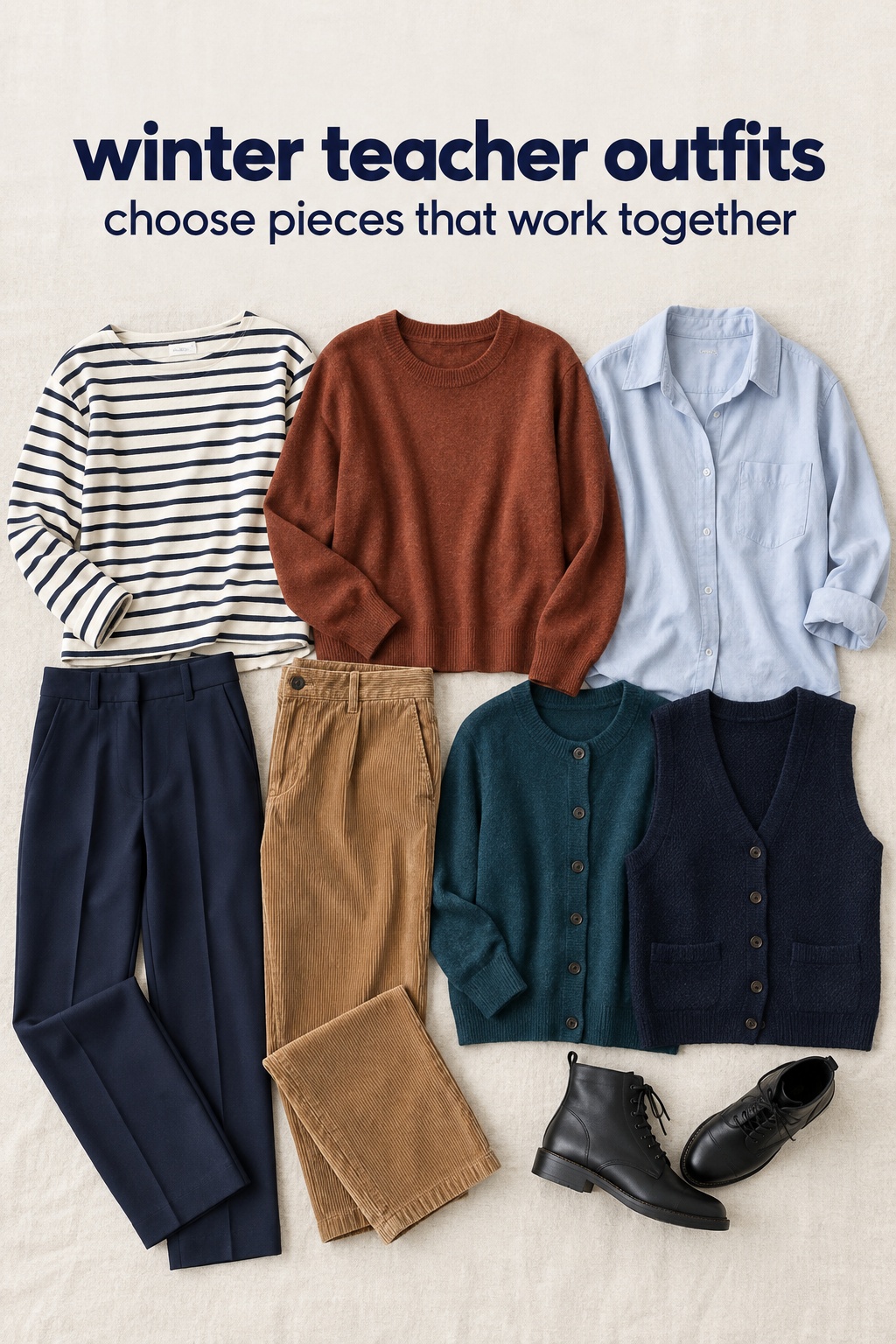
The rotation below uses nine pieces: two pairs of pants, three tops, two indoor layers, one pair of classroom boots, and one coat. Navy, camel, cream, rust, pale blue, and teal make the examples easy to follow, but you can substitute your own colors. The useful part is the relationship between the pieces. Each combination includes an indoor version and a specific layer change for a different part of the school day.
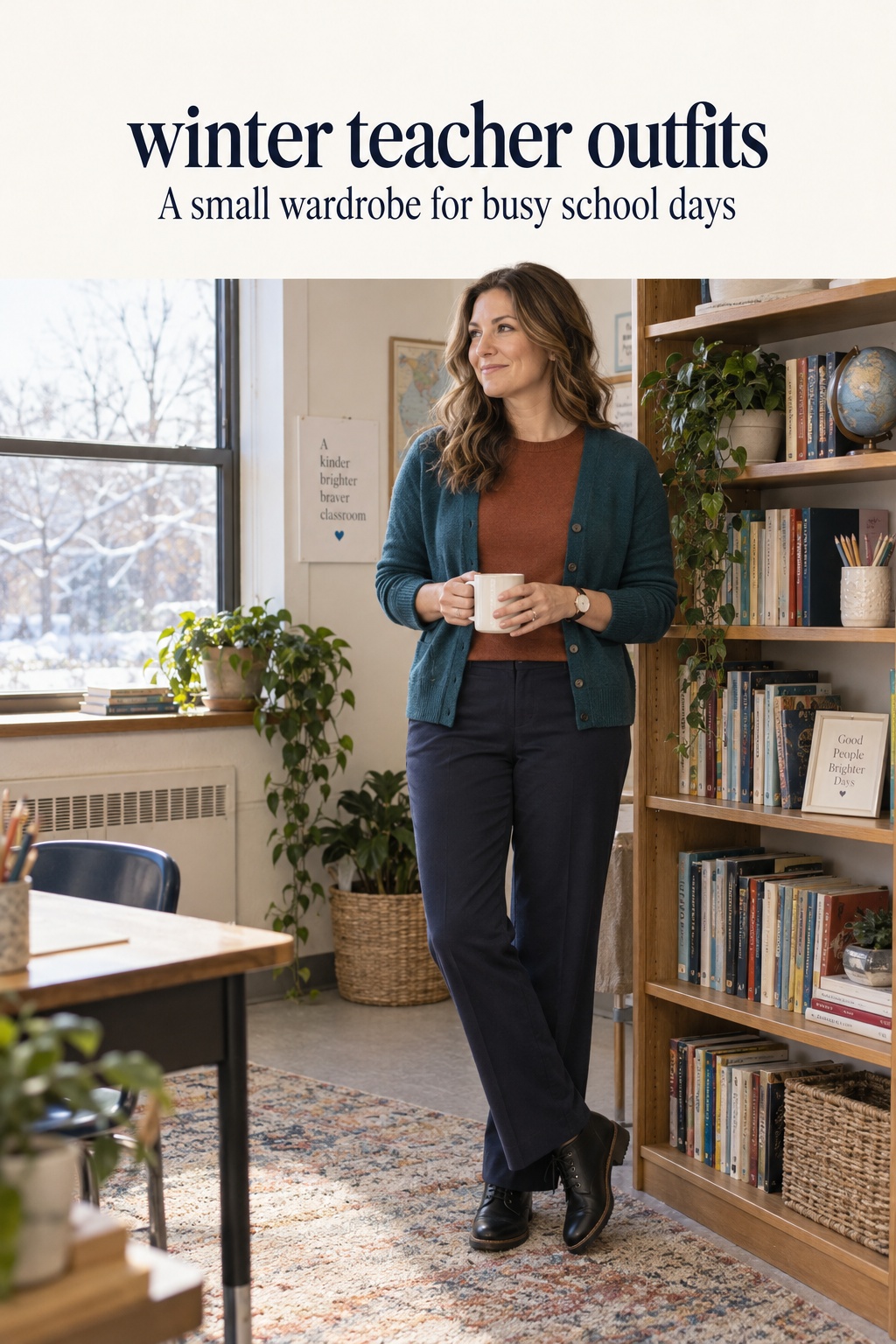
Give nine pieces specific jobs in your winter rotation
Think of this as a working section of your closet, rather than a complete wardrobe for the season. Underwear, socks, weather accessories, and any specialist work clothing sit outside the nine-piece count. You may also need spare tops between laundry days. The count simply makes it possible to see which pieces are doing which jobs, and which extras you can leave out of your morning decisions.
Begin with the clothing you already reach for. A navy pair of straight trousers is the first bottom in this example. Choose a pair that lets you sit, bend, and take a long step without pulling at the waistband. Try it with the boots you intend to wear. The hem should stay clear of the floor, and the leg opening should sit over the boot without repeatedly catching on its shaft.

Found the dress? Keep the rest in one place.
Zarellea brings guest details, vendors, timelines, and every next step together — so your wedding plan feels as good as your look.
Camel straight corduroy pants are the second bottom. Here, corduroy introduces a visible texture and a lighter color, not a promise of a particular warmth level. If you prefer another fabric, use tan chinos or a second pair of tailored pants. Give the two bottoms the same practical responsibility: they should accept all three tops and both indoor layers. A pair that only works with one special shirt makes the rotation harder to use.
Three tops that can stand alone
The first top is a cream-and-navy striped long-sleeve tee. Look for a neckline and coverage you feel comfortable wearing after you remove a cardigan. Check it under classroom-like lighting and while reaching forward. A top that requires another piece to cover an awkward gap is less useful in a rotation built around taking layers off.
The second is a rust fine-gauge crewneck. Use it as the day’s main top, not as a pullover you plan to remove over a thin undershirt. It should fit comfortably under either indoor layer. If rust is not your color, a muted rose, brick, or ocher version can play the same visual role. The third top is a pale blue collared blouse with enough shoulder room for reaching and sleeves that you can secure neatly at the wrist.
These three tops create different moods without changing the bottom half. Stripes add pattern, rust adds a strong block of color, and the blouse adds a collar. You do not need to combine all three effects in one outfit. Keep the choice visible and simple so that an early-morning decision comes down to one top and one task, rather than several competing details.
Two indoor layers, then shoes and a coat
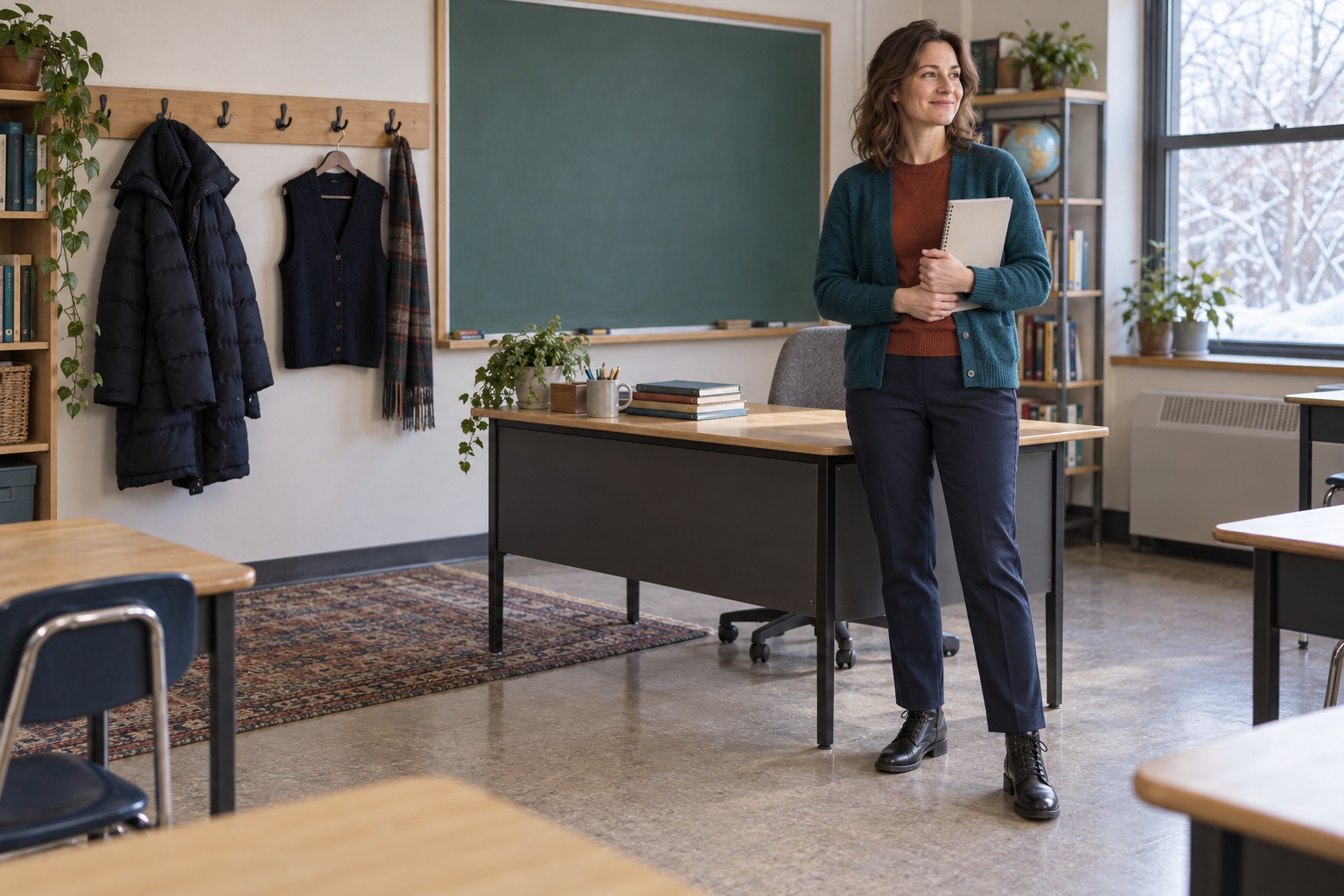
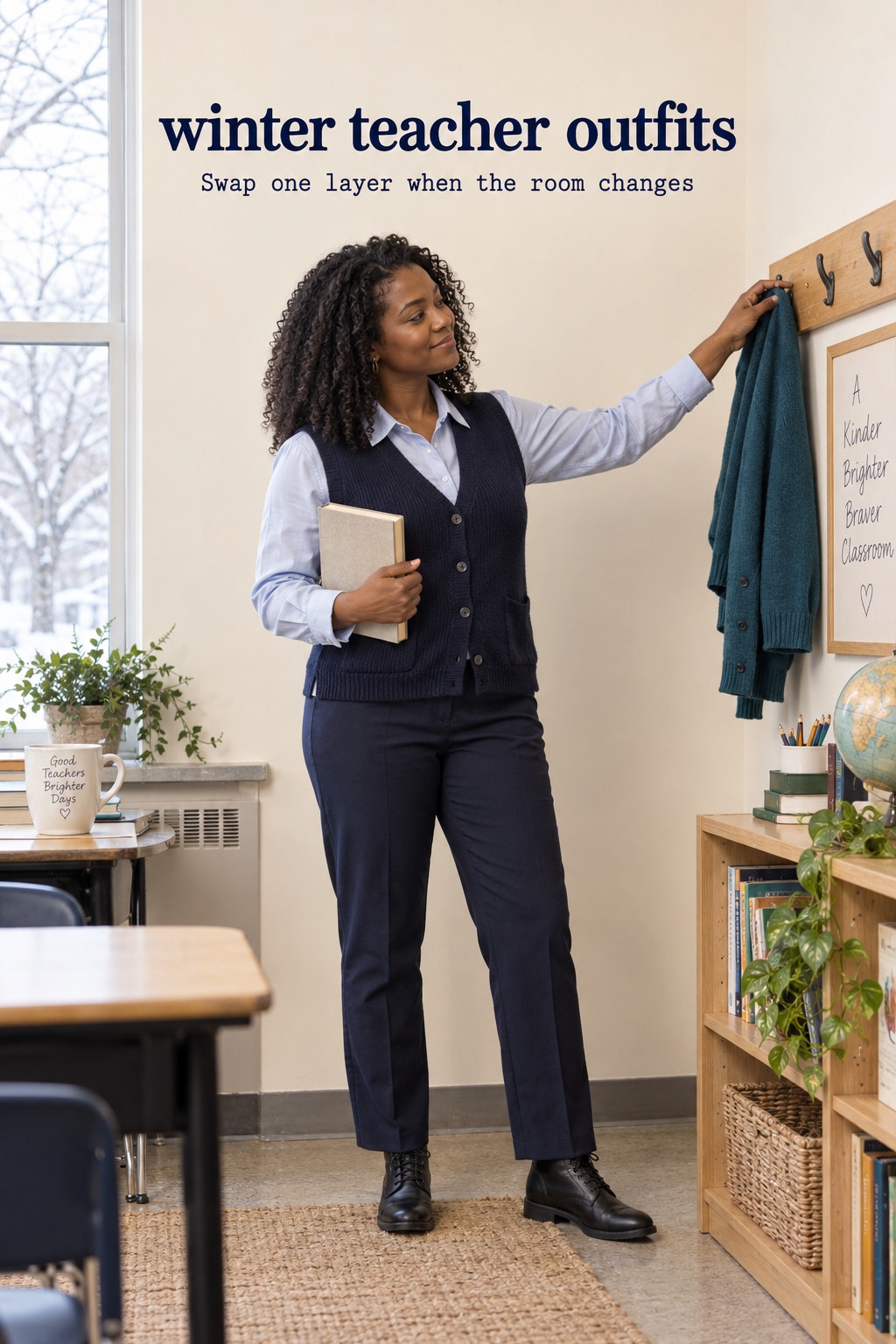
A teal button cardigan provides the sleeved option. In the examples, it finishes near the high hip and can be worn open. A navy button-front knit waistcoat provides the sleeveless option. Choose an opening large enough to fit over your blouse without the armholes pulling. The cardigan and waistcoat are alternatives most of the time; wearing both is optional and should depend on how the combination feels to you.
Black flat lace-up ankle boots connect all five outfits. These are a styling example, not a claim that any particular boot will feel comfortable for every wearer or suit winter ground conditions. Use a pair you already know you can work in. A navy padded coat completes the nine pieces and belongs to the commute and outdoor portions of the day, rather than the indoor outfit.
Lay the seven indoor garments out together before adding anything else. Test each top with both bottoms, then try the two layers over each combination. An existing piece can replace any item that does not earn its place. The idea of winterizing what you already own also appears in Thrifty Wife Happy Life’s fall-to-winter teacher capsule guide. Here, the extra step is deciding exactly when each layer stays on or comes off.
Set up three layer states before Monday morning
Give your winter teacher outfits three recognizable versions: cool room, warm room, and outside. You do not need temperature numbers for them. Use the conditions you actually encounter, along with your own comfort. These states are a planning aid that lets you make a small change quickly while preserving the clothes underneath.
For the cool-room version, start with the rust crewneck, navy trousers, and boots, then add the teal cardigan. Leave it open if that is how it sits comfortably. This is the most visibly layered combination in the rotation. Before treating it as a dependable outfit, sit at a desk, reach to an imaginary upper shelf, and bring both arms forward. The cardigan should move with you instead of dragging the crewneck upward.
For the warm-room version, remove the cardigan and keep the rust top and navy trousers. The top was chosen to stand on its own, so this is a planned version of the outfit. Hang the cardigan somewhere available to you or fold it in your work bag. If it lives on the back of a chair, make sure it does not fall onto the floor or get trapped under the chair’s wheels.
For the outside version, put your coat over the outfit and add the weather accessories you need. Try the coat with the cardigan underneath before relying on the combination for duty. If the sleeves feel crowded, choose the waistcoat as the indoor layer on days with more outdoor time. A cardigan, waistcoat, or fashionable ankle boot is not automatically adequate outdoor protection just because it belongs to a winter outfit.
Check the wrists as carefully as the neckline
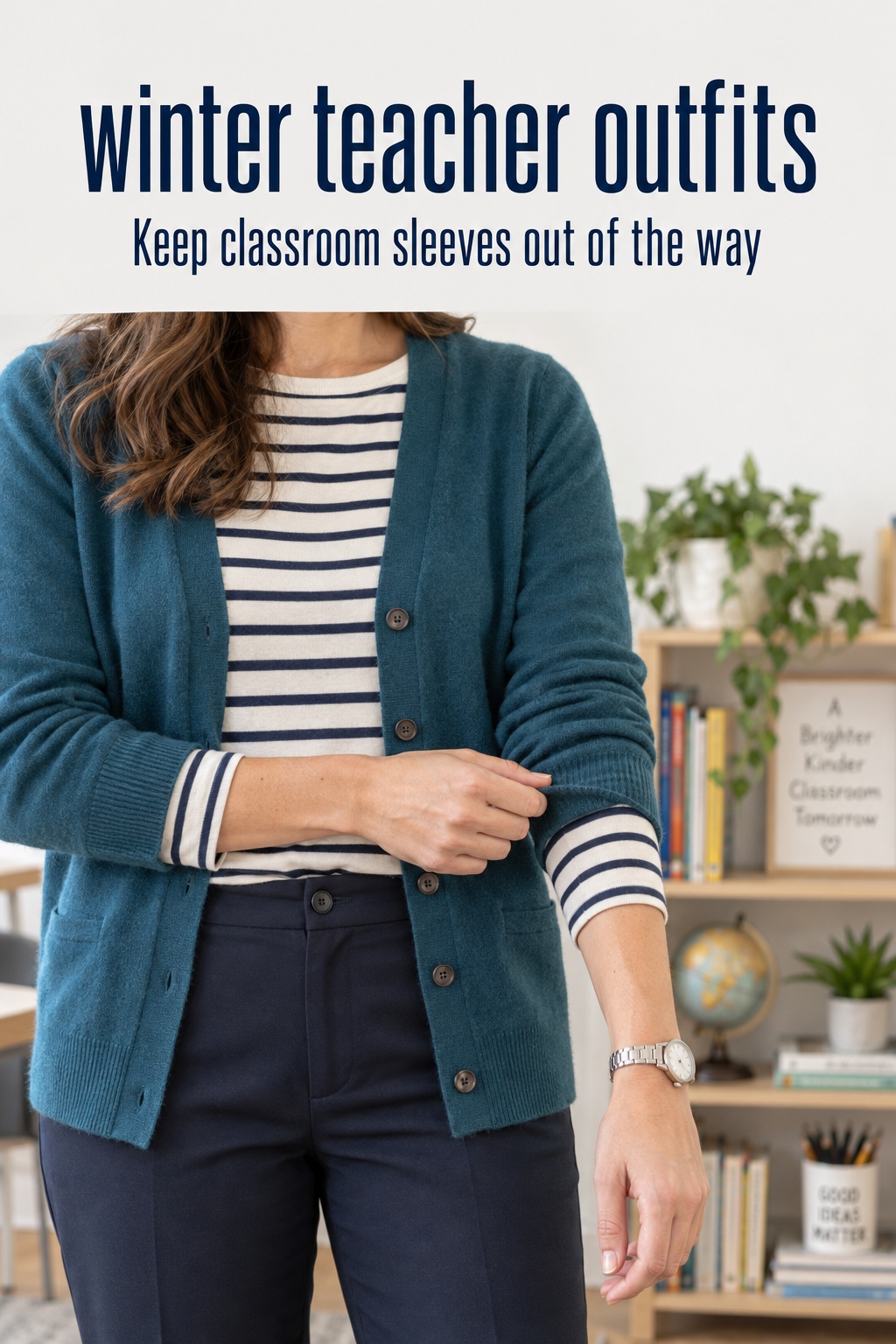
The sleeve detail matters when you handle books, mark papers, or work at a practical station. With the striped tee and cardigan combination, push the cardigan cuff back enough to expose the closer-fitting tee sleeve. Move your hand across a desk and reach for a book. If the knit keeps sliding toward your palm, use the waistcoat for that lesson or choose a cardigan with cuffs that stay where you put them.
With the blouse, try a single tidy cuff fold if that suits the garment. Check it while wearing the waistcoat, then while wearing the cardigan. A rolled sleeve that fits alone can become awkward when pushed into another sleeve. Make the choice before the day begins, rather than discovering during a demonstration that you have to keep rearranging both layers.
Build one place for the layer you remove
The ability to take a layer off is only helpful when there is somewhere sensible to put it. Decide whether your cardigan belongs on an available hook, in a drawer, or in a clean part of your bag. Keep the coat and indoor knit separate when possible so you can retrieve either without unpacking the whole outfit.
Choose where your small essentials go in each version, too. If you keep a pen in the cardigan pocket, you will need to move it when the cardigan comes off. If school access items are required, use the arrangement your workplace specifies. Think through the change once, and the same sequence can serve several outfits. The goal is a layer swap that takes little attention away from the lesson.
Use the rotation on five different teaching days
The five combinations below reuse the same pieces with different responsibilities. Treat the weekday names as convenient labels, then move the outfits to match your timetable. A practical lesson on Thursday might need Tuesday’s sleeve arrangement; a meeting on Monday might suit Thursday’s collar. The rotation works because the garments are interchangeable, not because a particular outfit belongs to a particular day.
Monday: rust and navy for a cool classroom start
Wear the rust crewneck with navy straight trousers, the teal cardigan, and black ankle boots. The contrast between rust and teal makes the layered version feel considered without adding a scarf indoors. Keep the crewneck hem smooth under the cardigan. A full tuck is optional; if it pulls when you reach, leave it untucked at a length that feels tidy to you.
Your change for a warmer lesson is straightforward: remove the teal cardigan. Bring it back for a cooler room later, if needed. When you put the coat on for arrival or dismissal duty, check that the cardigan sleeves have not bunched at the elbows. This combination is useful when you want an uncomplicated first outfit with two visually distinct indoor versions.
Tuesday: stripes with sleeves you can manage
Combine the striped long-sleeve tee and navy trousers, then add the teal cardigan. This keeps the color on the outer layer while the base outfit stays quieter. The narrow stripes remain visible through the open front. Black boots repeat Monday’s footwear, so there is no new trouser-and-shoe relationship to check.
For an activity where long cardigan cuffs get in your way, take the cardigan off or replace it with the navy waistcoat. You are changing the sleeve arrangement while retaining the same top and bottom. If you choose the waistcoat, look at it from the side with your arms forward. It should not bunch under the arm or lift the tee as you move.
Wednesday: camel corduroys for a room-to-room day
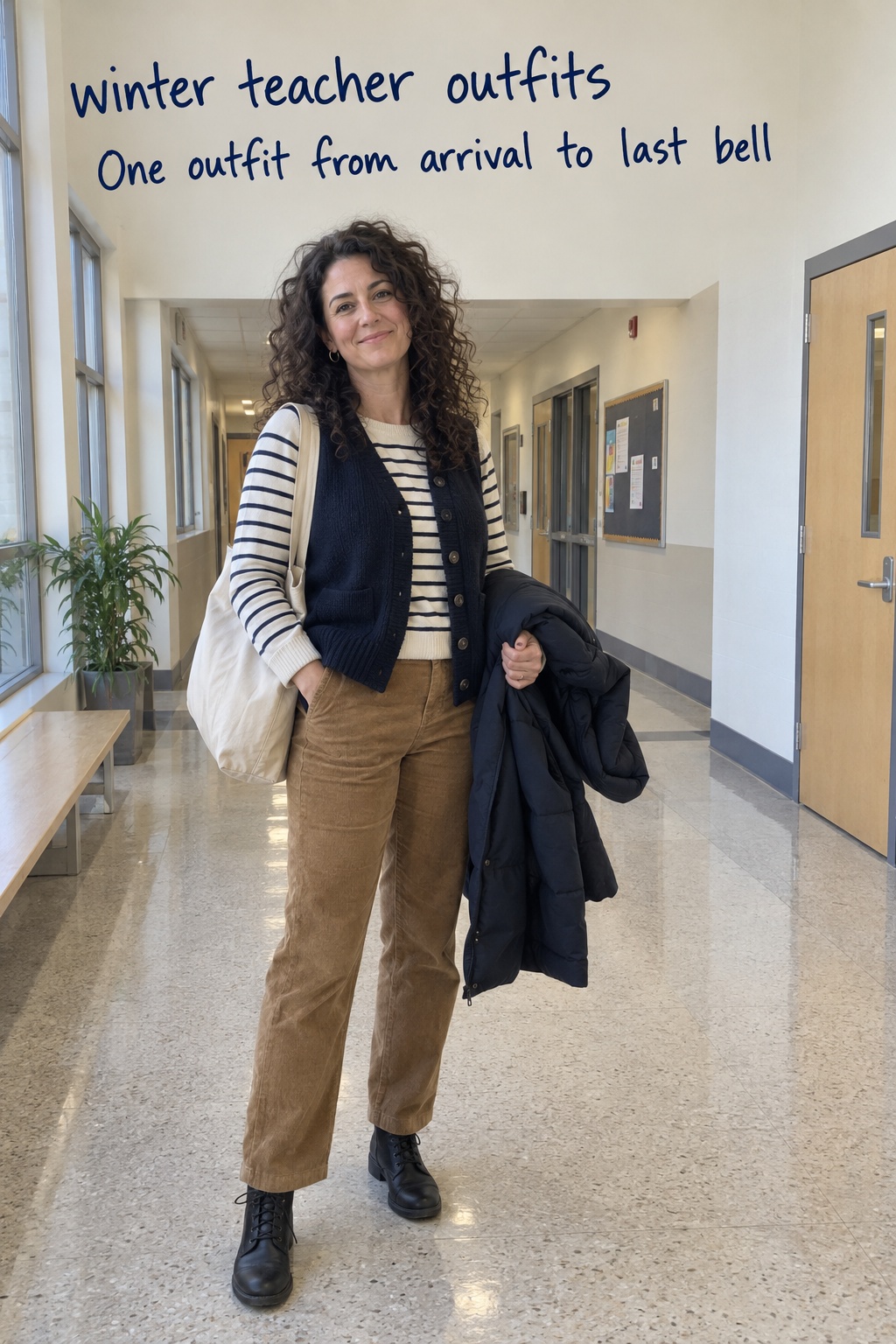
Wear the striped tee with camel straight corduroy pants and the navy waistcoat. The camel bottom separates this look from Tuesday without introducing a new top. A button-front waistcoat can stay open so the stripes continue down the middle; button it only if it sits comfortably when you are seated.
Carry or wear the navy coat for arrival according to the conditions, then store it after coming inside. If one classroom feels cool, add the cardigan instead of the waistcoat. If another feels warm, return to the striped tee alone. The candid hallway illustration shows this base combination with the coat carried over an arm, making the separation between indoor dressing and outerwear easy to see.
Thursday: a blue collar with one adjustable knit
Choose the pale blue blouse, navy trousers, and navy waistcoat. The blouse collar provides a visible detail even when the waistcoat comes off. Straight trousers keep the bottom half familiar, while the different neckline changes the outfit enough that it does not feel like another version of the crewneck day.
If the room cools down, substitute the teal cardigan or add it over the waistcoat only after checking the combined fit. For a warmer room, hang up the waistcoat and leave the blouse as your main top. This gives you a clear plan for a day that includes teaching and a conversation with colleagues or families, subject to your school’s own expectations for dress.
Friday: a quieter change through color and texture
Pair the rust crewneck with camel corduroy pants and the teal cardigan. These are pieces already used earlier in the rotation, brought together in a different combination. Navy no longer dominates the bottom half, and the corduroy texture sits beside the fine-gauge top. Keep the same boots if they remain the right choice for your day.
Take the cardigan off when you do not need it. If you want a different outline, replace it with the navy waistcoat. You do not have to use jeans to make this a Friday outfit, especially if denim is not an option at your workplace. The change comes from recombining the existing pieces, rather than creating an entirely separate casual wardrobe for one day.
Repair the rotation when a piece or temperature changes
A useful rotation survives ordinary interruptions. A blouse may be in the laundry, a cardigan may be unavailable, or the day’s outdoor schedule may change. Keep the jobs of the pieces in mind, and you can make a substitution without adding several new decisions. Replace the missing function first, then consider whether you want to change the appearance.
When the cardigan is unavailable
Use the navy waistcoat over the striped tee, rust crewneck, or pale blue blouse. If you specifically need sleeves on your removable layer, borrow another open-front cardigan from your closet. Test its length and sleeve room with both bottoms. The substitute does not have to match the original teal; a cream or navy cardigan can play the same role with a quieter result.
If neither indoor layer is ready to wear, use the top and bottom alone when they suit the room. If they do not provide the comfort you need, choose a different outfit for that day. A small capsule is a tool for narrowing options, not a rule that prevents you from using other suitable clothes. It is more useful to notice the missing layer than to force an incomplete combination.
When one pair of pants is in the laundry
Move the next outfit onto the remaining bottom. The pale blue blouse and waistcoat can go with camel pants; the rust crewneck and cardigan can return to navy trousers. Notice that each top was selected to work with both. That simple compatibility does more for the rotation than collecting several statement pieces that depend on a single matching bottom.
Keep a spare work-appropriate top available if your schedule calls for it. It can replace the striped tee or blouse without becoming another mandatory capsule item. Follow the care labels on your own garments and plan around how long they take to become ready to wear again. The rotation does not assume that every piece can be washed together or worn repeatedly between washes.
When the classroom stays cold or gets warmer
If you repeatedly need the cardigan, make it the default indoor layer rather than an item you keep retrieving. Then reassess the top beneath it: can you remove the cardigan and still feel dressed for class? If you repeatedly feel too warm, begin with the blouse or striped tee and carry the waistcoat as an option. Change the daily starting point based on the room you know.
For a warmer spell, keep the bottoms and tops while reducing the number of indoor layers. For a colder commute or a longer outdoor duty period, reassess your outerwear and outdoor footwear separately. You may need shoes suited to the ground conditions and a change of shoes indoors. Do not ask the classroom boots or the teal cardigan to cover a job they were not chosen to do.
If you prefer a dress or skirt
Replace one bottom with a familiar skirt, or replace a top-and-bottom combination with a dress. Check the cardigan and waistcoat over that replacement, then sit, take a normal step, and reach forward. If the skirt needs different shoes or legwear, include those in your plan rather than treating the substitution as automatically identical to the trouser outfits.
You can also swap the straight trousers for a wider or slimmer cut you prefer. Repeat the hem-and-boot check, because the relationship at the ankle may change. The essential habit is preserving a complete base outfit, a removable indoor layer, and a separate outdoor plan. Once those jobs are clear, winter teacher outfits can stay personal while giving you fewer things to solve before the first bell.
FAQ
How can I dress for a cold morning and a warm classroom?
Choose a classroom top and bottom that work without your cardigan, then add the cardigan and an appropriate coat for the parts of the day when you need them. Remove the coat indoors first, then the cardigan if the room feels warm. Plan a place to put both so changing layers is straightforward.
Should a teacher’s winter cardigan stay at school?
It can, if your workplace has suitable storage and the cardigan is useful across your outfits. Choose a color that works with your usual tops, and take it home for care as needed. If you use the same cardigan on the commute, carry it instead and establish a consistent indoor storage spot.
How do I avoid several bulky sleeves under a winter coat?
Try your coat with the actual top and indoor knit you intend to wear. If the sleeves feel crowded, replace the sleeved cardigan with a waistcoat, or use a different coat that accommodates the combination. Check the elbows and shoulders while bending your arms; standing still will not reveal every fit problem.
Can this winter rotation work without jeans?
Yes. The five outfits use navy trousers and camel corduroy pants throughout. Jeans can replace a bottom if your workplace allows them and they work with the tops and layers, but they are not required. You can create a more relaxed-looking day by changing the top, color combination, or knit layer instead.
What should I change for an outdoor supervision day?
Keep the indoor base if it suits your teaching schedule, then choose outerwear, weather accessories, and footwear for the actual outdoor conditions and time outside. Try the coat over your indoor layer beforehand. If outdoor shoes are unsuitable for the classroom, plan a change rather than compromising either part of the day.
How many pieces do I need for winter teacher outfits?
This example uses nine pieces, including one pair of boots and one coat, to demonstrate five combinations. It is not a universal wardrobe minimum. You may need duplicates for laundry, additional footwear, different outdoor gear, or specialist work clothes. Use the count to understand the combinations, then adapt it to your timetable and closet.