Gucci Moodboard: A Polished System for Modern Luxury Style
Gucci moodboard: the visual system behind the Gucci aesthetic
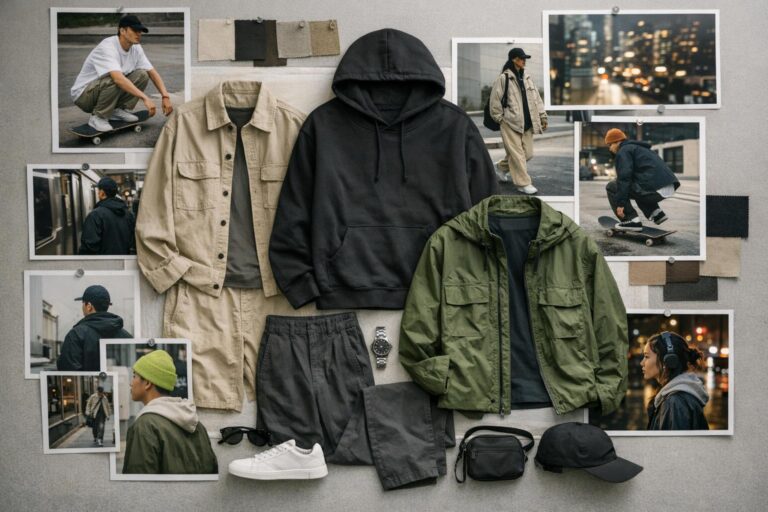
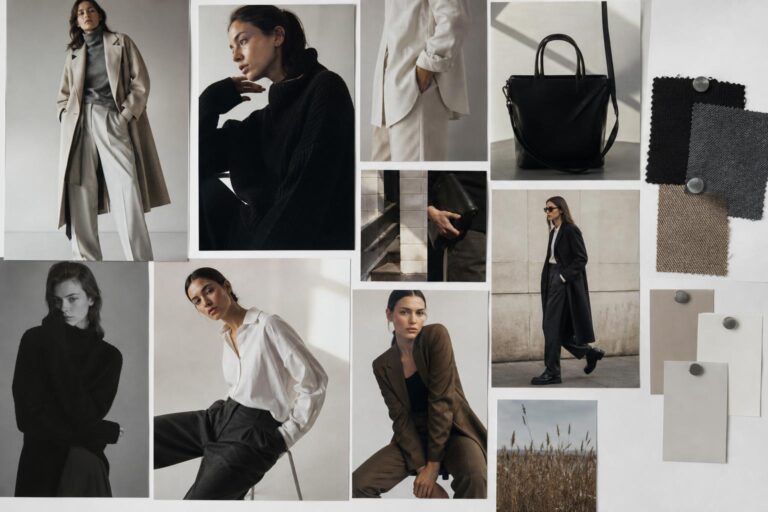
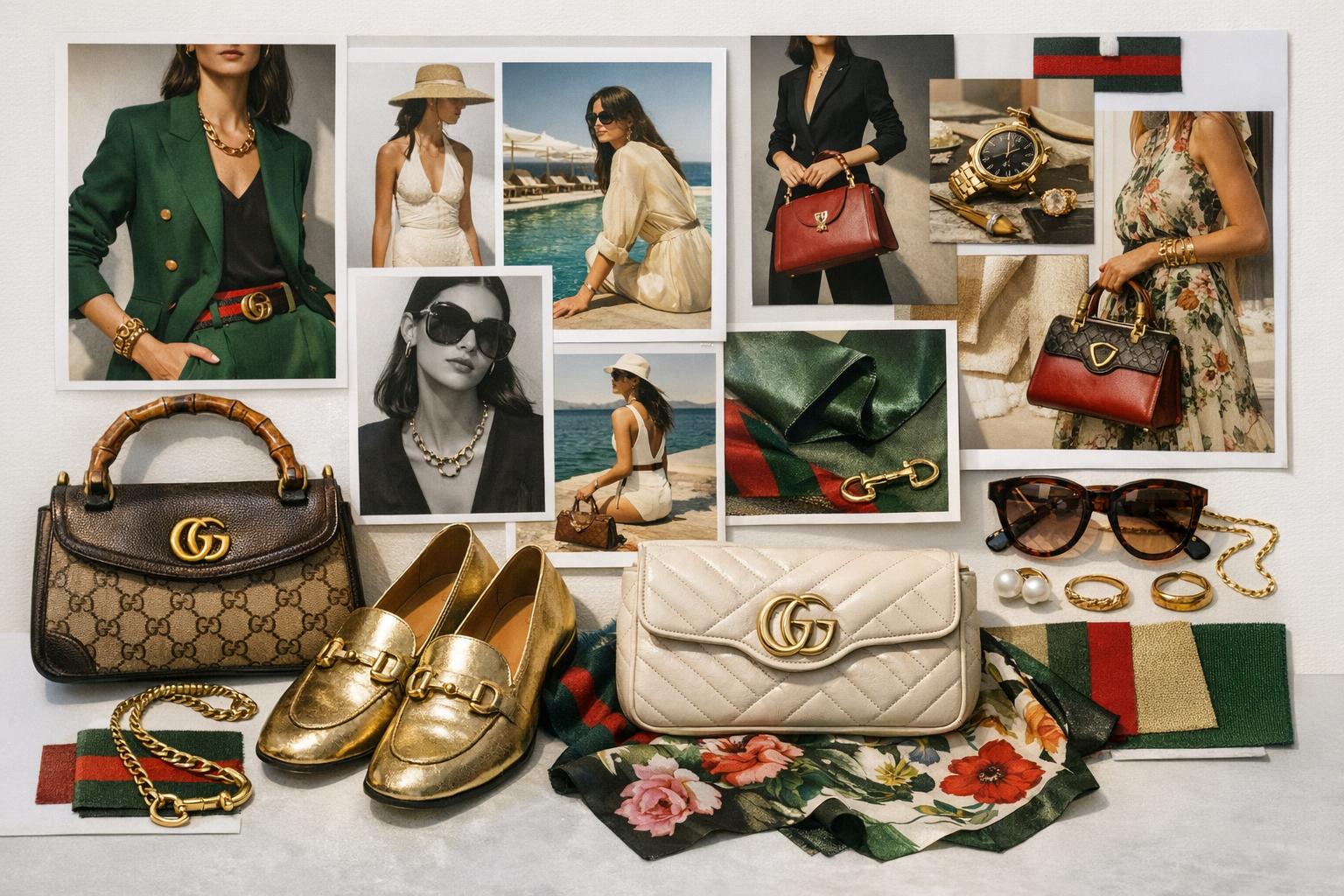
A gucci moodboard isn’t just a collage of pretty images—it’s a working tool for translating Gucci into a repeatable visual language. The reason this keyword pulls up so many Behance projects, Pinterest boards, and editorial mood board articles is simple: Gucci is a brand built on recognizable signals (motifs, palettes, product cues, campaign imagery) that people want to collect, remix, and apply to creative work. Whether you’re building a Gucci board for a design concept, assembling a Gucci collage for styling direction, or saving a Gucci wallpaper aesthetic to lock in a mood, the best moodboards behave like a system: they set rules for color, texture contrast, proportion play, and visual anchors.
This guide treats the moodboard as both inspiration and method. You’ll get a structured way to build a Gucci mood board that reads clearly—on a screen, in a PDF lookbook format, or as a pin-ready layout—while staying aligned with the brand cues people actually associate with Gucci across editorials, lookbooks, and curated collections.
What a moodboard does (and why Gucci makes it unusually effective)
A moodboard is a curated set of visuals used to define the direction of a project: styling, branding, editorial design, or campaign mood. It compresses decision-making. Instead of debating every detail, you decide the mood once—then the board becomes the reference point for what fits and what doesn’t.
Gucci is a natural fit for moodboard work because the brand lives at the intersection of luxury branding and editorial mood. In practice, Gucci imagery is often already “moodboard-ready”: it comes with distinct iconography, strong palette cues, and product silhouettes that work as instant visual anchors. That’s why top results for this topic skew visual-first (Behance, Pinterest, DeviantArt), with editorial counterparts (like a GQ fashion team mood board) showing how professionals use boards to summarize a future-facing trend direction.
Found the dress? Keep the rest in one place.
Zarellea brings guest details, vendors, timelines, and every next step together — so your wedding plan feels as good as your look.
For readers using this for real projects—design mockups, styling direction, creative concepts—the advantage is clarity. A good Gucci moodboard makes the Gucci aesthetic legible without relying on long explanations. The board should communicate luxury, mood, and intent at a glance.
Where people pull Gucci moodboard references from (and what each source is best for)
Not all moodboard sources behave the same way. The top ecosystem for “gucci moodboard” is split between portfolio platforms, social curation, editorial articles, and lookbook-style PDFs. Each is useful, but for different reasons—and the strongest boards usually combine them.
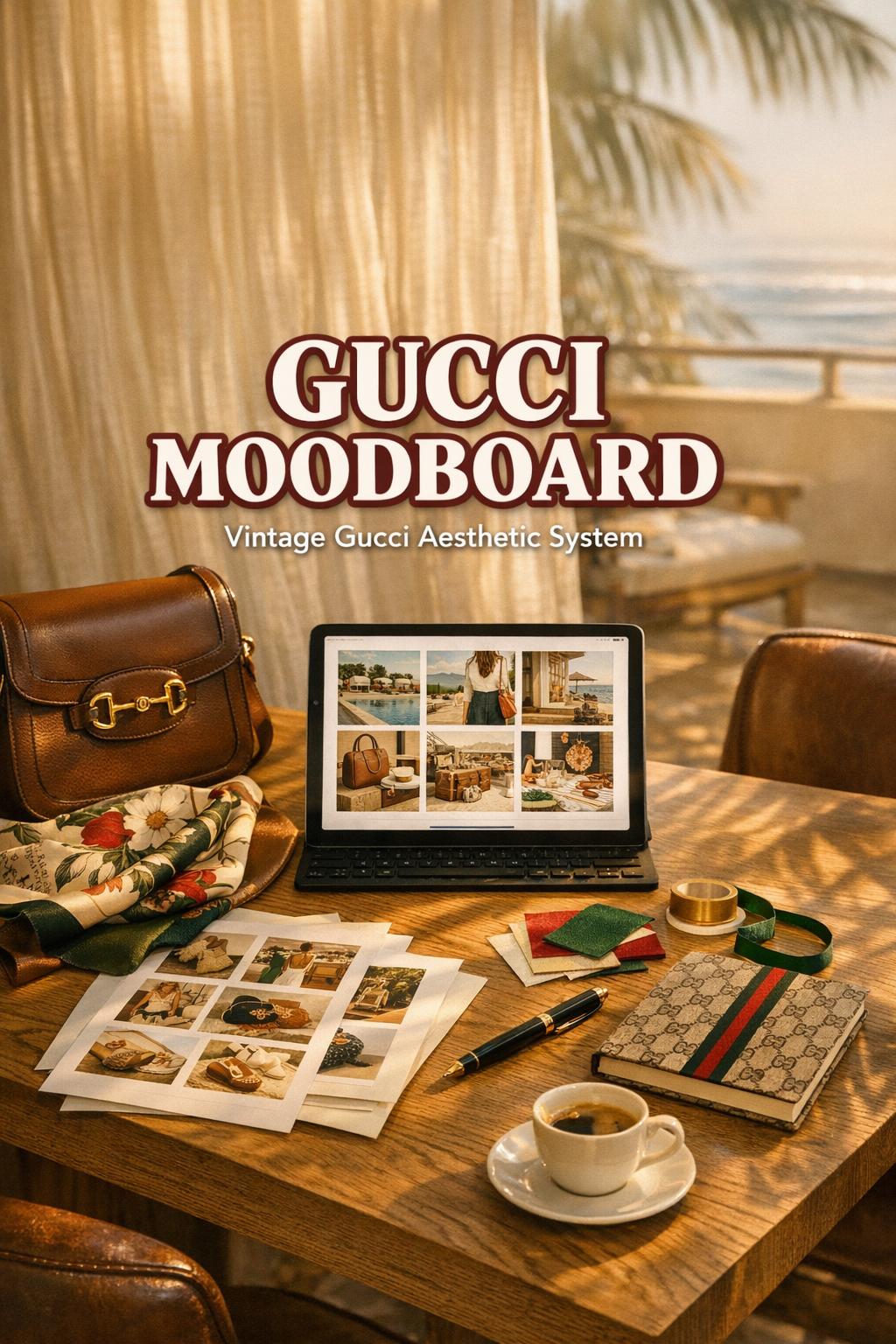
- Behance: best for moodboard composition, layout ideas, and brand-identity cues presented like a creative project. It’s where you study structure: how creators group imagery, typography, and palette in a clean, editorial way.
- Pinterest boards: best for volume and discovery. These boards function like visual libraries for Gucci aesthetic references—useful for collecting options before you narrow the direction.
- DeviantArt: best for fan-made or single-image mood boards. These can be strong for bold, simplified interpretations when you want a clear “one-page mood.”
- Editorial coverage (GQ): best for understanding moodboard logic at an industry level—how teams assemble influences and track brand impact (including Gucci) over time.
- Lookbook/PDF formats (Heyzine-hosted PDF): best for presentation. If your end goal is a client-ready deck or brand mood presentation, the lookbook approach shows how moodboard-driven visuals can read as a cohesive narrative.
- Gucci’s own site: best as a contextual anchor for brand storytelling and campaign/collection framing. Even when you’re working from third-party images, you want the story logic to feel Gucci-aligned.
Practical workflow: use Pinterest to collect widely, Behance to refine the structure, and a PDF lookbook mindset to finalize how the story flows from one page to the next.
Gucci brand storytelling as moodboard material
The most persuasive Gucci moodboards don’t just show products; they show narrative. Gucci’s brand language is often discussed through campaigns, collections, and editorial imagery on its official channels, and that storytelling is what turns a board from “fashion images” into “brand mood.”
In moodboard terms, brand storytelling means you choose an organizing idea and let every visual support it. For Gucci, that usually means building around luxury mood imagery—high contrast lighting, bold styling, or a specific seasonal context—then repeating recognizable cues until the board becomes consistent.
If your board feels scattered, it typically means you’ve collected too many types of Gucci at once. The fix isn’t more pins—it’s a tighter storyline and fewer competing visual rules.
Gucci identity through eras: using designers as a filter (not trivia)
Many moodboards fail because they treat Gucci as a single static look. In reality, Gucci shifts across creative direction, and those shifts change how you should build a board. Using designers as an organizing filter helps you choose what “Gucci” means for your specific project—even if your final output is a simple Gucci collage.
Vintage gucci aesthetic: the value of archival signals
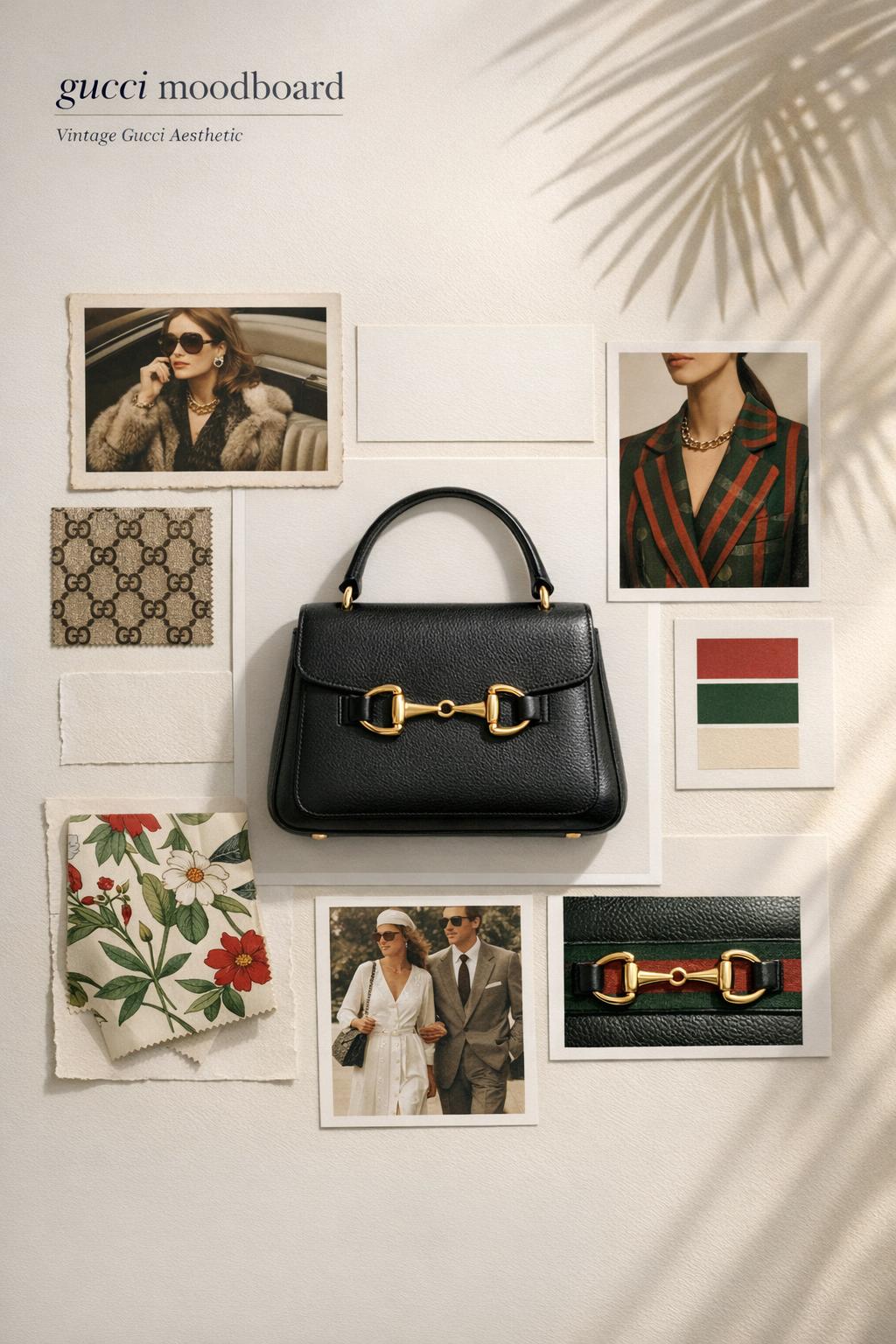
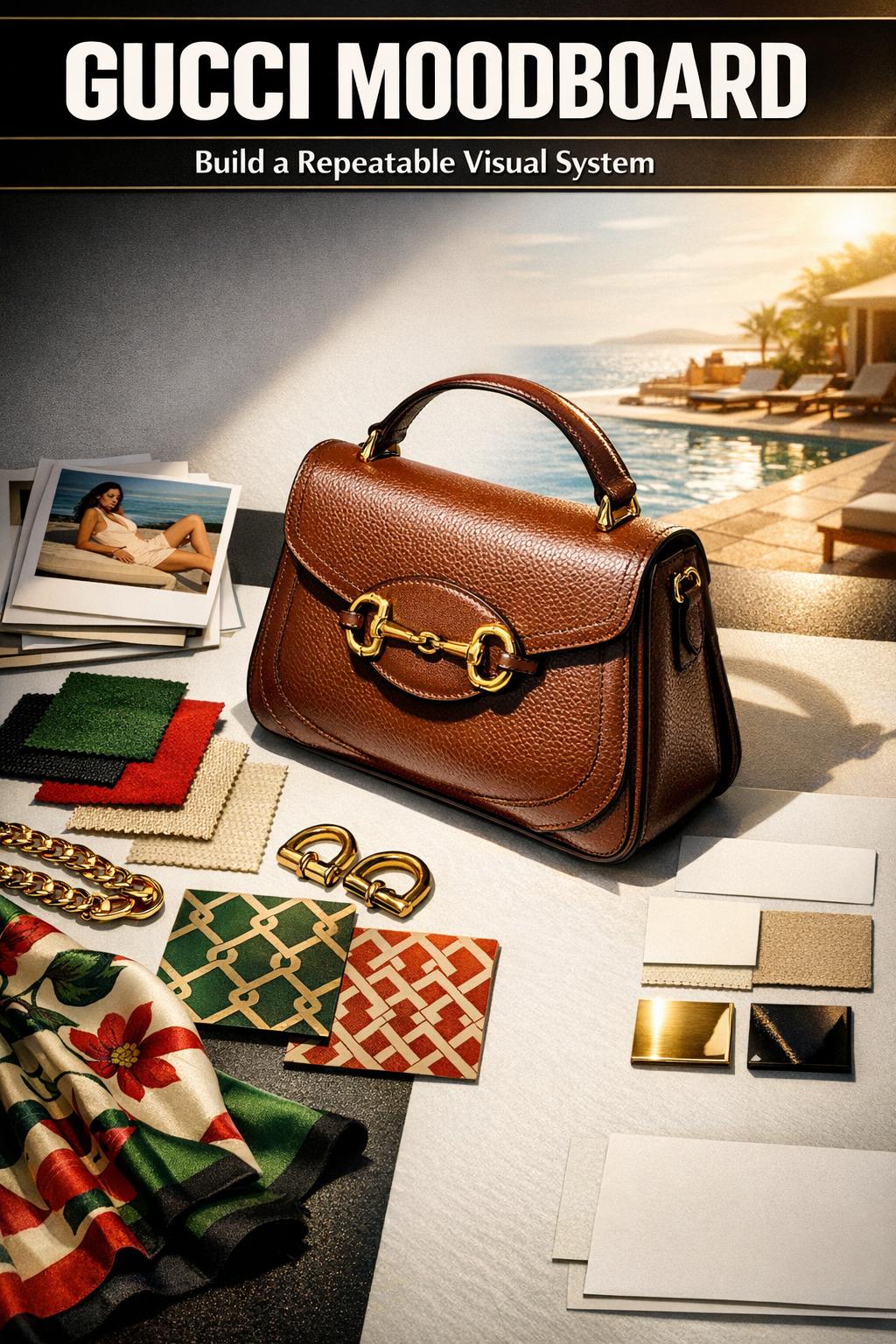
The vintage gucci aesthetic is one of the most common moodboard directions because it’s built on instantly recognizable motifs and classic luxury cues. A board in this lane benefits from restraint: fewer, stronger symbols repeated with intention. Think in terms of visual anchors rather than excess decoration—one logo moment, one motif moment, one product silhouette moment, then supporting imagery that reinforces the same tone.
In practice, vintage-leaning boards are where icons like the GG logo, the horsebit, and the Flora scarf motif become the organizing spine. They’re not just decorative; they’re identity markers that make the board read as Gucci even before someone notices a product.
Tom Ford and the “classic-to-editorial” pivot
Tom Ford is often referenced as an era marker when people want Gucci to feel sharpened and editorial. For moodboards, that translates to cleaner composition, stronger silhouette balance, and less “scrapbook energy.” If your goal is a Gucci board that looks like an editorial layout rather than a chaotic pin wall, you borrow that discipline: tight cropping, consistent lighting, and a clear hierarchy between statement piece and supporting visuals.
Alessandro Michele and maximalist mood logic
Alessandro Michele is logically implied when people talk about Gucci as a universe of eclectic styling and layered references. In moodboard terms, that direction supports denser collage work—but it still needs structure. The trick is controlled maximalism: repeat colors, repeat motifs, and use one dominant pattern family so the board feels intentional rather than random.
Sabato De Sarno and the modern reboot mindset
Sabato De Sarno is frequently brought up as part of the “current direction” conversation around Gucci, which matters because moodboards are often made for what’s next, not just what’s archived. If you’re building a board meant to feel current, prioritize modern luxury signals: more negative space, cleaner typography choices, and a simplified palette that still nods to Gucci iconography without overwhelming the layout.
Use this as a decision rule: if you can’t describe your board as either “heritage revival” or “modern reboot,” you’re likely mixing too many eras and weakening the message.
The Gucci color palette: building harmony without flattening the mood
Color is the fastest way to make a gucci moodboard feel branded. Gucci boards often lean on green, red, and gold color families because they signal luxury and heritage while still working in contemporary styling. But the board only looks premium if the palette is controlled.
Fashion-wise, palette control is what prevents visual chaos. A strong board uses tonal layering: multiple shades within the same color family, plus one metallic or high-contrast accent that behaves like a visual anchor. This is how you get richness without noise.
- Green: use it as the foundation tone. It reads as classic and grounded and plays well with texture contrast (leather, hardware shine, printed silk).
- Red: treat it as a directional accent. Too much red can overpower the board, so it works best in small, repeated hits across the collage.
- Gold: use it as a finish, not a base. Gold details signal luxury branding—ideal for hardware, typography accents, or a single hero image with metallic highlights.
Tip: if you’re building a Gucci wallpaper aesthetic for a phone or desktop, reduce the palette to two dominant colors plus one accent. Wallpapers require readability; too many colors make the screen feel cluttered.
Motifs and iconography: the “recognition layer” that makes a board instantly Gucci
A Gucci mood board becomes credible when it includes iconography that reads as Gucci even out of context. These motifs operate like brand shorthand. They also solve a common moodboard problem: you can mix imagery styles (editorial photos, product shots, typography) and still maintain coherence if the motif layer is consistent.
The most useful set of visual anchors—because they’re repeatedly implied in Gucci discourse and moodboard culture—includes the GG logo, the horsebit, and the Flora scarf motif. In a collage, they can appear as close-ups, repeated patterns, or minimal graphic references, depending on whether you’re building a vintage gucci aesthetic or a modern reboot board.
Practical styling logic: motifs are strongest when they’re paired with a clear silhouette story. A board with motifs only can feel like branding without fashion. A board with silhouettes only can feel generic luxury. Together, they read as Gucci.
The Gucci Lido mood: translating “summer style moodboard” into wearable logic
Seasonal moodboards work because they compress styling decisions around weather, light, and lifestyle context. The Gucci Lido idea—framed as the summer style moodboard you’ve been waiting for—leans into resort energy: a lighter mood, a sense of movement, and a palette that can still handle luxury cues without feeling heavy.
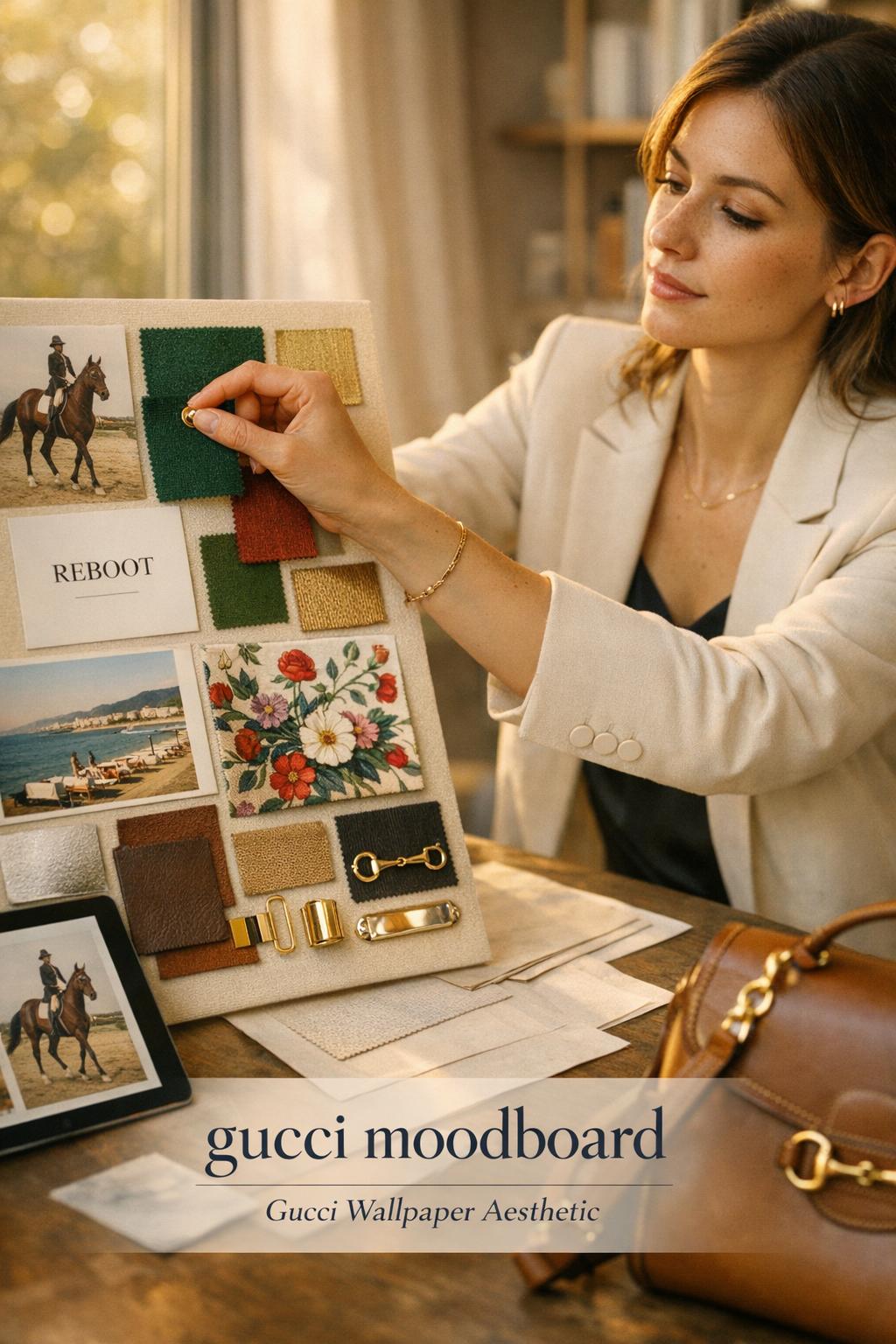
For outfit composition, the key is contrast management. Summer looks can fall flat if everything is lightweight and similar in texture. A Gucci-leaning summer board typically benefits from one structured or glossy element to create texture contrast—think a bag moment as a visual anchor against softer apparel.
When you build a Gucci Lido-inspired board, focus on three signals: a breezy seasonal palette, a resort-wear vibe, and product references (like bags and apparel) that reinforce the luxury context. The board should feel like it belongs to summer without losing the brand’s polish.
How editors build mood boards: lessons you can borrow from a fashion team workflow
A professional mood board isn’t a scrapbook; it’s a decision framework. Editorial teams assemble boards to map influences, designers, and trend directions—then use that board to keep coverage cohesive. That mindset applies directly to Gucci boards, especially when you’re trying to define a 2026-ready direction that acknowledges legacy without copying it.
The most transferable lesson is curation discipline. Instead of saving everything that looks Gucci, you save what supports the concept. Every image must earn its place by contributing to one of these roles: palette, silhouette, motif, typography, or lifestyle context.
- Palette images set the color rules.
- Silhouette images set proportion play and the balance between structure and softness.
- Motif images lock recognition (GG logo, horsebit, Flora scarf motif).
- Product images clarify category emphasis (bags, apparel, accessories).
- Lifestyle/editorial images define the mood: light, season, and energy.
Tip: if your board feels repetitive, you’ve likely collected too many images serving the same role. Swap duplicates for images that add a missing role, such as typography or layout references.
Building a gucci moodboard that looks intentional (step-by-step, but not rigid)
Most people begin with image collecting and end with an overcrowded canvas. A more reliable approach is to decide your structure first, then collect to fill that structure. This keeps your Gucci board readable whether it lives on Pinterest, a Behance project page, or a PDF lookbook.
Step 1: define the board’s purpose and format
A Gucci wallpaper aesthetic needs negative space and a central focal point. A Gucci collage for Pinterest can be denser but must still have a clear hierarchy. A PDF lookbook-style moodboard should feel sequential—each page building on the last. Choose one format upfront so your layout choices support the end use.
Step 2: choose one “era lens” and one seasonal context
This is where many boards break: mixing vintage gucci aesthetic cues with modern reboot minimalism and a summer resort context all at once. Instead, select one era lens (Tom Ford, Alessandro Michele, or Sabato De Sarno as directional references) and one seasonal frame (such as the Gucci Lido summer mood). This creates a controlled concept that still feels rich.
Step 3: build a palette strip and a motif strip before you place hero images
Start with a small set of palette swatches (green, red, gold families if you’re leaning heritage) and a motif strip (GG logo, horsebit, Flora scarf motif references). Once those are fixed, your hero images become easier to choose because you can test whether they match the established rules.
Step 4: anchor with two hero images, then support with details
Two hero images are usually enough: one that captures the editorial mood, and one that shows product category emphasis (bags, apparel, accessories). Then add detail shots that reinforce texture contrast—hardware shine, leather depth, print scale—without competing for attention. This is where your board starts to look like a designed composition rather than a dump of pins.
Step 5: add typography and grid logic to make it read like luxury branding
Even a purely visual Gucci moodboard benefits from subtle editorial design: clean alignment, consistent spacing, and a restrained typography choice. Think in terms of editorial grids—simple columns, predictable margins, and intentional whitespace. This is a key difference between “inspiration” and “presentation.”
Common Gucci moodboard mistakes that weaken the final look
Gucci is recognizable, but that doesn’t mean every Gucci-related image belongs on the same board. The following mistakes are common across social curation boards and beginner collages—and they’re fixable with small, editorial-level adjustments.
- Too many competing palettes: heritage tones and neon accents can coexist, but only if one stays dominant. If everything is loud, nothing is a visual anchor.
- Motifs without structure: repeating the GG logo, horsebit, and Flora scarf motif without a layout grid makes the board feel like wallpaper in the wrong way—busy, not branded.
- No silhouette story: luxury fashion moodboards need proportion play. Include imagery that signals structure vs softness so the styling logic is clear.
- Over-reliance on product shots: too many product-only visuals flatten the mood. Balance with editorial imagery to preserve brand storytelling.
- Format mismatch: a board designed like a Pinterest collage doesn’t automatically translate to a PDF lookbook. Presentation requires hierarchy and whitespace.
Tip: do a “thumbnail test.” Zoom out until the board is small on your screen. If you can’t immediately identify the palette, the motif layer, and the hero image, the hierarchy needs tightening.
Three Gucci board concepts you can build immediately (with styling logic)
Instead of treating Gucci as one mood, use concept boards that separate intent. Each of the options below works as a standalone Gucci board and can be expanded into a Pinterest series, a Behance case study, or a PDF lookbook.
Heritage revival board (vintage gucci aesthetic with controlled richness)
This direction is strongest when you want the board to feel archival and brand-coded. Use green/red/gold as the palette spine, then repeat a tight set of motifs: GG logo, horsebit, and a Flora scarf motif reference. Styling logic: keep silhouettes structured enough to hold the heritage mood, then add softness through print or drape so the board doesn’t feel like a museum display.
Where it performs best: brand identity cues, luxury branding presentations, and moodboard Gucci brand identity explorations that need clear recognition.
Modern luxe board (Sabato De Sarno lens with editorial restraint)
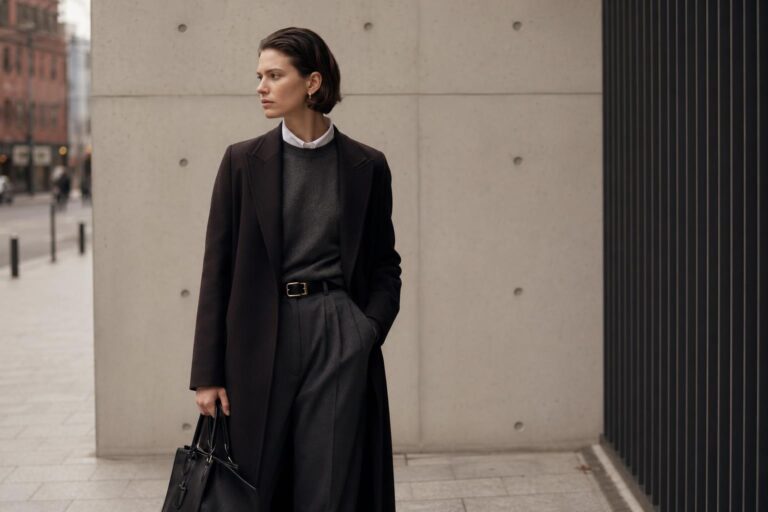
This board uses less visual noise and more precision. Limit motifs to subtle placements and keep the collage airy—more whitespace, fewer overlapping elements. Styling logic: silhouette balance is the hero; let one statement piece (often an accessory or a sharply defined apparel shape) do the heavy lifting while the rest of the board supports it through tonal layering.
Where it performs best: editorial mood/creatives, minimalist brand mood presentations, and projects that need Gucci influence without heavy retro coding.
Gucci Lido summer board (seasonal moodboard with resort polish)
This is your warm-weather Gucci moodboard: a summer style moodboard that stays luxurious. Keep the palette sunlit and controlled, then add product references (bags and apparel) to maintain category clarity. Styling logic: build texture contrast—something glossy or structured against lighter, breezier elements—so the board doesn’t feel flat.
Where it performs best: travel and lifestyle concepts, seasonal styling guidance, and Pinterest-forward boards that need immediate “summer” readability.
Making a Gucci collage feel expensive: composition rules that change everything
A Gucci collage can look premium or messy depending on composition. The difference is rarely the images themselves; it’s spacing, hierarchy, and how you handle repetition. Luxury branding is disciplined, even when the mood is maximal.
Start by choosing one primary focal point and one supporting focal point. Then treat every other image as a detail layer. That’s how you maintain a “designed” feeling, similar to what you see in portfolio moodboard projects and lookbook-style presentations.
- Hierarchy: one hero image, one product anchor, then details.
- Repetition: repeat one motif at least three times, but at different scales.
- Alignment: use an invisible grid; even collage layouts need underlying structure.
- Whitespace: allow breathing room so the eye can rest—this is key to an editorial mood.
Tip: if you want the collage to double as a Gucci wallpaper aesthetic, build two versions—one dense for moodboard viewing and one simplified for wallpaper readability.
From inspiration to deliverable: turning a moodboard into a PDF lookbook
Many Gucci moodboards live as single canvases, but a lookbook-style PDF format changes the impact. A PDF lets you pace the story: establish the palette first, introduce motifs second, then show product and styling direction as the conclusion. This mirrors how moodboard-driven presentations often communicate luxury narratives.
Think of the PDF as a sequence of moodboard chapters. Each page should answer one question: What are the colors? What are the icons? What is the mood? What are the product cues? This structure also helps if you’re presenting to a team, because the logic is visible rather than assumed.
Balanced perspective: a PDF lookbook approach is more time-intensive than a Pinterest board, and it requires tighter image consistency. If you’re still exploring, stay in Pinterest/Behance-style collecting. If you’re presenting a direction, move into lookbook sequencing.
Practical tips for sourcing and organizing images (without losing the plot)
Because gucci moodboard content is image-centric, it’s easy to spend hours collecting and end up with a cluttered library. Organization is a creative advantage: it protects your concept and keeps the board coherent.
- Create three folders: “palette,” “motifs,” and “hero/editorial.” This forces role clarity.
- Name by function: label images “hero-mood,” “product-anchor,” “motif-closeup,” rather than vague names.
- Stop at a cap: set a limit (for example, two hero images and eight supporting images) so curation stays sharp.
- Use board iterations: build one exploratory Gucci board, then a second “final edit” board with only what supports the concept.
Tip: if you’re building for Pinterest, prioritize vertical readability. If you’re building for Behance, prioritize a clean editorial grid and a clear beginning-to-end flow.
Using a Gucci board for real styling decisions: outfits, occasions, and comfort
A Gucci board isn’t only for designers; it’s also a style tool. The value is decision compression: once the board defines silhouette balance and palette, getting dressed becomes faster and more consistent. This is especially useful for travel days, event weekends, or seasonal transitions when you need multiple outfits that still feel connected.
For a summer context like Gucci Lido, comfort and movement matter. Boards that include a resort mood should reflect breathable, light-feeling visuals and avoid overly heavy cues that read winter-coded. For an editorial mood board influenced by a fashion team approach, the priority is coherence across looks: similar tonal layering, repeated statement piece logic, and consistent accessory emphasis.
Real-world use case: if your board’s hero images are structured and high-contrast, your outfit composition should echo that—clean lines, a strong accessory anchor, and minimal competing textures. If your board is maximalist (Alessandro Michele-coded), you can layer prints and motifs, but keep one stabilizer: a repeating color family or a consistent silhouette shape so the look doesn’t become costume-like.
Gucci wallpaper aesthetic: how to translate a moodboard into a background that actually works
A Gucci wallpaper aesthetic is a specific subset of moodboard design. It’s not just about beauty; it’s about function. Your icons and colors need to read behind app icons, text, and UI overlays. That means you need less clutter and more controlled contrast.
Use one motif as the repeating cue (GG logo, horsebit, or Flora scarf motif), then keep the palette tight—two dominant tones plus one accent. The board can still feel Gucci, but it won’t fight the screen. This is where editorial whitespace becomes more than a style choice; it becomes usability.
Tip: build the wallpaper from the same assets as your main Gucci collage, but simplify it. A strong system produces multiple outputs: a dense moodboard for planning and a minimal wallpaper for daily visual reinforcement.
FAQ
What is a gucci moodboard used for?
A gucci moodboard is used to organize Gucci-inspired visual cues—palette, motifs, product references, and editorial mood—into one clear direction for styling, branding concepts, or creative presentations, often in formats like Pinterest boards, Behance layouts, or lookbook-style PDFs.
Where can I find Gucci moodboard examples online?
Gucci moodboard examples commonly appear on Behance as portfolio projects, on Pinterest as curated boards, on DeviantArt as image-centric mood boards, in editorial mood board features from publications like GQ, and in lookbook/PDF-style presentations hosted online.
How do I make a Gucci board look cohesive instead of cluttered?
Choose one era lens (such as Tom Ford, Alessandro Michele, or Sabato De Sarno as directional references), limit the palette (often green/red/gold families for heritage), repeat a small set of motifs (GG logo, horsebit, Flora scarf motif), and apply an editorial grid with clear hierarchy so your hero images lead and details support.
What colors work best for a Gucci mood board?
Gucci moodboards often rely on green, red, and gold color families because they signal luxury and heritage; the most refined results come from tonal layering within those families and using gold as an accent rather than a dominant base color.
What motifs make a moodboard read as Gucci quickly?
Motifs that commonly function as instant Gucci recognition cues include the GG logo, the horsebit, and the Flora scarf motif; using them consistently across the board helps unify mixed imagery like editorials, product shots, and typography.
What is the Gucci Lido moodboard concept?
Gucci Lido is framed as a summer style moodboard concept that translates Gucci into a resort-ready direction, typically using a lighter seasonal mood, polished styling cues, and product references that keep the luxury context intact while feeling warm-weather appropriate.
How is an editorial mood board different from a Pinterest Gucci collage?
An editorial mood board, like those assembled by fashion teams, prioritizes role-based curation (palette, silhouette, motifs, product anchors, lifestyle context) and clarity of direction, while a Pinterest Gucci collage often prioritizes discovery and volume and may require a second, tighter edit to become presentation-ready.
Can I turn a Gucci moodboard into a PDF lookbook?
Yes—many moodboard-driven presentations translate well into a PDF lookbook format by sequencing the story across pages, typically moving from palette and motifs to hero imagery and product anchors, which creates a clearer narrative than a single crowded canvas.