
Fashion Moodboard Ideas for Polished City Outfits, Every Day
Most wardrobe stress doesn’t come from a lack of clothes—it comes from a lack of direction. You’re standing in front of your closet with a real constraint (heat, rain, long hours on your feet, a dress code that’s vague but still feels high-stakes) and your outfit choices suddenly feel random. That’s where fashion moodboard ideas become a practical tool, not just a pretty collage: they give your styling decisions a system.
This guide is built for the common problem of getting dressed when your day requires you to look intentional and feel comfortable at the same time—think commuting, meetings, errands, travel, and last-minute plans that shift the vibe. A moodboard isn’t only “inspiration”; it’s an outfit logic map that helps you repeat what works, avoid what doesn’t, and build looks faster.

Below, you’ll find inspiration board fashion frameworks and multiple outfit solutions you can translate into real outfits immediately. You’ll also learn how to structure a fashion styling portfolio moodboard (even if you’re not a stylist) and how to build a digital mood board that stays useful beyond one season.
Why your outfits feel “off” in real life (even when the pieces are good)
The styling challenge usually shows up as a mismatch between what the outfit is optimized for and what the day actually demands. You might dress for the weather but not the setting, or dress for the setting but not your movement needs. The result is an outfit that looks fine in isolation, yet feels wrong on your body during a long day.
Found the dress? Keep the rest in one place.
Zarellea brings guest details, vendors, timelines, and every next step together — so your wedding plan feels as good as your look.
Most outfit frustration is caused by four variables that compete with each other: comfort, practicality, silhouette, and context. A coat that photographs beautifully can feel heavy during a commute. Shoes that look sharp can fail after two hours of walking. A minimalist look can read flat without a visual anchor. Mood boards aesthetic fashion planning helps because it forces you to define the context first, then choose pieces that perform inside that context.

Fashion moodboards as a problem-solving tool (not just an aesthetic)
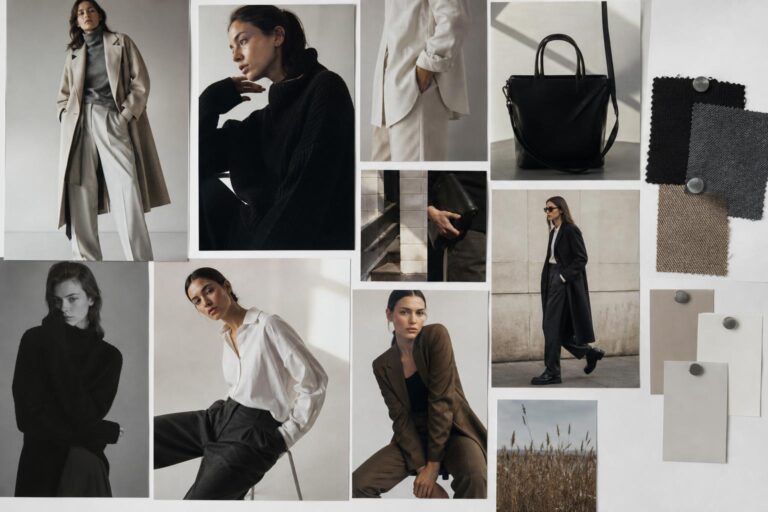
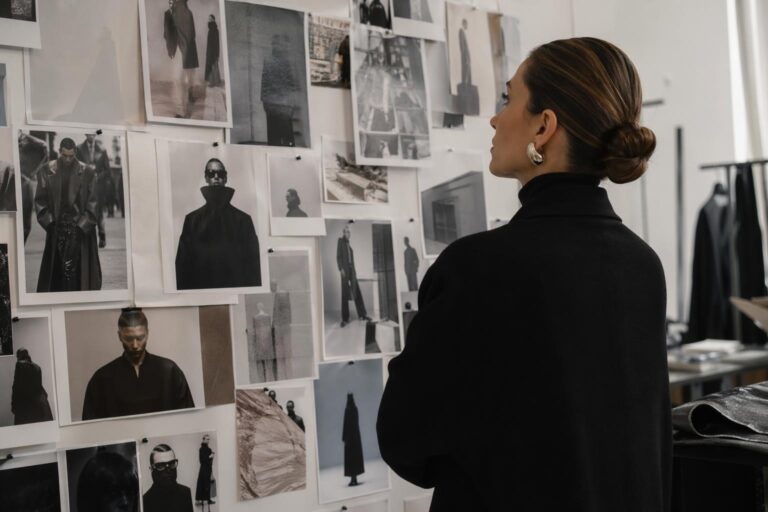
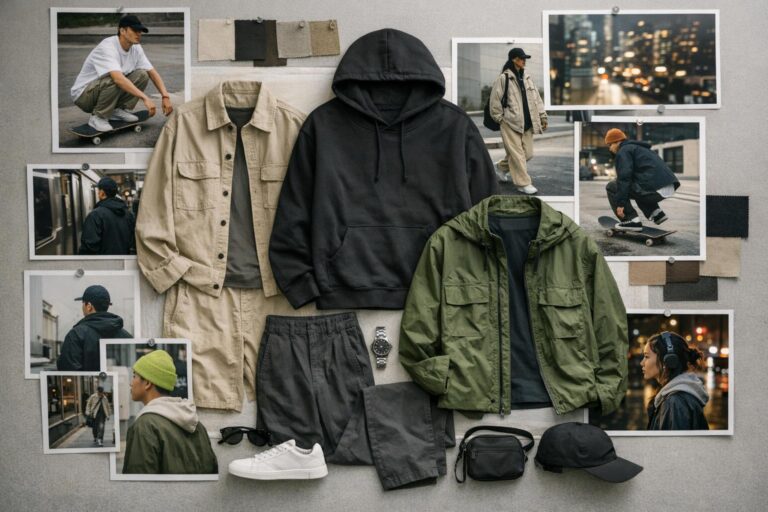
A fashion moodboard is a curated set of references—outfits, colors, textures, shapes, and styling details—that communicates a consistent direction. In practice, it functions like a decision filter: if an item doesn’t fit the moodboard’s rules, it doesn’t enter the outfit. That’s how an inspiration board fashion approach reduces “closet noise.”
A useful moodboard also clarifies relationships: how proportions balance (oversized with slim, cropped with high-rise), how texture contrast adds depth (smooth with nubby, crisp with drapey), and how color harmony keeps outfits from feeling chaotic. Treat your board like a styling brief for your own life.
- Context: where you’re going and what you’ll be doing (movement, time outside, seating, commuting).
- Silhouette rule: the dominant shape you’ll repeat (long/lean, boxy, cinched, tailored).
- Palette boundary: a small range of colors that mix easily.
- Texture strategy: one contrast element that makes basics look intentional.
- Practical anchor: the comfort piece you refuse to compromise on (shoes, outerwear, bag, base layer).

Build a digital mood board that actually helps you get dressed
A digital mood board works best when it’s built around repeatable outfit formulas, not one-off editorial looks. The goal is to capture combinations you can recreate with your own wardrobe: “wide-leg trouser + fitted knit + structured layer” is a formula; “a single perfect outfit photo” isn’t enough information to repeat.
For practical use, organize your board by situations (workday, weekend, travel, evening) and tag each image with the function it serves: footwear strategy, layering approach, silhouette balance, or palette. This turns moodboarding into a modular styling system you can pull from in minutes.
The four-board structure that keeps your style consistent
Instead of one massive collage, build four smaller boards that mirror real life. This is where fashion mood board ideas become actionable: each board solves a different dressing problem and reduces last-minute outfit improvisation.
- Daily uniform board: 10–20 looks you can wear repeatedly with small variations.
- Weather and layering board: outfits designed for temperature swings, wind, or rain.
- Occasion board: looks for dinners, events, and anything with a social or professional dress code.
- Experiment board: controlled risk—new silhouettes, bolder color, statement pieces.
How to translate “mood” into wardrobe decisions
Words like “clean,” “cool,” or “romantic” don’t automatically produce good outfits. Translation is the missing step: you need to define what the mood looks like in silhouette, palette, and styling details. For example, “polished” might mean structured shoulders, crisp fabrics, and minimal accessories; “relaxed” might mean drape, soft texture, and low-contrast tonal layering.
This is also how a moodboard supports a fashion styling portfolio: it demonstrates intention. The board becomes the logic behind the looks—your rationale for proportion play, texture contrast, and seasonal palette choices.
Key dressing principles that make your moodboard wearable
To keep your inspiration board fashion-focused and wearable, you need principles that hold up under real conditions: movement, long hours, changing temperatures, and mixed settings. These are the rules that prevent a board from becoming aspirational but impractical.

Principle 1: Build outfits around a “visual anchor”
A visual anchor is the piece that makes the outfit read intentional: a structured jacket, a sharp shoe shape, a statement bag, or a strong color note. Without an anchor, comfortable basics can look unfinished. With an anchor, the same basics read styled. On your mood boards aesthetic fashion references, identify what consistently plays that role.
Principle 2: Use silhouette balance to protect comfort
Comfort improves when your outfit’s volume is distributed strategically. If your bottom is wide or relaxed, the top often benefits from a more defined shape (fitted knit, cropped jacket, tucked shirt) to keep the look intentional. If your top is oversized, a slimmer bottom creates clean proportion. This is the simplest way to look polished without relying on fussy pieces.
Principle 3: Choose a palette boundary, then add one controlled contrast
A tight palette makes getting dressed faster and reduces the chance of “almost” outfits—those combinations that feel slightly noisy. Then add one controlled contrast: a darker shoe, a brighter accessory, or a different texture. The contrast creates depth without breaking the moodboard’s cohesion.
Principle 4: Treat layering as climate management, not decoration
Layering succeeds when each layer has a job: warmth, wind protection, indoor comfort, or silhouette structure. When layers are purely decorative, you end up carrying them. Build your digital mood board with layers that can be removed without collapsing the outfit’s proportions.
Outfit solutions you can pull directly from your moodboard
The following outfit solutions are designed for the real-world scenario that causes the most styling anxiety: a full day with multiple settings (outdoors + indoors, casual + slightly professional, walking + sitting). Each solution includes a clear outfit composition and the styling logic behind it, so you can adapt it to your closet and your moodboard rules.
Outfit solution: lightweight layered look for temperature swings
This is the outfit formula for days that start cool, turn warm, and still involve indoor air-conditioning. The base should be breathable and clean-lined; the top layer should add structure without bulk. The goal is climate flexibility with a stable silhouette.
- Key pieces: fitted tee or lightweight knit, straight or relaxed trouser, mid-weight jacket or overshirt, comfortable closed-toe shoes.
- Why it works: the jacket acts as the visual anchor and temperature regulator; the base layer stays polished when the jacket comes off.
- Styling logic: keep the palette tonal so the layer removal doesn’t change the outfit’s identity.
To reflect this on a digital mood board, save images that show the “jacket on” and “jacket off” version of the same look. That’s the difference between inspiration and a system you can actually use.
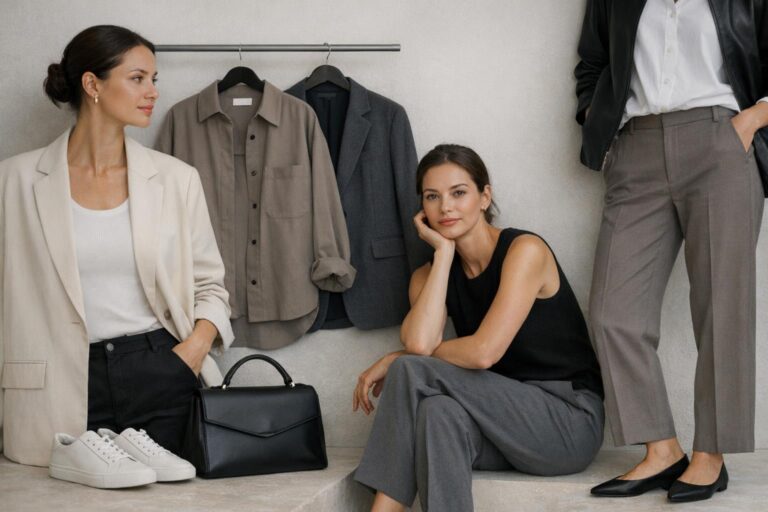
Outfit solution: smart casual balance that survives a long day
Smart casual fails when it leans too formal (uncomfortable) or too casual (under-dressed). The balance point is a tailored element paired with a relaxed one, creating a composed silhouette without stiffness.
- Key pieces: structured blazer or crisp outer layer, soft top underneath, tailored trouser or clean denim, low-profile shoes suitable for walking.
- Why it works: structure up top signals polish; comfort below keeps the outfit functional.
- Styling logic: use texture contrast—structured layer against a softer knit—to create depth without extra accessories.
If you’re building a fashion styling portfolio board, this is a strong category to include because it demonstrates proportion control and realistic client-ready styling.
Outfit solution: comfortable city outfit built around walkable footwear
When you know you’ll be walking, the shoes are not an afterthought—they’re the design brief. Start with footwear that can handle distance, then build the outfit upward so it reads intentional rather than purely utilitarian.
- Key pieces: walkable shoes, relaxed pant or jean, simple top, structured or medium-structure outer layer, hands-free bag.
- Why it works: the outer layer provides the outfit’s visual anchor; the shoe choice protects comfort.
- Styling logic: keep the hemline compatible with the shoe shape so proportions stay clean while moving.
On mood boards aesthetic fashion references, look for city outfits with movement: walking shots reveal whether proportions hold up outside a static pose.
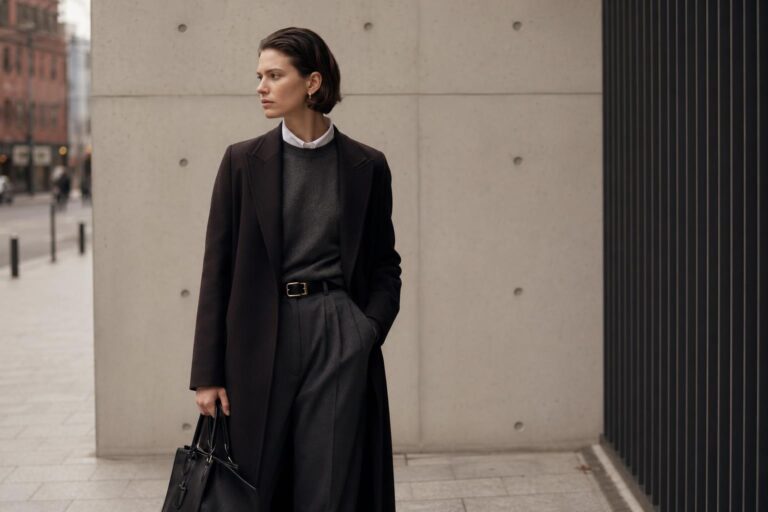
Outfit solution: tonal layering for a polished minimal look
Tonal layering is one of the most reliable strategies for looking elevated with minimal effort. The concept is simple: keep most of the outfit in one color family, then use texture and shade shifts to create dimension.
- Key pieces: matching or near-matching top and bottom, a third layer in a slightly different shade, clean shoes, one accessory with shape (belt, bag, or structured jacket).
- Why it works: low-contrast outfits elongate the line of the body, which reads polished and modern.
- Styling logic: texture contrast prevents tonal outfits from looking flat—mix smooth with knit, crisp with drapey.
This is also one of the easiest fashion mood board ideas to maintain across seasons: the palette can stay consistent while fabric weights change.
Outfit solution: statement-piece control for instant outfit clarity
A statement piece is most effective when the rest of the outfit behaves like a frame. If everything competes, nothing leads. This solution is for days when you want personality without sacrificing practicality.
A statement piece is most effective when the rest of the outfit behaves like a frame. If everything competes, nothing leads. This solution is for days when you want personality without sacrificing practicality.
- Key pieces: one statement item (bold color, strong shape, or standout texture), neutral or tonal basics, simple shoes, minimal accessories.
- Why it works: the statement becomes the visual anchor; the basics keep the outfit wearable.
- Styling logic: limit contrast to one focal point so the outfit still feels cohesive in real environments.
On a digital mood board, this is where you save close-up details: fabric texture, hardware, and silhouette shape. Those are the elements you can replicate even if you don’t own the exact piece.
Outfit solution: polished comfort for travel days and long commutes
Travel outfits fail when they prioritize aesthetics over endurance. The best travel uniform is built around soft structure: pieces that move easily but still hold shape. The objective is to arrive looking composed, not wrinkled or restricted.
- Key pieces: comfortable knit top, relaxed trouser with a clean line, layering piece that doubles as warmth and structure, shoes you can walk in for hours, practical bag.
- Why it works: comfort is built into the base; structure is added through the layer and clean silhouette.
- Styling logic: keep the outfit’s lines simple so it stays sharp even when you’re seated for long periods.
This is an ideal category for inspiration board fashion planning because it forces you to style for movement, temperature shifts, and time—constraints that quickly expose whether a look is actually wearable.
Make your moodboard work harder: styling variations that expand each idea
The power move is not collecting more references—it’s extracting more outfits from the same concept. A strong board produces multiple combinations from a stable set of pieces. That’s how you build consistency without boredom.
Swap the anchor, keep the base
Take a base uniform you trust (clean top + reliable bottom + walkable shoes) and rotate the anchor: a structured jacket one day, a sharper shoe another day, a more defined bag on a day you need polish. The base protects comfort; the anchor adjusts the message.
Change texture before you change color
If your wardrobe palette is tight, texture is your variation engine. Switching from a crisp layer to a softer one changes the outfit’s mood while staying within the same color boundary. This is a signature move in mood boards aesthetic fashion: the look evolves without becoming chaotic.
Use proportion play to refresh familiar pieces
Small proportion shifts have outsized impact. Tucking a top, choosing a cropped layer, or changing the rise of a trouser can recalibrate the silhouette. Capture these proportion differences on your digital mood board so you can replicate the effect quickly.
Tips that keep fashion mood boards wearable in the real world
Wearable moodboards are designed around performance: how fabric behaves, how shoes support your day, and how layers interact with indoor and outdoor environments. The following tips are less about “more style” and more about fewer outfit failures.
Tips: build in a comfort checkpoint
Before committing to a look from your inspiration board fashion references, identify the comfort checkpoint: the one part of the outfit that cannot be compromised. For many people it’s shoes; for others it’s waistbands, sleeve tightness, or temperature control. If you ignore the checkpoint, you’ll spend the day adjusting your outfit instead of living in it.
Tips: save “real-life angles,” not just perfect photos
To keep a digital mood board practical, include references that show outfits while walking, sitting, or layered. Perfect front-facing images can hide fit problems and impractical styling. Real-life angles reveal whether the silhouette holds up and whether the outfit still reads intentional when it moves.
Tips: plan footwear early, then style upward
Footwear changes everything: stride, posture, and proportion. If you pick shoes last, you’ll often break the silhouette you built. Start with the shoe required by your day (walking, weather, formality), then choose hemlines and layers that support it.
Tips: turn your moodboard into a packing guide
For travel or busy weeks, moodboards aren’t just inspiration—they’re packing logic. Choose pieces that appear repeatedly across your saved looks and pack those first. This reduces overpacking and makes every item earn its space through repeatability.
Common mistakes that make moodboards useless (and how to fix them)
Most moodboards fail because they’re built like entertainment instead of a styling tool. The fix is not to abandon the concept—it’s to tighten the board’s logic so it serves your life.
Mistake: collecting aesthetics without defining the situation
If your board mixes beach looks, office tailoring, evening outfits, and winter layers with no separation, you’ll end up with inspiration but no decisions. Fix it by dividing the board by context, then creating outfit formulas that match each context.
Mistake: saving outfits that rely on discomfort
If the reference outfit only works when you stand still, it won’t survive your day. Fix it by saving versions that include walkable shoes, functional outerwear, and layers that can be removed without ruining the silhouette.
Mistake: ignoring proportion, then blaming your wardrobe
When outfits feel off, it’s often proportion—hem length, rise, volume distribution—not the quality of your clothes. Fix it by adding notes to your mood boards aesthetic fashion images: “cropped jacket,” “tucked top,” “high-rise with fitted knit.” Those are actionable details.
Mistake: building a board you can’t shop from your own closet
A moodboard should translate to what you already own. If every saved look relies on pieces you don’t have (or a lifestyle you don’t live), it becomes a fantasy. Fix it by including at least a few photos that match your real conditions: your typical weather, your commute, and your preferred comfort level.
How to use fashion moodboard ideas to build a mini fashion styling portfolio
You don’t need to be a professional stylist to benefit from portfolio thinking. A fashion styling portfolio approach simply means you can show (to yourself, or to a client if you are a creator) consistent outfit direction across different needs: casual, smart casual, travel, and occasion. Your moodboard becomes the strategy; your outfits become the proof.
Start by selecting one core silhouette you repeat and refining it across contexts. This is where a digital mood board is especially useful: you can group variations and identify what stays consistent (palette, proportion) and what changes (layer weight, footwear, accessories). The result is style cohesion that still feels adaptable.
- Core board: your signature silhouette + palette boundary.
- Workable variations: three versions that shift formality through one anchor piece.
- Weather adaptations: the same formula with different layers.
- Occasion upgrade: the same base with sharper textures and a stronger visual anchor.
A quick checklist before you commit to a look
Use this as a final filter when you’re pulling an outfit from your inspiration board fashion references. It’s designed to prevent the most common real-life outfit failures: discomfort, mismatch with setting, and silhouettes that fall apart once layers come off.
- Movement test: can you walk, sit, and reach comfortably?
- Temperature plan: does each layer have a job, and can you remove one without losing shape?
- Anchor check: what is the visual anchor that makes the outfit intentional?
- Proportion check: is there a clear balance between volume and definition?
- Context match: does the outfit align with your day’s dress code and activities?

FAQ
What are the most practical fashion moodboard ideas for everyday life?
The most practical fashion moodboard ideas are built around repeatable outfit formulas tied to real situations—workdays, commuting, weekends, travel, and events—so the board functions like a styling plan rather than a collection of random looks.
How do I make an inspiration board fashion-focused without copying outfits exactly?
Instead of copying, extract the outfit logic: identify the silhouette rule (like oversized top with slim bottom), the palette boundary, the visual anchor, and the layering strategy, then recreate that structure using pieces you already own.
What should I include on a digital mood board to make it more wearable?
Include images that show movement and layering, plus notes on footwear, proportion, and what makes the look work; wearable boards highlight function (comfort and climate) as clearly as they highlight aesthetics.
How do mood boards aesthetic fashion concepts help with comfort?
Mood boards aesthetic fashion concepts help with comfort when they prioritize performance details—walkable shoes, layers that regulate temperature, and silhouette balance—so the outfit stays polished while meeting real-life needs like walking and long hours.
How can I use fashion moodboards to get dressed faster in the morning?
Create smaller boards by context and save complete outfit formulas (not single items), then rely on a consistent palette and one visual anchor; this reduces decision fatigue because your choices are pre-filtered by the board’s rules.
What’s the difference between a fashion styling portfolio board and a personal moodboard?
A fashion styling portfolio board emphasizes clarity and consistency across scenarios—showing how you can adapt a core silhouette and palette to different needs—while a personal moodboard can be looser, focused primarily on your own daily style direction.
Why do my outfits look good on a moodboard but feel wrong when I wear them?
This usually happens when the saved looks don’t account for your real conditions—weather swings, walking, sitting, or indoor temperature—so the fix is to collect references that show practical layering and movement, then apply a comfort checkpoint before committing.
How many images should be on a useful fashion moodboard?
A useful board is tight enough to communicate a clear direction but varied enough to show repeatable formulas; a smaller set of strong, consistent references is more effective than a large, mixed collection that doesn’t translate into decisions.