
Autumn Outfits Aesthetic For a Cozy, Polished Fall
Crisp mornings change the way clothing behaves. A trench coat suddenly matters again, boots feel grounding rather than heavy, and a knit thrown over the shoulders can shift an entire outfit from flat to atmospheric. That is the appeal of the autumn outfits aesthetic: it turns practical dressing into something visually rich, built on layering, texture, and a color story that feels instinctively seasonal.
What makes this aesthetic resonate is not just the mood. It is the balance between aspiration and usability. The same wardrobe formulas that look editorial in a gallery of fall outfits ideas also make sense in real life: a coat over a knit dress, a skirt anchored by boots, or a simple capsule wardrobe of outerwear, knitwear, and versatile dresses that can be recombined without much effort.

At its best, autumn outfits aesthetic dressing is less about copying one exact look and more about understanding the composition behind it. Color, silhouette, and fabric do most of the work. Once those elements are in place, even basic autumn outfits can feel considered, modern, and distinctly personal, whether the mood leans cozy, city-ready, moody, or softly tailored.
What defines the autumn outfits aesthetic
The autumn outfits aesthetic sits at the intersection of fall fashion, wardrobe formulas, and mood-based styling. It is shaped by three core ideas that appear again and again in the most compelling autumn outfit ideas: layering, texture mixing, and dependable seasonal staples. Instead of relying on statement dressing alone, it builds visual interest through combinations that feel easy to repeat.
Found the dress? Keep the rest in one place.
Zarellea brings guest details, vendors, timelines, and every next step together — so your wedding plan feels as good as your look.
Layering is the structural base. A coat over knitwear, a dress paired with boots, or outerwear used to sharpen a soft silhouette all create dimension without requiring complicated styling. This is why capsule wardrobe logic appears so naturally within autumn dressing. When pieces are selected for compatibility rather than novelty, the wardrobe becomes more versatile and the aesthetic becomes easier to maintain.
Texture gives the season its character. Research around fall aesthetic outfits consistently points toward knitwear, wool, suede, leather, tweed, boucle, corduroy, and shearling as the materials that make autumn feel tactile and complete. Even a minimal outfit gains depth when the surfaces contrast: a smooth boot against a soft dress, or a structured coat over a relaxed sweater.
The final defining quality is mood. Some readers gravitate toward cozy and casual interpretations, others toward dark academia, vintage influence, or polished street style. These are not separate wardrobes. They are variations on the same autumn framework, adjusted through silhouette, color intensity, and accessory choices.

Color and texture as the real foundation
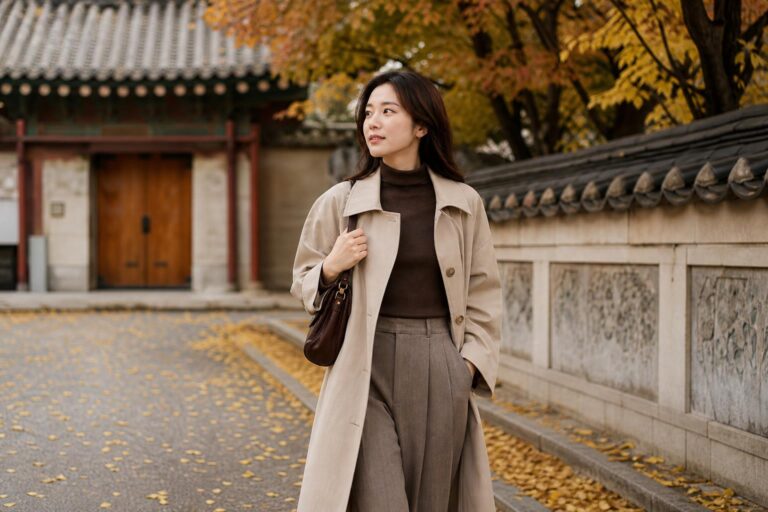
If spring dressing often relies on freshness, autumn dressing relies on depth. The seasonal palette highlighted across fall and autumn style coverage centers on camel, rust, olive, cream, forest green, charcoal, oatmeal, burgundy, and other earth-toned neutrals. These shades work because they layer naturally. They do not compete for attention, which makes them especially effective in outfits built from multiple pieces.
Camel is one of the strongest visual anchors in an autumn wardrobe. It softens darker pieces and brings coherence to black, cream, and olive. Rust and burnt orange create immediate seasonal character, but they tend to work best when paired with neutral companions rather than other saturated tones. Forest green and charcoal have a quieter elegance and often make outfits feel more urban and editorial.
Texture should be treated as equal to color, not secondary to it. A monochrome or tonal outfit can still feel dynamic if the materials vary. Knit sweaters, trench coats, wool outerwear, suede details, leather boots, and tweed or corduroy surfaces create subtle contrast even within a restrained palette. This is often what separates an outfit that simply looks dressed for cooler weather from one that fully captures the autumn aesthetic.
A practical texture framework
- Use knitwear for softness and volume.
- Add outerwear such as a trench coat, blazer, or coat to introduce structure.
- Bring in boots or loafers as the grounding element.
- Use scarves, belts, or a tote bag to refine the palette rather than distract from it.
- Mix no more than two or three dominant textures in one look to avoid visual overload.
This approach keeps the outfit composition clear. Autumn style tends to look strongest when one texture leads, one supports, and one grounds.

Layering formulas that make basic autumn outfits feel elevated
Most successful autumn outfit ideas can be reduced to formulas. That is useful because formulas remove the pressure to constantly invent new combinations. They also make shopping decisions more intelligent: once you know how you dress, you can invest in pieces that repeat across many looks rather than buying isolated items.
The soft base plus structured outer layer
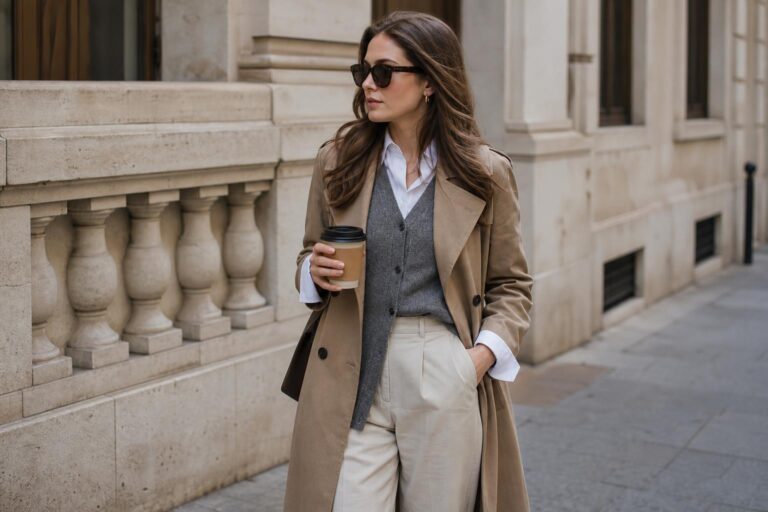
This is one of the most reliable layering strategies for daily wear. Start with a knit dress, sweater, or fine knitwear base. Add a trench coat, blazer, or heavier coat on top. Finish with boots. The visual logic is simple: softness underneath, structure above, weight at the bottom. That creates silhouette balance and makes even minimal combinations feel complete.
This formula is especially effective for office-adjacent dressing, coffee meetings, city errands, and any moment when you want comfort without losing polish. If the base layer is fitted or clean-lined, outerwear can be oversized without swallowing the outfit. If the base is already voluminous, a more tailored coat keeps the proportions controlled.
The skirt-and-knit formula with grounded footwear
Autumn styling often benefits from one piece that moves and one piece that stabilizes. A skirt with knitwear captures that balance well. The knit adds seasonal weight, while boots give the outfit a visual anchor. This is one of the easiest ways to create a feminine silhouette that still feels practical for colder weather.
To keep the look from feeling overly delicate, choose stronger accessories: a belt, a more substantial tote bag, or a coat with a defined shoulder line. If the skirt has volume or drape, the knit should be more contained. If the skirt is narrow or simple, a softer, slightly relaxed sweater creates better proportion play.
The layered casual formula for low-effort days
Basic autumn outfits do not need to look plain. A sweater, jacket, and boots combination can carry significant style energy when the tones are cohesive and the fabrics do not all read the same. Casual autumn looks become more convincing when they are intentionally edited. One jacket, one knit, one practical shoe, and one accessory cluster are often enough.
Style insight: the fastest way to make a casual fall outfit feel editorial is to avoid random color decisions. Keeping the look inside a family of camel, cream, olive, charcoal, or rust gives it the quiet consistency associated with fashion magazine styling.

Relaxed layers with a soft minimal edge
This interpretation of the autumn outfits aesthetic is built for readers who want ease first. Think simple knitwear, a coat with clean lines, straight visual flow, and accessories that support rather than interrupt. The mood is calm, modern, and quietly polished.
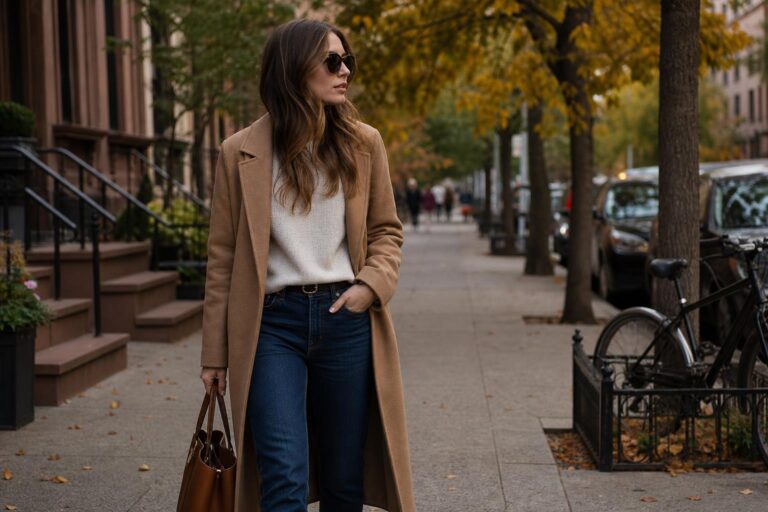
A cream or oatmeal sweater under a camel trench coat creates tonal layering without looking precious. Add boots in a darker shade to ground the palette. The reason this combination works is contrast through density rather than contrast through color. Light knitwear softens the face, camel adds warmth, and darker footwear prevents the outfit from floating.
This is also one of the easiest autumn outfit formulas to recreate from a capsule wardrobe. Most people already own some version of a neutral sweater, practical outerwear, and ankle or knee-high boots. Refinement comes from fit and finishing. Slightly cleaner lines, a scarf in a related tone, or a structured tote bag can change the entire impression.
Easy ways to recreate the look
- Keep the palette within two or three related shades.
- Choose one oversized element only, either the coat or the knit.
- Use boots as the visual anchor instead of adding too many accessories.
- If the outfit feels flat, add texture rather than another color.
Tailored pieces with an oversized silhouette
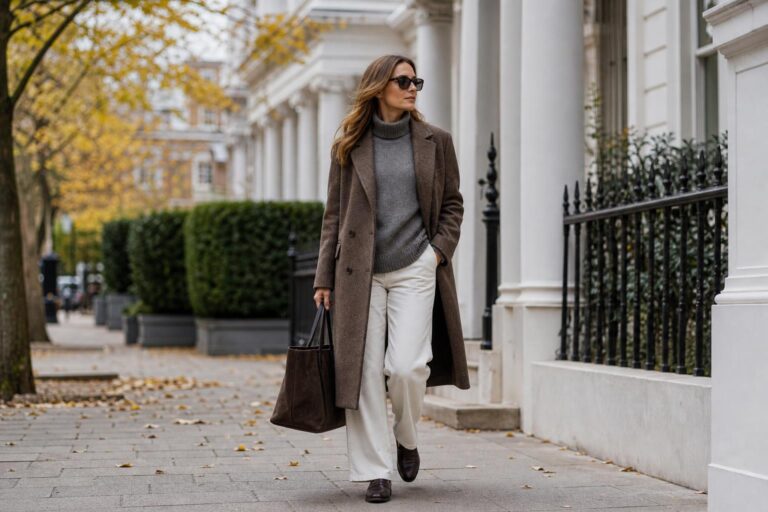
One of the strongest directions in modern autumn looks is the tension between tailored structure and relaxed volume. A blazer over knitwear, or a longer coat over a compact dress, creates shape without stiffness. This balance is central to many city-ready autumn outfits and aligns well with both practical dressing and editorial styling notes.
The oversized element should feel intentional, not accidental. A roomier coat or blazer works because it frames the body and leaves space for layers. The rest of the outfit needs a degree of restraint. Slim boots, a cleaner hemline, or a defined waist through a belt can keep the silhouette from appearing heavy.
Why this combination works: oversized tailoring carries visual authority, while knitwear or a softer base layer keeps the outfit approachable. The result is polished but not severe. This is especially useful for readers who want fall outfits ideas that translate from daytime office settings to evening plans with minimal adjustment.
Tip: if you are building an autumn capsule wardrobe, outerwear is often the smartest first investment because it is the piece most people see first and the one that most clearly establishes the seasonal mood.
Effortless weekend styling with vintage and heritage influence
Autumn naturally lends itself to heritage-coded details. Plaid patterns, corduroy, tweed, and classic coats all sit comfortably within the season because they mirror its textures and slower visual rhythm. This is where the vintage and heritage side of the autumn aesthetic becomes especially wearable.
A plaid shirt layered under a jacket, paired with boots and grounded by darker neutrals, reads relaxed without becoming overly rustic. A corduroy skirt with knitwear introduces texture that feels season-specific. Tweed outerwear can sharpen an otherwise soft outfit and bring the composition closer to editorial fall looks without sacrificing practicality.
The key is moderation. Heritage references work best when one or two details lead. If plaid, tweed, and corduroy all appear at once, the outfit can feel costume-like. If a single vintage-textured piece is framed by modern basics, the result feels current and much easier to wear in everyday life.
Most versatile item
Among heritage-inspired pieces, a coat is usually the most adaptable. It can sit over dresses, skirts, and knitwear-based outfits, making it far more flexible than a highly specific patterned item that only works with a narrow set of combinations.
Dark academia and moody fall aesthetic, made wearable
Dark academia appears in editorial fall styling because it naturally aligns with autumn’s mood. The palette leans deeper, the layers feel intellectual and composed, and the textures often have more gravity. But in practical terms, this aesthetic works best when translated through selective elements rather than strict adherence.
Charcoal, forest green, burgundy, and cream create a more scholarly, moody version of the autumn palette. Pairing a darker coat with knitwear and loafers or boots gives the outfit immediate structure. A dress under outerwear can soften the mood, while a skirt-and-knit combination makes the look feel more directional.
The advantage of this style direction is that it photographs beautifully and carries strong seasonal identity. The limitation is that if every piece is dark and heavily textured, the outfit can become visually dense. Cream, oatmeal, or lighter knitwear helps break that up and creates cleaner contrast around the face.
For everyday wear, focus on the principles behind dark academia rather than a rigid formula: layered separates, deeper tones, and textured materials that suggest thoughtfulness rather than overt drama.
Feminine contrast with structured basics
Many of the easiest autumn outfits become more compelling when softness is set against structure. This is why dresses remain so important in fall styling. A knit dress or a simpler dress silhouette can become seasonally appropriate the moment it is paired with boots and topped with a coat or blazer.
The styling logic is strong because dresses create uninterrupted line, while outerwear and footwear add definition. Boots prevent the look from feeling too transitional or summery. A blazer or trench keeps the outfit aligned with cooler-weather dressing and introduces the layering needed for visual depth.
This formula is especially useful for readers who want the autumn aesthetic without moving fully into heavy or masculine-coded pieces. It keeps movement and softness in the look while still respecting the season’s preference for texture and weight.
How to wear this in everyday life
For day, keep the accessories pared back and let the coat or boots do the work. For evening, a darker outerwear piece or a stronger accessory can make the same dress feel more intentional. This is one of the more efficient wardrobe formulas because one dress can rotate across multiple contexts with only small changes in layering.
Seasonal accessories that complete the aesthetic
Autumn accessories are less about decoration and more about reinforcement. Scarves, hats, gloves, belts, tote bags, loafers, and leather boots all contribute to the mood, but their main function is to sharpen the outfit’s composition and support seasonal practicality.
Scarves bring softness and are particularly useful in casual autumn looks where the clothing itself is simple. Belts can define shape in layered outfits that might otherwise feel too loose. Tote bags help support city-ready styling because they add utility without breaking the visual line. Loafers create a polished transition before heavier boot weather, while boots remain the most dependable finishing piece across nearly every autumn formula.
Accessories should match the energy of the outfit. In a soft minimal look, choose streamlined additions. In a dark academia or heritage-inspired outfit, more character-rich accessories can make sense. What matters is coherence. If the clothing is already heavily textured, accessories should often be simpler so the outfit does not become overworked.
Accessory tips
- Let one accessory family lead, such as boots or scarves, instead of styling everything at maximum intensity.
- Use belts when a layered silhouette starts to lose shape.
- Choose a tote bag when you want functionality that still feels editorial.
- Introduce loafers for a cleaner, lighter alternative to boots on milder days.
Building an autumn capsule wardrobe that still feels expressive
The capsule wardrobe concept appears repeatedly in autumn style discussions for good reason. Fall is a season of repetition. The weather shifts enough to require layers, but not so dramatically that an entirely new wardrobe is needed every week. A strong autumn capsule wardrobe focuses on pieces that can move across casual days, office settings, city outings, and more aesthetic mood-driven dressing.
The goal is not strict minimalism. It is compatibility. Every item should work with multiple others, especially across the core categories of outerwear, knitwear, dresses, skirts, and boots. If the color palette is cohesive and the silhouettes are balanced, a relatively compact wardrobe can still generate a wide range of outfit ideas.
12 to 15 key pieces to prioritize
- A trench coat
- A second coat with more warmth or stronger structure
- A blazer for smart layering
- Two to three knit sweaters
- A cardigan
- A knit dress
- One additional dress that layers well
- A skirt
- A plaid shirt or similar layering piece
- A jacket
- Boots for daily wear
- Optional loafers for milder weather
- A scarf
- A belt
- A tote bag
This kind of capsule creates room for cozy casual outfits, polished workwear formulas, and stronger aesthetic interpretations without forcing too much shopping. It also supports sustainability-minded decisions, especially if you focus on materials and silhouettes that will remain useful across more than one season.
Budget-friendly alternative: instead of replacing everything, upgrade the categories that influence the outfit most visually. Outerwear, boots, and knitwear usually make the largest difference. Existing dresses and skirts often become more autumnal simply through better layering.
Outfit mood map: from cozy casual to elevated evening
One reason the autumn outfits aesthetic has such broad appeal is that it can shift tone without abandoning its core language. The same fundamentals of layering, texture, and tonal dressing can support very different social settings and personal styles.
Cozy casual
This mode leans into sweaters, scarves, jackets, and practical boots. The palette is usually cream, camel, olive, or rust. The silhouette is relaxed but not shapeless. The appeal here is comfort with visual intention, often suited to daytime plans and low-effort dressing that still feels seasonal.
City-ready chic street style
This version sharpens the lines. Coats and blazers become more prominent, tote bags and loafers may enter the mix, and charcoal or forest green can replace softer tones. The outfit composition feels more directional, but the base formula remains familiar: layered outerwear, reliable footwear, and a controlled color palette.
Elevated evening
Evening autumn dressing does not require abandoning the aesthetic. A dress with boots and a darker coat already contains enough drama if the textures are rich and the palette is intentional. Charcoal, burgundy, or deep green can make the outfit feel more nocturnal, while simpler accessories prevent the look from becoming heavy.
What links all three moods is the same wardrobe strategy. Autumn style is strongest when it operates like a system rather than a series of unrelated looks.
How body type and proportion affect autumn layering
Layering adds beauty, but it also adds volume. That is why proportion awareness matters. The most flattering autumn outfits are rarely about following one silhouette blindly. They are about understanding where shape should be added, where line should stay clean, and how garments interact once stacked.
For hourglass proportions, waist definition often helps layered outfits retain clarity. A belt or a coat that naturally shapes the body can preserve balance. For rectangle silhouettes, texture contrast and selective volume can create more dimension, especially through knitwear paired with tailored outerwear. For inverted triangle shapes, skirts or softer lower-half movement can counterbalance stronger shoulders. For those who prefer straighter lines, dresses under long coats create a clean vertical effect with minimal styling effort.
None of this needs to feel restrictive. The point is not to dress according to rules, but to use proportion deliberately. If an outfit feels off, the issue is often not the individual piece. It is the relationship between volume, hem length, and the visual weight of the shoes.
Quick proportion checks
- If the coat is oversized, keep the base layer cleaner.
- If the skirt or dress has movement, choose footwear with enough presence to anchor it.
- If the palette is dark from head to toe, add one lighter knit or scarf for contrast.
- If the outfit feels bulky, remove one layer before adding accessories.
Common mistakes that weaken the autumn aesthetic
Autumn dressing often looks effortless, but the strongest looks are tightly edited. A few recurring mistakes tend to disrupt the effect, especially when trying to recreate inspiration images in real life.
The first is over-layering without hierarchy. Layering should create depth, not confusion. If every piece competes for attention through bulk, color, or texture, the silhouette loses direction. The second is ignoring the role of footwear. Boots and loafers are not afterthoughts in fall outfits; they are grounding elements that often determine whether the outfit feels seasonally coherent.
Another common issue is using too many disconnected tones. Earth-toned palettes work because they harmonize. Adding random bright or unrelated shades can break the mood unless handled with precision. Finally, highly aesthetic dressing can become impractical if movement and comfort are ignored. Outerwear needs to accommodate layers beneath it, and skirts or dresses should still function with the chosen boots and climate conditions.
Styling mistakes to avoid
- Do not add scarves, hats, belts, and statement textures all at once.
- Do not pair delicate outfits with footwear that feels visually too light for fall.
- Do not build the wardrobe around single-use pieces if you want a practical capsule.
- Do not confuse oversized with unstructured; shape still matters.
Real-life styling decisions that matter more than trend language
A useful autumn wardrobe responds to life, not just mood boards. The best outfit formulas for 2025 and beyond are the ones that handle changing temperatures, long days out, and repeated wear without losing visual impact. This is where practical decision-making becomes part of the aesthetic rather than separate from it.
If your day involves commuting, outerwear and shoes should do more work than highly specific layers. If you move between indoor and outdoor settings, lighter knitwear under a coat is usually more adaptable than dense bulk throughout. If you wear dresses often, boots become one of the most strategic purchases in the wardrobe because they extend the usefulness of pieces you may already own.
For readers drawn to fashion publication imagery, this is an important distinction: the most successful real-world version of autumn outfits aesthetic is not the one with the most pieces. It is the one where every item earns its place through comfort, versatility, and visual cohesion.
Why this aesthetic keeps returning every fall
Autumn style returns so strongly because it aligns mood with wardrobe logic. The season naturally invites layering, and layering naturally creates visual depth. Coats, knitwear, skirts, dresses, jackets, scarves, and boots all become more relevant at once, which gives dressing an immediacy that feels creative without becoming forced.
There is also a psychological clarity to the season’s palette and textures. Earth tones, wool, suede, leather, tweed, and corduroy evoke stability and warmth. That is why cozy, moody, editorial, and street-style interpretations can all coexist under the same umbrella. They draw from the same emotional and visual base, then diverge through proportion and styling emphasis.
The enduring appeal of the autumn outfits aesthetic lies in that flexibility. It offers enough atmosphere to feel aspirational, enough structure to feel intelligent, and enough practicality to become part of everyday life rather than a once-in-a-while style experiment.

FAQ
What does autumn outfits aesthetic actually mean?
It refers to a fall dressing approach built around mood, layering, texture, and a cohesive seasonal palette. Instead of focusing on one single trend, it combines practical wardrobe formulas such as coats, knitwear, dresses, skirts, and boots with a visual atmosphere that feels cozy, polished, moody, or city-ready.
How do I create autumn outfits aesthetic without buying a whole new wardrobe?
Start by working with what you already own and shift the styling. Add outerwear, use boots to ground lighter pieces, and layer knitwear over or under existing items. Prioritize one or two strategic additions, usually a coat, knitwear, or boots, because those pieces change the seasonal feel of an outfit the fastest.
Which colors work best for autumn outfits?
Camel, rust, olive, cream, forest green, charcoal, oatmeal, and burgundy are especially effective because they layer well and reflect the depth associated with fall fashion. These shades help create tonal outfits and make it easier to combine multiple layers without the look feeling chaotic.
What shoes fit the autumn aesthetic best?
Boots are the most consistent choice because they ground dresses, skirts, and knitwear-based outfits while reinforcing the seasonal mood. Loafers also work well on milder days, especially in more tailored or dark academia-inspired combinations where a polished finish matters.
How can I make basic autumn outfits look more elevated?
Focus on composition rather than adding more items. A structured coat over soft knitwear, a controlled color palette, and one strong texture contrast usually create more impact than extra accessories. Elevation in autumn dressing often comes from fit, proportion, and tonal consistency rather than complexity.
What is the easiest layering formula for fall?
One of the easiest formulas is a soft base layer, such as a sweater or knit dress, topped with structured outerwear and finished with boots. This works because it balances comfort with definition and can be adapted for casual, office, or evening settings with only minor changes.
Can autumn outfits aesthetic work for different body types?
Yes, but the key is proportion. Layering should be adjusted based on how much volume you want in different areas. Belts can add definition, coats can create clean vertical lines, and skirts or dresses can help balance stronger shoulders. The aesthetic is flexible as long as silhouette balance is considered.
What pieces matter most in an autumn capsule wardrobe?
The most useful pieces are outerwear, knitwear, dresses or skirts that layer well, and dependable boots. A trench coat, a second coat, a blazer, sweaters, a cardigan, a knit dress, and a scarf create a strong foundation because they can be recombined across many autumn outfit ideas.
How do I keep fall layering from looking bulky?
Use a clear layering hierarchy. Let one piece provide volume and keep the rest more controlled. If the coat is oversized, simplify the base layer. If the knit is chunky, choose cleaner outerwear. Also pay attention to shoes, because strong footwear helps balance layered outfits and prevents them from looking top-heavy.
Are cozy fall outfits and editorial fall looks part of the same aesthetic?
They can be. Both often rely on the same building blocks: layering, seasonal textures, earth-toned palettes, and practical staples like coats and boots. The difference usually comes down to styling intensity. Cozy looks lean softer and more casual, while editorial looks push texture contrast, silhouette play, or mood-driven details further.