
Dark Autumn Outfits That Feel Polished
Getting dressed in autumn sounds easy until your wardrobe starts pulling in two different directions. You want depth, richness, and polish, but real life asks for practicality: changing temperatures, long workdays, casual weekends, and outfits that still feel intentional after a coat goes on. That is exactly why dark autumn outfits can feel both inspiring and unexpectedly difficult to build.
The dark autumn palette is visually strong. Burgundy, chocolate brown, olive, forest green, navy, indigo denim, camel, and taupe all carry more weight than lighter seasonal colors, so small styling decisions matter more. The wrong texture can make the outfit feel heavy. Too much contrast can disrupt the warmth. Too many deep tones at once can flatten the silhouette instead of refining it.

The good news is that dark autumn dressing becomes much easier once you stop treating it as a list of colors and start treating it as a wardrobe system. A successful deep autumn look is not only about wearing burgundy or dark green. It is about balancing visual depth with movement, warmth with structure, and richness with enough clarity that the outfit still feels wearable in everyday life.
That is where this guide comes in: not as a random roundup, but as a practical style resource for building dark autumn outfits that work for work, weekends, evenings, and all the in-between moments that define a real wardrobe.
Found the dress? Keep the rest in one place.
Zarellea brings guest details, vendors, timelines, and every next step together — so your wedding plan feels as good as your look.
What makes dark autumn styling feel harder than it should
Dark autumn sits in an interesting place within color analysis. It shares autumn warmth, but it also depends on depth and contrast. That creates a common wardrobe problem: people understand the palette in theory, yet their outfits still feel muddy, overly dark, or unnecessarily complicated once they try to wear it in real life.
The issue usually starts with how deep tones behave on the body. Burgundy, olive, chocolate, and navy are beautiful anchors, but they visually advance more than pale neutrals do. If every piece is dense in color and texture, the outfit can look heavy before accessories even enter the picture. This is especially noticeable with autumn layers like wool coats, leather jackets, suede boots, or thick knitwear.
Weather also complicates the palette. In many U.S. settings, autumn is not one clean season. It can mean cool mornings, warm afternoons, indoor heating, unexpected rain, and a need to move between office settings, errands, and evening plans. That makes outfit adaptability essential. A dark autumn wardrobe has to layer well without becoming bulky and has to feel polished whether the outerwear stays on or comes off.
There is also a social styling element. Dark autumn outfits often look more elevated by default because the palette carries a sense of richness and refinement. That is useful for workwear and evening dressing, but it can make casual outfits feel overdressed if there is no relaxed piece to offset the structure. Dark indigo denim, soft knitwear, and practical loafers or ankle boots become important because they keep the palette grounded.

Understanding the dark autumn palette before you build outfits
Dark autumn, often discussed alongside deep autumn, is defined by warmth, depth, and a rich overall finish. The most useful way to understand it is through color roles rather than isolated shades. Every effective outfit needs anchors, supporting tones, and a small amount of contrast control.
Core colors that do the heavy lifting
The most consistent dark autumn anchors across outfit guidance are burgundy, chocolate brown, olive, forest green, navy, and dark indigo denim. These are not just pretty seasonal shades. They function as wardrobe stabilizers. Burgundy adds warmth and refinement. Chocolate brings softness compared with black. Olive and forest green create dimension without feeling loud. Navy and indigo provide a cleaner, more practical base for everyday dressing.
Camel and taupe matter because they stop the palette from becoming too dense. They create breathing room. In dark autumn dressing, lighter warm neutrals are not a departure from the palette; they are often what makes the deeper tones look more expensive and intentional.
How neutrals should behave in a deep autumn wardrobe
Many dark autumn outfits fail because the neutral choice is too stark or too cool. Warm-toned neutrals such as camel, taupe, and chocolate brown keep the outfit cohesive and soften the visual transitions between stronger colors. Black can work as an accent, but when it becomes the foundation of the entire look, it can pull the outfit away from that signature autumn warmth.
A useful styling principle is this: let one deep color lead, let one neutral support, and let texture create the third layer of interest. That approach prevents the outfit from relying on color alone.

The styling logic behind dark autumn outfits that actually work
A wearable dark autumn look depends on three things: proportion play, tonal layering, and texture contrast. Once these are in place, the outfit feels intentional even if the formula is simple.
- Proportion play: deep colors look more balanced when the silhouette has structure. A long wool coat over slim or straight-leg trousers feels cleaner than stacking multiple oversized pieces in equally dark shades.
- Tonal layering: staying within a close range of rich tones creates sophistication, but it still needs separation. Burgundy knitwear against chocolate trousers works because the colors are distinct enough to read individually.
- Texture contrast: suede, velvet, leather, cashmere, mohair, and denim stop dark tones from collapsing into one flat block of color.
This is why dark autumn outfit ideas often look strongest when they combine one soft fabric, one structured element, and one practical anchor. Think cashmere with leather, wool with denim, or suede with a smooth midi dress. The visual depth comes from materials as much as color.
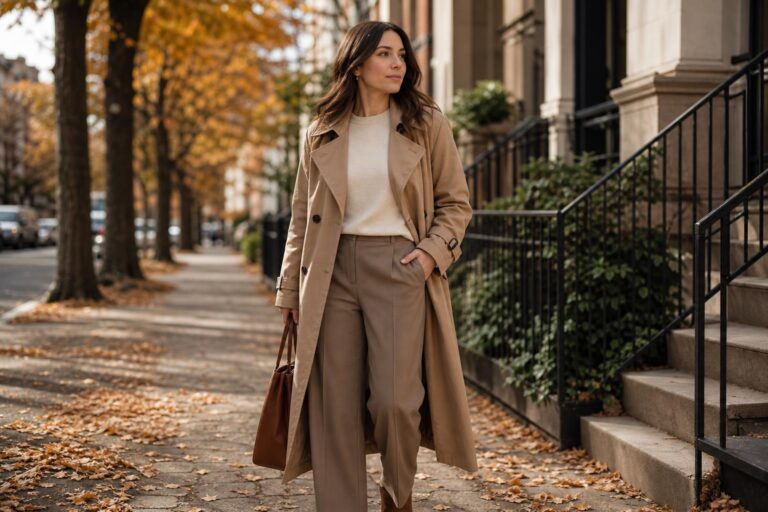
Tip: when an outfit feels too serious, do not automatically remove the deep colors. Instead, adjust the finish. Swap a stiff jacket for an olive trench, replace a formal boot with a loafer, or bring in indigo denim to relax the composition.
Start with a dark autumn capsule wardrobe, not endless outfit ideas
The easiest way to build reliable dark autumn outfits is through a capsule wardrobe framework. This matters because the palette is cohesive by nature. A smaller set of well-chosen pieces creates more combinations than a large wardrobe full of near-matches that never quite work together.
The essential pieces worth repeating
- A camel coat or wool coat in a warm neutral
- An olive trench or structured jacket
- A leather jacket or leather bomber jacket for sharper contrast
- Burgundy knitwear, such as a sweater or cardigan
- A forest green or olive top for tonal layering
- Dark denim jeans in navy or indigo
- Chocolate brown trousers or wool trousers
- A midi dress or wrap dress in burgundy or deep green
- Ankle boots or loafers in dark brown or burgundy
- Gold jewelry or antique brass-toned accents
This kind of deep autumn capsule wardrobe works because every item has a clear role. The coat lightens and frames. The jacket sharpens. The knitwear adds warmth. The denim makes the palette casual. The dress covers evenings and event dressing without requiring a separate style identity.
Brands and resources such as ColorBook, Shop My Palette, Color Season AI, Color Curator, MyStyleBox, and DiscoverFashions all reflect the same central idea: the palette should guide the wardrobe, not trap it. The most useful takeaway is not to buy more pieces in the same color, but to build enough variety in garment type and texture that those colors can perform in different settings.

Relaxed layers that still feel polished
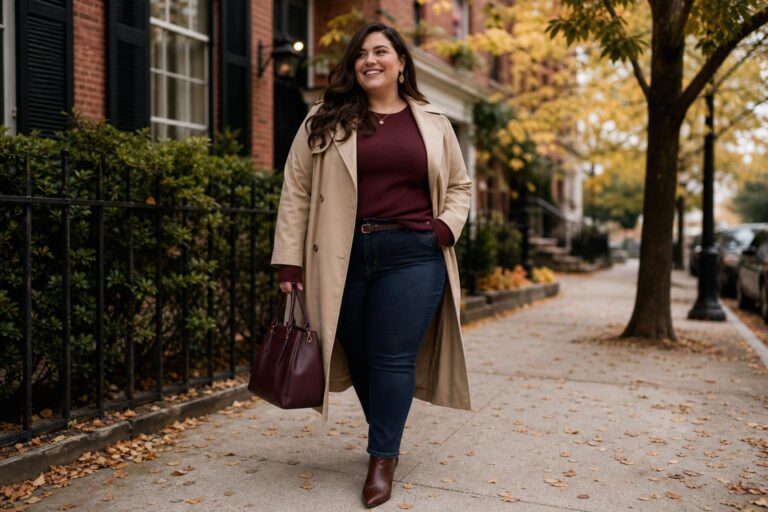
This is the dark autumn answer to the daily “I need to look put-together, but I also need to be comfortable” problem. The strongest version starts with dark indigo jeans, a burgundy sweater, and a camel coat. Add ankle boots in chocolate brown and understated gold jewelry.
The outfit works because the silhouette is simple, but the palette has enough tonal variation to look styled. Indigo denim grounds the look and keeps it from leaning too formal. Burgundy near the face brings warmth and richness. Camel acts as the visual light source, stopping the combination from becoming too dense.
For body type and comfort considerations, this formula is flexible. A slightly cropped sweater helps define the waist over straight-leg jeans. A longer coat elongates the line if you want more verticality. If you prefer more softness, replace the sweater with a cardigan and keep the base layer fitted to avoid bulk.
Why this outfit works
The contrast is controlled rather than harsh. The coat provides shape, while the knit texture softens the denim. This balance makes the outfit feel finished even when the pieces themselves are familiar and easy to repeat.
Easy ways to recreate the look
If camel outerwear is not in your closet, an olive trench creates a slightly moodier version with the same practicality. If jeans feel too casual for your day, swap in chocolate trousers and keep the burgundy knit for warmth and cohesion.
Comfortable city outfits with structure
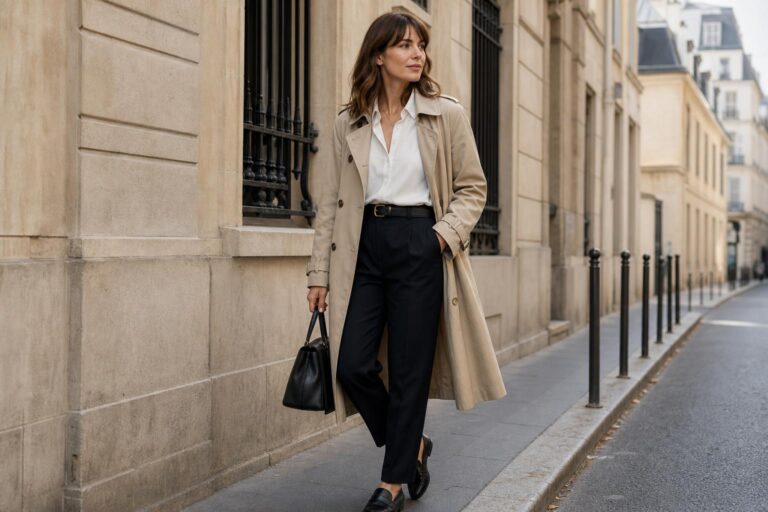
For city dressing, dark autumn outfits need sharper lines. Walking, commuting, and temperature shifts all demand function, but the look still has to hold its shape. A strong formula here is chocolate trousers, a forest green knit top, and a leather jacket. Finish with loafers for daytime or ankle boots for more edge.
The leather element matters. In a deep autumn palette, leather adds crispness that prevents warm shades from reading too soft. It also improves the proportion balance of knitwear, especially if the top has volume. The trousers keep movement easy and feel more polished than denim, while the green top adds saturation without competing with the outer layer.
This look also solves a common problem with autumn outfits: visual heaviness above the waist. Because the trousers carry some depth too, the eye moves through the whole outfit instead of staying trapped around the jacket and knit.
Best shoe pairing: loafers create a cleaner office-to-evening transition, while ankle boots add weight and work better when the jacket is the main outer layer.
Soft layering without added bulk
One of the easiest ways to get dark autumn dressing wrong is over-layering thick fabrics in equally deep shades. The outfit may technically fit the palette, but it can feel restrictive and visually crowded. A better approach is to keep the fabrics lighter and let color do more of the work.
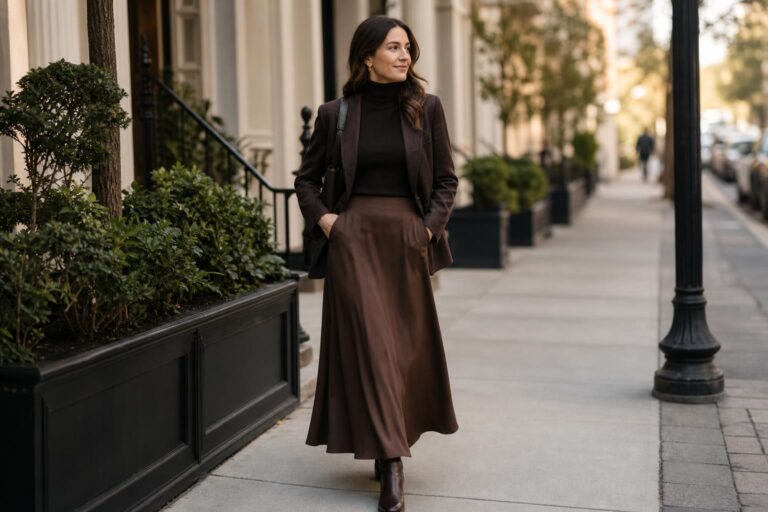
Try a taupe or camel base top under a burgundy cardigan with a midi skirt in olive or deep brown. Add loafers or slim ankle boots. This combination is especially effective for indoor-heavy days, casual offices, or weekends when you want warmth without the density of a full knit-and-coat combination.
The styling logic is all about spacing. A lighter base near the face softens the rich cardigan. The midi skirt introduces movement, which prevents the deeper tones from looking static. The outfit still reads as dark autumn, but it feels breathable and easier to wear over long hours.
Common comfort mistake
Stacking a heavy sweater under a heavy jacket and then adding a dense scarf often creates more friction than warmth. The outfit loses mobility, and the silhouette becomes bulky. A lighter underlayer with one strong knit piece usually performs better.
Dark denim as the casual anchor
Dark denim has a special role in autumn dressing because it bridges palette guidance and real-world ease. It appears repeatedly in autumn editorial styling for a reason: indigo gives depth without the hardness of black and works with almost every major dark autumn color.
A highly repeatable formula is dark indigo jeans, an olive jacket, and a chocolate or taupe knit. This is the kind of outfit that survives a full day of errands, school runs, coffee meetings, or casual travel without feeling sloppy. The denim keeps the palette grounded. The olive outer layer adds seasonal identity. The warm neutral knit prevents the combination from becoming too dark from top to bottom.
Who What Wear’s emphasis on dark denim autumn styling fits neatly into this palette logic. Indigo is not just a trend detail here; it is one of the most practical foundations for anyone trying to make deep autumn color theory feel modern and wearable.
Quick styling adjustment
If the outfit feels too casual, change the top rather than the jeans. A smoother knit, a more fitted silhouette, or a structured bag will elevate the composition faster than swapping the denim itself.
Skirts and dresses that keep the palette refined
Dark autumn outfits often lean heavily on trousers and denim, but skirts and dresses can be some of the easiest ways to express the palette elegantly. The key is to choose silhouettes that let the color richness show without requiring excessive accessories.
A burgundy wrap dress with dark brown ankle boots is one of the strongest one-piece solutions in the palette. The wrap shape naturally creates definition, which is useful because deep colors can otherwise minimize shape. Burgundy carries enough visual interest that the look feels intentional even when styling is minimal.
A second strong option is a deep green midi dress layered under a camel coat. This works particularly well for workwear, dinner, or transitional event dressing because the coat adds lightness and structure while the dress keeps the palette focused and uninterrupted.
For skirt outfits, a chocolate or olive midi skirt with a fitted knit top creates better proportion balance than pairing a full skirt with a bulky sweater. If you want more volume on the bottom half, keep the top smoother and more compact so the outfit still has a clear line.
Fabric insight
For one-piece looks, fabric finish matters as much as color. A wrap dress in a fluid material feels easier and more versatile than a very stiff silhouette in the same shade. It allows the deep tone to look rich rather than rigid.
Texture pairings that give dark autumn outfits depth
Texture is one of the biggest underused tools in dark autumn styling. Deep tones can be beautiful on their own, but they become far more dimensional when materials are intentionally mixed. Velvet, suede, leather, wool, cashmere, and denim all bring different levels of light absorption and surface variation, which is exactly what gives the palette its signature richness.
Velvet, suede, and leather in practical rotation
Velvet works best when it is treated as the focal texture rather than the entire outfit theme. A burgundy velvet piece paired with smooth boots or a structured coat feels modern. Too many plush textures at once can look costume-like and become difficult to wear outside evening settings.
Suede is especially effective in dark autumn because it softens the palette. Olive or chocolate suede accessories, or a suede jacket, add depth without harshness. Leather adds the opposite effect: definition, polish, and a stronger outline. That makes suede and leather useful counterbalances depending on whether the outfit needs more softness or more edge.
Brocade and other ornate textures are best reserved for event dressing or party-focused autumn outfits. They can suit the palette beautifully, but they need simpler companion pieces to stay wearable.
Metallic accents that support rather than interrupt
Gold jewelry and antique brass-toned details sit naturally within the warmth of deep autumn. They act as finishing touches rather than contrast devices. That distinction matters. Cool metallics can create a sharper break in a palette built on warmth and saturation, while warm metals reinforce the continuity of the look.
Workwear, weekends, and evenings: dark autumn by context
The most useful dark autumn wardrobe is one that changes context without losing identity. A good palette should simplify dressing decisions, not create separate uniforms for every setting.
Professional outfits with authority but not stiffness
For workwear, start with chocolate trousers or a deep skirt, then add a forest green or burgundy top and finish with a camel coat or structured outer layer. This combination looks composed because it distributes depth across the outfit instead of concentrating it in one area. Loafers are particularly effective here because they maintain polish without making the look feel overly formal.
If your workplace leans conservative, navy becomes one of the most useful supporting colors in the deep autumn palette. It reads professional immediately while still blending comfortably with olive, burgundy, and warm neutrals.
Weekend casual that still feels intentional
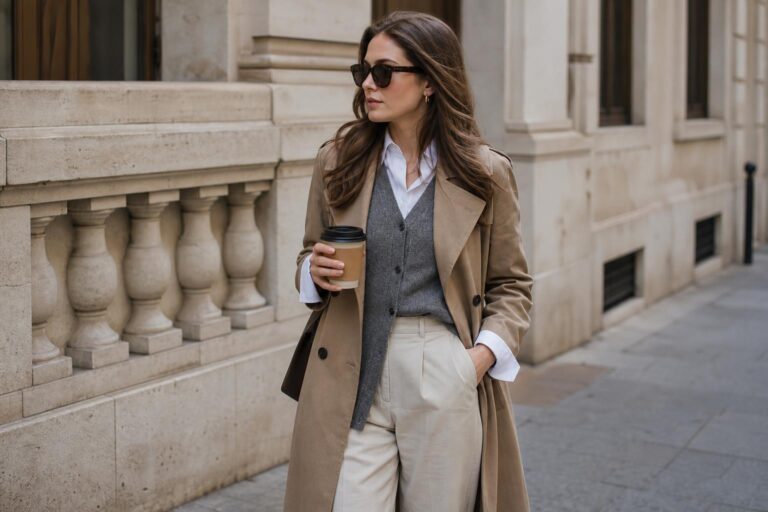
Weekend dressing benefits from one relaxed anchor and one elevated element. Dark denim with a taupe knit and olive trench is an easy example. The jeans and trench keep the outfit practical for movement and changing weather, while the knit softens the overall look. Add a roomy but structured bag and minimal gold jewelry for an outfit that feels considered without being high-maintenance.
Evening and event outfits with depth
Dark autumn party and evening dressing works best when it leans into color richness and texture rather than excessive embellishment. A burgundy dress, dark boots, and warm metallic jewelry create enough impact on their own. A deep green dress with a camel or chocolate coat is another strong option for dinners, seasonal gatherings, or more refined autumn events.
The advantage of these combinations is that they feel polished without becoming fragile. That matters for real event dressing, where coats, walking, sitting, and long hours can quickly expose whether an outfit is only visually good or actually wearable.
Regional U.S. dressing: why the same palette needs different handling
Dark autumn styling shifts depending on location, and this is where many wardrobes become more functional. In a colder urban setting such as NYC, the palette can carry more wool, leather, and heavier outerwear because the climate supports visual density. Camel coats, leather jackets, dark denim, and boots all make sense together because the outfit spends more time under outer layers.
In places with milder or less predictable weather, the same palette often needs lighter construction. An olive jacket may outperform a heavy wool coat. A cardigan and midi skirt may be more practical than a thick sweater with multiple layers. The palette stays the same, but the weight of the garments changes.
This is a useful reminder that dark autumn is not a costume template. It is a color framework. The best results come from adapting the depth of the palette to your climate, commute, and daily movement rather than forcing every seasonal texture into one look.
Celebrity and influencer references that clarify the palette
Public figures can be useful palette references when the goal is understanding visual direction rather than copying exact outfits. Color Curator points toward celebrity-based palette examples, while editorial fashion content often uses influencer styling to show how deep tones work in practice.
Halle Berry and Eva Mendes are helpful references for dark autumn aesthetics because they illustrate how rich, warm, and deep colors can feel polished rather than overpowering. Monikh appears in autumn denim styling conversations because dark indigo and tonal layering translate especially well in everyday editorial dressing. The lesson from these references is not about celebrity imitation. It is about seeing how depth, warmth, and contrast are distributed across real outfits.
When using celebrity or influencer inspiration, focus on the structure of the outfit: where the dark anchor sits, whether the neutral is warm or cool, and how texture is used to create separation. That is far more useful than chasing exact items.
Common styling traps that make dark autumn outfits feel off
Most dark autumn wardrobe problems are not caused by the colors themselves. They come from how those colors are distributed, layered, and finished.
- Using black as the entire base: a small black accent can work, but an all-black foundation often erases the warmth that makes dark autumn distinct.
- Ignoring texture: rich tones need surface variation. Without it, the outfit can look flat or too severe.
- Layering only bulky pieces: depth in color does not require heaviness in fabric. Too much weight can ruin movement and proportion.
- Choosing cool neutrals over warm ones: the palette becomes less cohesive when taupe, camel, and chocolate are replaced by colder alternatives.
- Making every piece a statement: dark autumn outfits are strongest when one element leads and the rest support the composition.
Tip: if an outfit feels wrong and you cannot identify why, look first at the neutral and the texture. Those two details usually explain the issue faster than the main color does.
Where to shop and what to look for
Shopping for dark autumn pieces becomes easier when you search by color family and garment role instead of broad seasonal trends. Resources such as ColorBook, Shop My Palette, Color Season AI, MyStyleBox, and DiscoverFashions are useful because they center the palette first, then connect it to wardrobe planning and outfit composition.
When evaluating a piece, ask three practical questions. Does the color belong to your main anchor family such as burgundy, olive, chocolate, navy, or camel? Does the fabric finish add something different from what you already own? And can the item work in at least two settings, such as office and weekend or casual and evening?
This is especially important for higher-impact categories like outerwear, boots, dresses, and leather jackets. A burgundy coat may be beautiful, but an olive trench or camel wool coat can often integrate more easily across a broader range of dark autumn outfits. The best buy is not always the most dramatic one. It is the piece that creates the most cohesion in your existing wardrobe.
A quick dark autumn outfit planner you can actually use
If getting dressed feels slow, simplify the process with one repeatable framework: choose one anchor color, one warm neutral, one texture contrast, and one practical shoe. That is enough to produce a finished dark autumn outfit without overthinking it.
- Anchor color: burgundy, forest green, olive, chocolate, navy, or indigo
- Warm neutral: camel, taupe, or a softer brown
- Texture contrast: leather, suede, denim, velvet, cashmere, wool, or mohair
- Practical shoe: ankle boots or loafers
Example combinations can be as simple as burgundy knit plus camel coat plus indigo denim, or olive jacket plus taupe top plus chocolate trousers. The consistency comes from the framework, not from wearing the exact same formula every day.
The most versatile piece in many dark autumn wardrobes is often the coat or jacket, not the statement top. Outerwear sets the tone immediately and controls how the entire palette reads in public, especially during U.S. autumn when layers are visible most of the day.
Final styling perspective
Dark autumn dressing becomes much less intimidating once you stop chasing perfect seasonal outfits and start building visual logic. Rich colors need shape, warm neutrals need purpose, and deep tones need texture to stay dimensional. When those elements work together, the wardrobe feels easier, more cohesive, and far more wearable.
The strongest dark autumn outfits are not the most complicated ones. They are the ones that balance depth with clarity and style with daily function. Start with the pieces you already own, refine the palette around your best anchors, and let practicality guide the final edits. That is what makes the look feel modern, polished, and realistic enough to wear on repeat.

FAQ
What colors are most important in dark autumn outfits?
The most important colors are burgundy, chocolate brown, olive, forest green, navy, and dark indigo, supported by warm neutrals like camel and taupe. These shades create the depth and warmth that define the palette while still giving enough variation for everyday outfit building.
Is dark autumn the same as deep autumn?
They are often used very closely together and share the same overall direction: rich, warm, deep color harmony. In practical wardrobe terms, both point toward the same styling priorities of depth, warmth, and controlled contrast.
Can dark autumn wear black?
Black can work as an accent, especially in footwear, small accessories, or selected outerwear details, but it is usually less effective as the full foundation of the outfit. Chocolate, navy, olive, and other deep warm tones tend to preserve the palette better and create a softer, more cohesive finish.
What is the easiest dark autumn outfit for everyday wear?
One of the easiest combinations is dark indigo jeans, a burgundy sweater, and a camel coat with ankle boots. It works because the denim keeps the look practical, the burgundy adds warmth, and the camel lightens the overall composition.
Which textures suit a deep autumn wardrobe best?
Velvet, suede, leather, wool, cashmere, mohair, and denim all work well because they add surface variation to deep tones. Texture is especially helpful in this palette because it prevents rich colors from looking flat or overly heavy when layered together.
How do I build a dark autumn capsule wardrobe?
Start with a small set of versatile pieces in the core palette, such as a camel coat, olive jacket, burgundy knit, dark denim, chocolate trousers, a deep-toned dress, and practical shoes like loafers or ankle boots. The goal is to create repeatable combinations rather than collect many similar items in slightly different shades.
Are dark autumn outfits suitable for workwear?
Yes, dark autumn colors often work especially well for professional dressing because they naturally look polished and grounded. Chocolate trousers, navy, burgundy tops, forest green knitwear, and camel outerwear can all create office-ready outfits without feeling severe.
What shoes work best with dark autumn outfits?
Ankle boots and loafers are two of the most useful options because they support the palette while staying practical for everyday wear. Dark brown, burgundy, and similarly rich tones usually integrate more smoothly than shoes that feel too bright or too stark.
How can I make dark autumn outfits feel less heavy?
Use a warm neutral like camel or taupe to break up the deeper shades, and combine heavy-looking colors with lighter or smoother textures. A lighter base layer, fluid dress, or cleaner shoe can make the entire outfit feel more breathable without leaving the palette.
Where can I find guidance for shopping dark autumn pieces?
Palette-focused resources like ColorBook, Shop My Palette, Color Season AI, MyStyleBox, Color Curator, and DiscoverFashions can help connect color analysis with actual wardrobe planning. They are most useful when you use them to identify versatile anchors, not just individual items.