Winter Rave Outfits: Solve the Cold-to-Club Problem
Your winter rave outfit looks right in the mirror, but the practical problem appears at the door: you need a coat for the queue, somewhere to put it inside, and a look you can dance in after the warm layers come off. Adding another sweater does not solve all three. It can simply leave you carrying more clothing while the outfit you wanted to show disappears underneath.
Build winter rave outfits around the constraint that is hardest to change. If the venue has reliable storage, you can separate outdoor clothing from the indoor look. If you need to keep everything with you, the number and size of removable pieces matter more. If the event is outdoors, choose clothing for those conditions first, then bring your color, shape, or shine into the layers you will actually wear.
Find the part of the night your outfit cannot handle
Start with one question: where will the outfit stop working? The answer might be the wait before entry, an overheated dance floor, a jacket that has nowhere to go, or shoes chosen for a photograph rather than your route. Identify that weak point before adding accessories. A specific problem gives you a useful change to make; a vague goal of looking warmer can lead to unnecessary layers.
Read the event information rather than guessing from the name. A warehouse-themed night might take place in a heated room, a partly open space, or several connected areas. An indoor venue can still involve an outdoor queue and a walk to transport. Note where you expect to be outside and whether you can return indoors while waiting to leave. Those details help you choose which pieces must remain available.
Found the dress? Keep the rest in one place.
Zarellea brings guest details, vendors, timelines, and every next step together — so your wedding plan feels as good as your look.
Next, separate the clothes you want to dance in from the clothes you need for the journey. Put on the intended indoor top, bottoms, and shoes without the coat. Does that version feel complete? If the only interesting piece is the coat, consider moving a color or texture into the top or trousers. You should be able to remove an outdoor layer without feeling as though you have removed the entire styling idea.
Too much clothing indoors, too little outside
A base outfit can be appropriate for the dance floor without being appropriate for a cold wait. Choose a removable layer that is easy to put back on, then choose outerwear for the forecast and expected exposure. Keep those roles distinct. A silver fashion jacket, fleece, or quilted vest can be part of your look, but its appearance alone does not tell you whether it is enough for the conditions outside.
Avoid building an indoor outfit that depends on hidden pieces you cannot conveniently remove. If you expect the room to be warm, thick layers under your trousers may leave you with fewer adjustment options than a front-opening layer on top. This does not mean you should leave necessary outdoor clothing behind. It means the complete plan needs to suit both parts of the night, including how you will change between them.
A great outfit with nowhere for its coat
Storage is a separate clothing decision. A long padded coat may be exactly what the journey needs, but you have to know what happens to it after entry. Do not make the outfit depend on an unnamed corner, someone else’s bag, or a friend holding it through every set. Choose a legitimate storage option or accept that the outerwear stays with you and adjust the rest of the look accordingly.
Also distinguish a coat from a bag full of clothes. A venue may handle them differently. The question is not simply whether a coat check exists, but whether it accepts the items you plan to remove, when you can retrieve them, and how you will keep the claim ticket. Resolve that before deciding to wear multiple removable jackets.
The outfit detail vanishes when you adjust it
An expressive indoor outfit can be as simple as a plum top under a silver zip jacket or a black top with silver pleated trousers. Pick a detail that you enjoy seeing in the version you will wear most. If the jacket is likely to come off, let the plum top remain a deliberate color choice. If your coat will stay on, try a bright beanie, a visible collar, or an interesting trouser shape beneath it.
This is a useful way to keep the outfit personal without adding several loose accessories. Your strongest detail can live in the clothing itself. Once it does, you can put your attention into the fit and storage of the practical layers instead of trying to decorate your way around a problem.
Choose the layer plan that your venue can support
There are three useful starting points: confirmed storage, keeping layers with you, and dressing for an outdoor event. They are not three levels of style. They are different arrangements for your belongings. Choose the arrangement that reflects the actual venue and then make the clothes work within it.
Confirmed coat check or lockers
When storage is confirmed, wear appropriate outerwear for arrival and remove it after entering. Check whether the service can take your additional indoor layer, or whether that piece needs to remain on you. A coat check that takes one coat is not automatically a storage solution for a jacket, bag, scarf, and loose accessories together.
For a concrete US example, Mission Ballroom’s official FAQ describes coat check and additional-item handling separately. Treat that as a reason to read your own venue’s details carefully, not as a policy that applies to every rave. Check the current event information before relying on any service, especially if your whole outfit plan requires it.
Move the things you need during the event out of the coat before handing it over. Keep the claim ticket in an accessible place that stays with you. Try the indoor outfit with your permitted bag, because a crossbody strap can sit differently once the coat is gone. You want the bag and clothing to work together in the version you will actually dance in.
Keeping your layers with you
If there is no confirmed storage, begin by reducing the number of separate pieces. A top with a front zip lets you adjust its opening without creating another garment to carry. A small midlayer might fit into a permitted bag, but test that with the other things already inside. Do not assume a winter coat will fold into the same space as a tee.
Try moving with the exact arrangement. If you will carry the coat, hold it while walking, turning, and raising your free arm. If you will wear it open, try the indoor outfit that way. If neither arrangement is manageable, change the plan before the night: confirm another legitimate storage option, change the event or travel arrangement, or choose a different outfit. Leaving necessary winter outerwear behind is not the solution to an inconvenient cloakroom.
A tied layer is an option only if the garment sits securely and does not trail. Try it with the bag in place and take several steps. Some coats are too bulky or too long for that arrangement. You do not need to make every item perform a clever double duty; sometimes carrying one suitable coat is more straightforward than juggling several smaller pieces.
An outdoor or partly outdoor event
Build this outfit around the clothing you expect to keep on. Choose the outer layer, covered legs, footwear, and weather accessories for the conditions, then add your styling choices where they remain visible. A cobalt neckline and beanie can give a graphite coat a clear color direction. A fully zipped coat can still be part of an intentional outfit.
The National Weather Service’s cold-weather guidance recommends layers, covered skin, shelter from wind, and replacing wet clothing with dry clothing. Use the forecast and event guidance when making the outdoor plan. The outfits below are styling examples, with no temperature rating or promise that a fashion garment will handle prolonged exposure.
Do not plan an outdoor night around removing the coat for the whole event. If you know you will move between sheltered and exposed areas, make the adjustment easy while retaining the clothes you need outside. The visual detail can be in the visible top, beanie, or trousers, rather than depending on an indoor-only outfit being on display all evening.
Try three winter rave outfits with a clear job for every piece
These combinations solve different versions of the problem. They use full-length bottoms and front-opening layers, while keeping the outfit’s identity in a visible color or finish. Substitute pieces you already own, but preserve the job of the item you are replacing. A shiny jacket and an insulated coat are separate choices even when they share a similar color.
Plum, black, and silver for an indoor night with storage
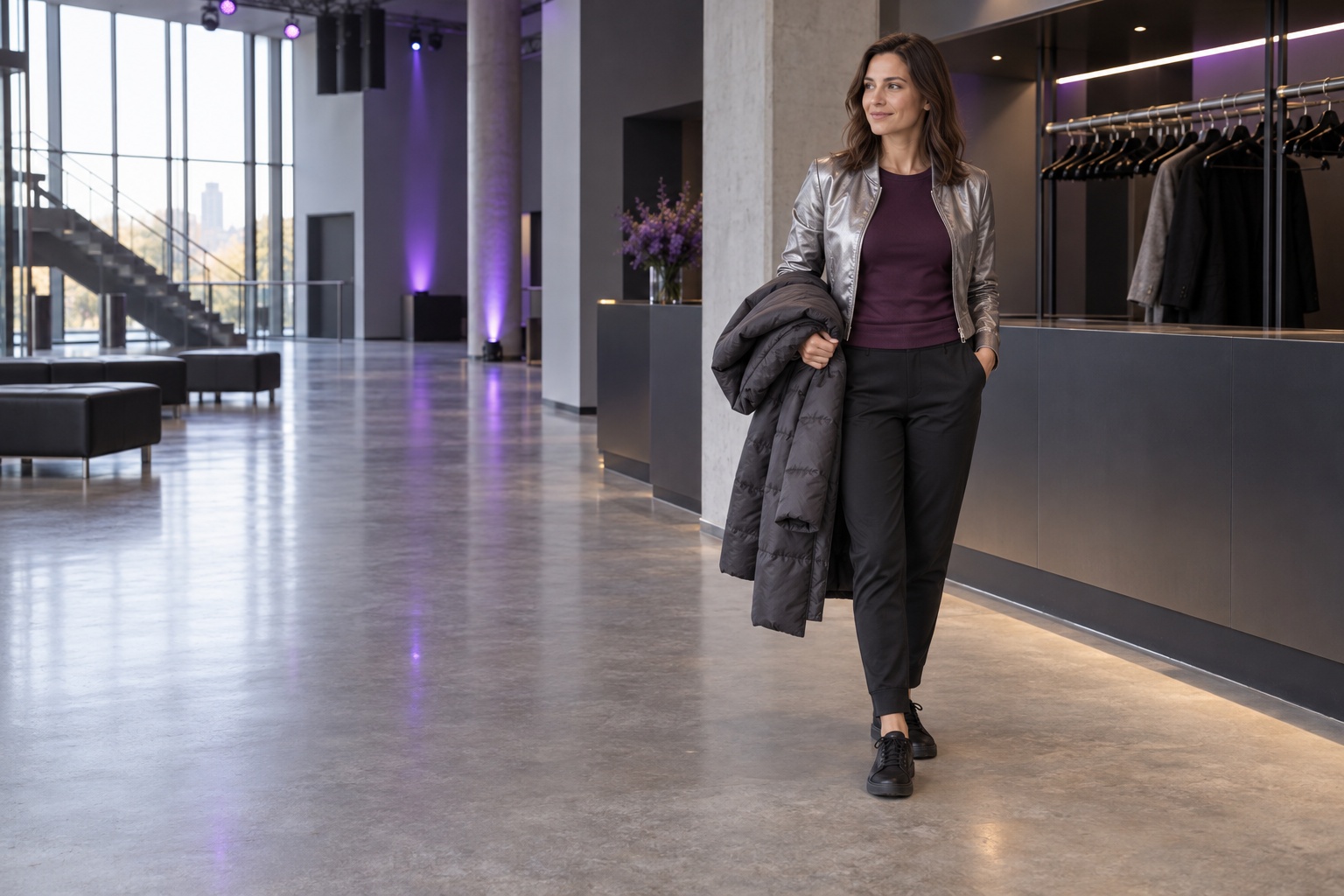
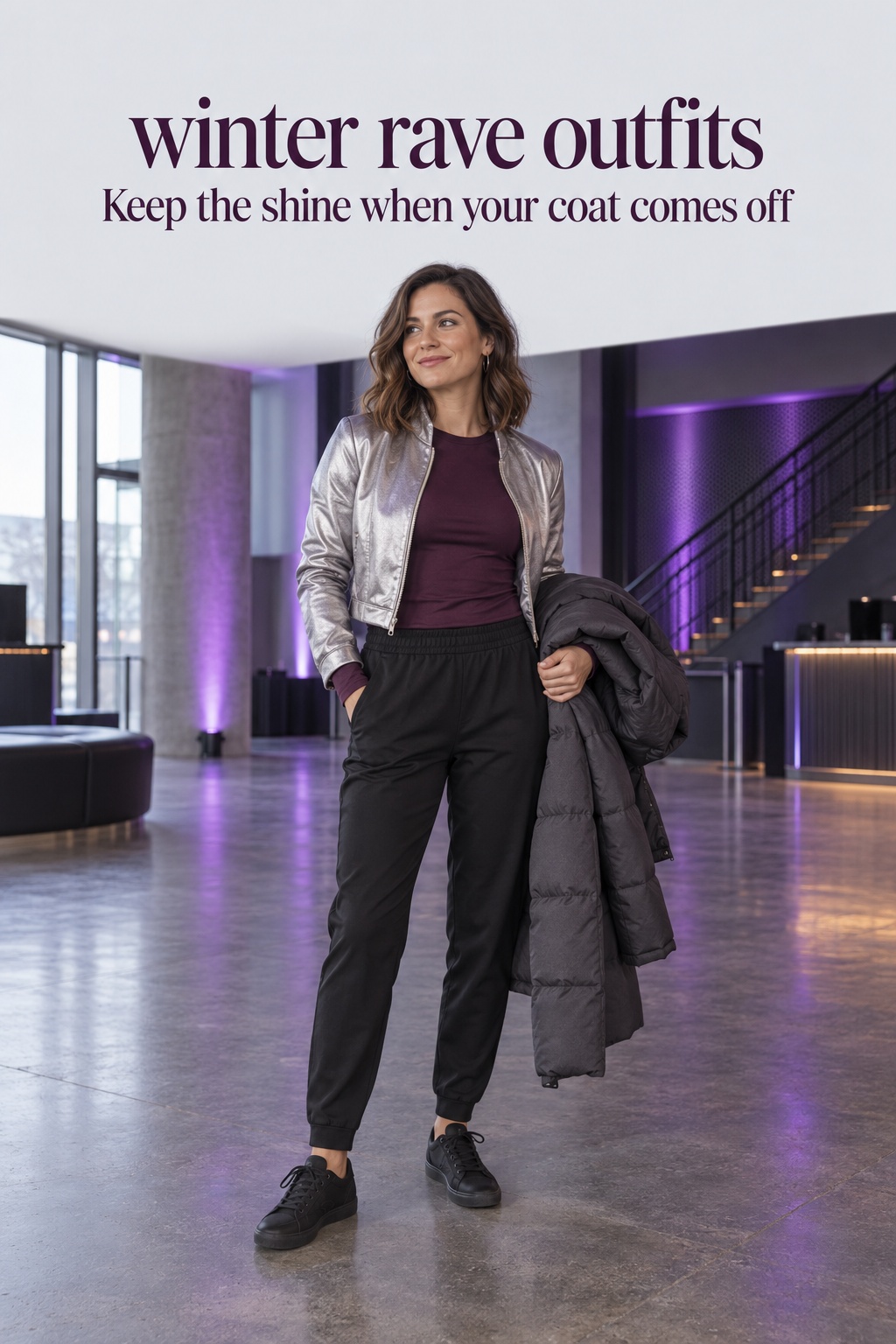
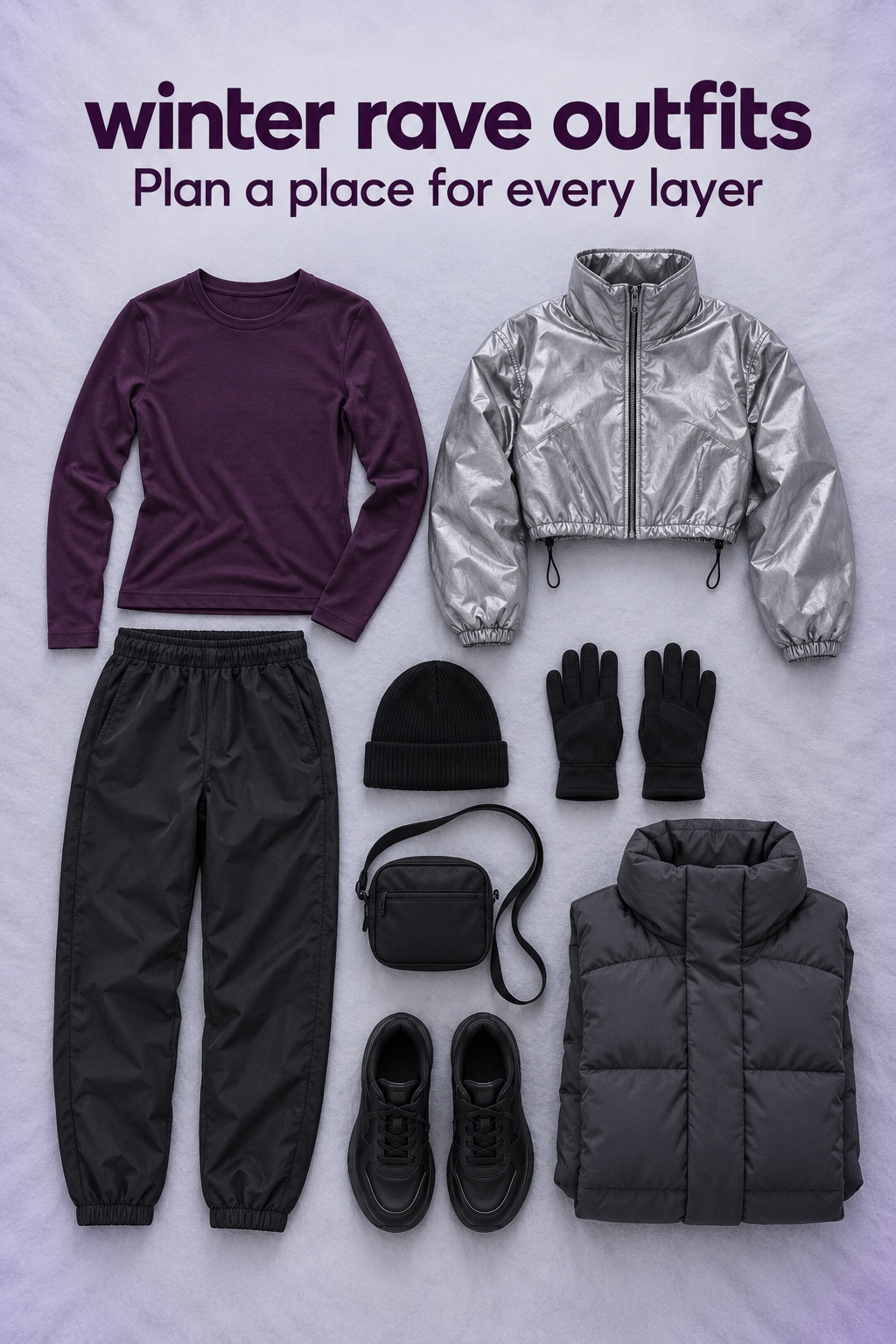
Start with an opaque plum long-sleeve crewneck top and black tapered track pants. Add a cropped silver front-zip jacket and black low-profile sneakers you already like wearing. The plum color gives the base outfit a point of view; the silver jacket adds another visible detail without requiring metallic pieces everywhere.
Wear a graphite padded coat for the journey when it is suitable for the conditions. Check the coat over the silver jacket before leaving, particularly at the shoulders and elbows. Once inside, put the coat in the confirmed storage service. Wear the silver jacket open or remove it if you prefer, using the additional storage arrangement you verified beforehand. The plum top and black trousers should still feel like a complete indoor outfit.
Look at the track-pant cuffs with the actual shoes. If the trousers expose more ankle than you want outside, choose a longer pair or suitable socks and different footwear for the route. Keep the shoe decision practical, even when the indoor version looks good in low-profile sneakers. The purpose of the tapered bottom is an uncomplicated outline, not a guarantee about warmth or traction.
Finish with a small zipped bag only if it meets the event rules. Try it across the plum top and under the open silver jacket. If the strap repeatedly catches at the collar or zip, change where it sits or choose another permitted arrangement. That small check is more useful than adding another accessory to make the outfit feel finished.
Cobalt and charcoal when you want fewer loose pieces
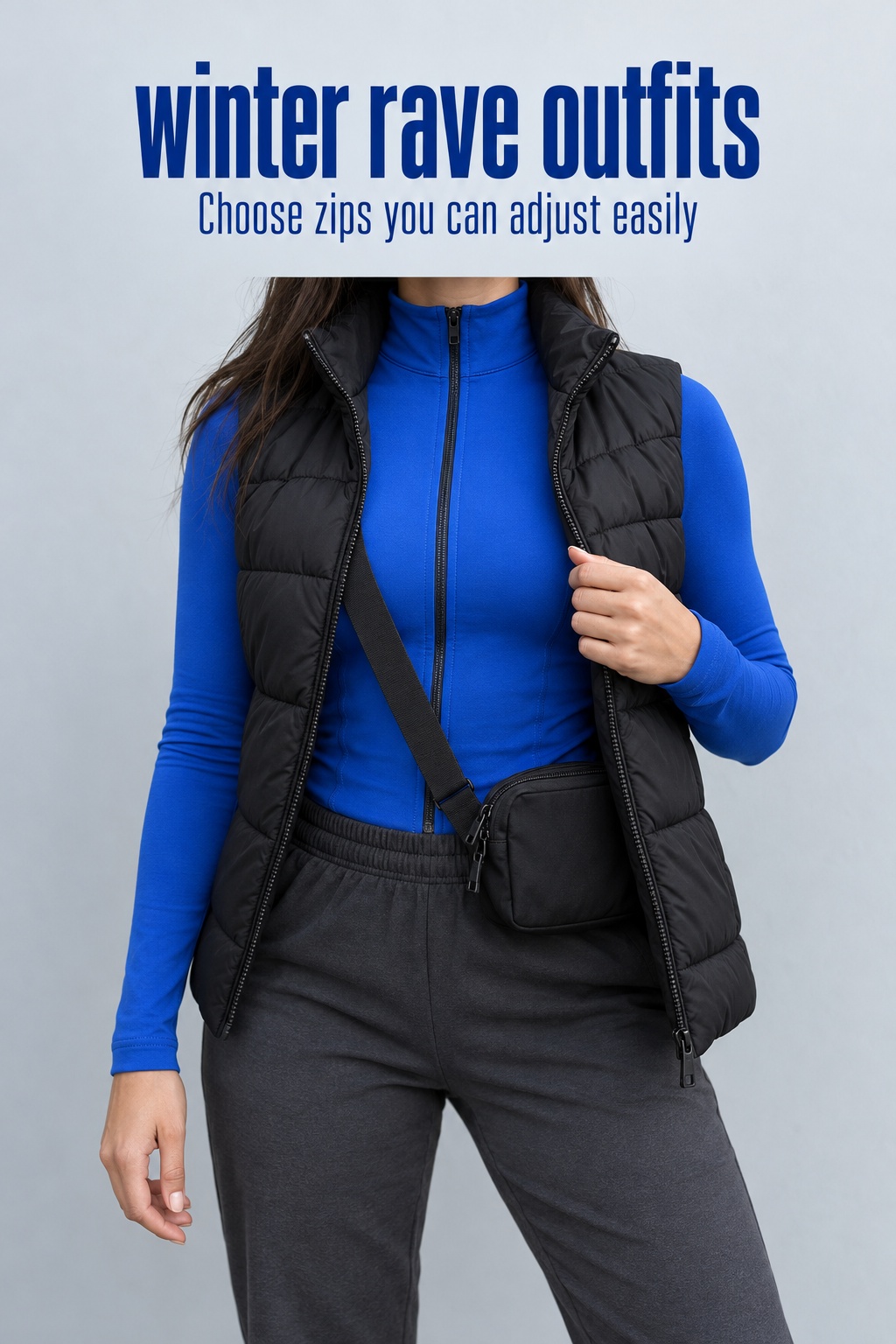
Wear an opaque cobalt zip-front long-sleeve top with charcoal tapered joggers. Add a black quilted vest as an optional indoor layer. The cobalt top remains the strong color even with the vest open, so the outfit does not depend on taking off a statement jacket to become interesting.
Try the two front openings separately. You might prefer the top zipped to a higher neckline with the vest open, or the vest removed once you are comfortable inside. Neither change requires pulling a garment over your head. If the vest has to come off, confirm that it can go in storage or into the permitted bag. If it cannot, leave it out of the indoor combination and keep the outdoor plan intact.
Use appropriate outerwear for the route and outdoor waits, such as a graphite hooded coat that accommodates the top and vest. For a colder outdoor portion, a cobalt beanie, gloves, and suitable covered footwear can complete the visible color relationship. Select those pieces for the actual conditions rather than assuming the example is enough everywhere.
For a night without storage, this outfit is only helpful if you can manage the outerwear you need. The front zips simplify the clothes on your body; they do not make the coat disappear. Carry it or wear it in the arrangement you tested, and choose a different plan if that becomes impractical. Fewer removable pieces help, but they do not remove the need to decide where each one goes.
Silver pleats and blue fleece for a variable indoor space
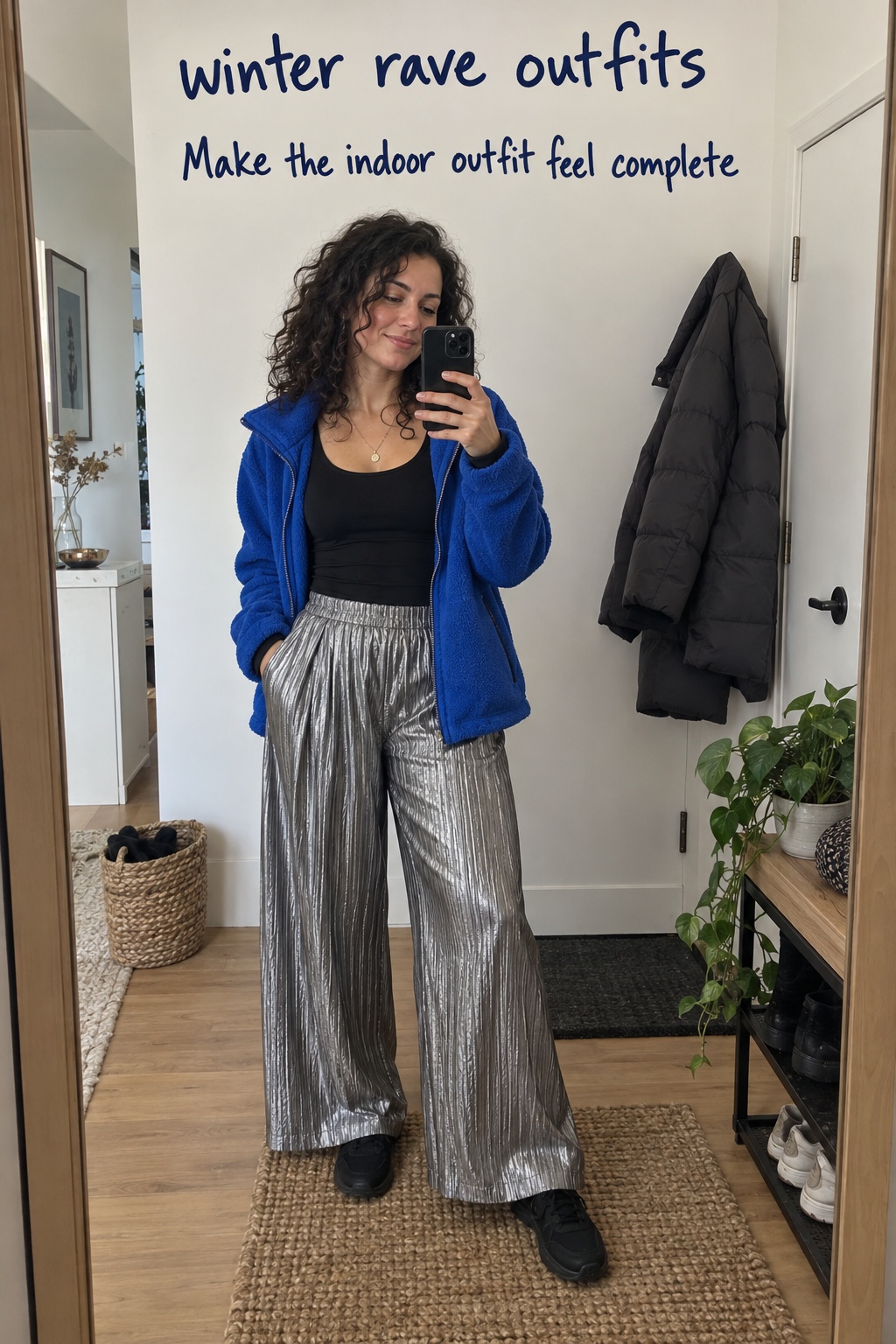
Combine silver pleated full-length trousers with an opaque black scoop-neck long-sleeve top. Add a bright blue zip fleece. Here, the trousers carry the shiny detail, so the outfit keeps its main visual idea whether the fleece is open, zipped, or removed. The black top provides a quiet center between the silver and blue.
Choose a trouser length that stays clear of the floor with your actual shoes. Pleats and a loose leg can look expressive without a hem dragging underneath the heel. Walk forward, step sideways, and turn in place. If the trousers catch, shorten the hem or choose another pair rather than relying on lifting them all night.
Wear your weather-appropriate coat for arrival. Use confirmed storage for it, and keep the blue fleece available if you expect to spend time in a cooler indoor area. If you remove the fleece, it needs its own storage place or a realistic fit inside the permitted bag. This is a layered indoor outfit, not an all-weather outdoor festival formula.
Keep the shoes and bag visually simple so the trousers can remain the main detail. If you want less shine, replace the silver trousers with plain dark ones and keep the blue fleece as the color focus. The problem-solving idea remains the same: the indoor outfit is complete, while the adjustable piece has a clear destination when it comes off.
Fix the small problems before the final set
The best time to discover a crowded sleeve, a bag that cannot close, or a hem that catches is at home. Put on the full outfit, including the coat and anything you will carry. Take a short movement test and then make the same layer changes you expect at the venue. That reveals practical issues the base outfit alone cannot show.
Your coat fits, but the sleeves feel crowded
If the coat feels tight over two layers, remove an unnecessary indoor piece from the plan or choose outerwear with room for the complete combination. Check the neckline, too. A high zip collar beneath a fleece collar and a coat collar may feel busier than you expected. You can keep the cobalt top as the main indoor garment and simplify what goes around it.
Do not solve the crowding by sizing every piece up automatically. Try different cuts and the actual combinations. A roomy coat over a close-fitting top might be comfortable where several overlapping boxy jackets are not. The question is whether the outfit moves well together, not whether each garment looks loose on its own.
The bag fits your essentials but not the removed layer
Pack it with the items you will need and add the folded layer. Can you close it and wear it comfortably? If not, remove the extra clothing from the indoor plan or arrange proper storage. A bag accepted at the entrance does not become larger just because the outfit needs a place for the fleece.
Keep the storage ticket and the items you need to leave accessible. Decide which pocket or compartment they belong in after the coat comes off. That simple arrangement can prevent a small layer change from becoming a search through several garments. Follow the event’s requirements for bags and belongings rather than assuming a particular bag style is universally allowed.
The outfit is comfortable inside, but the exit feels unfinished
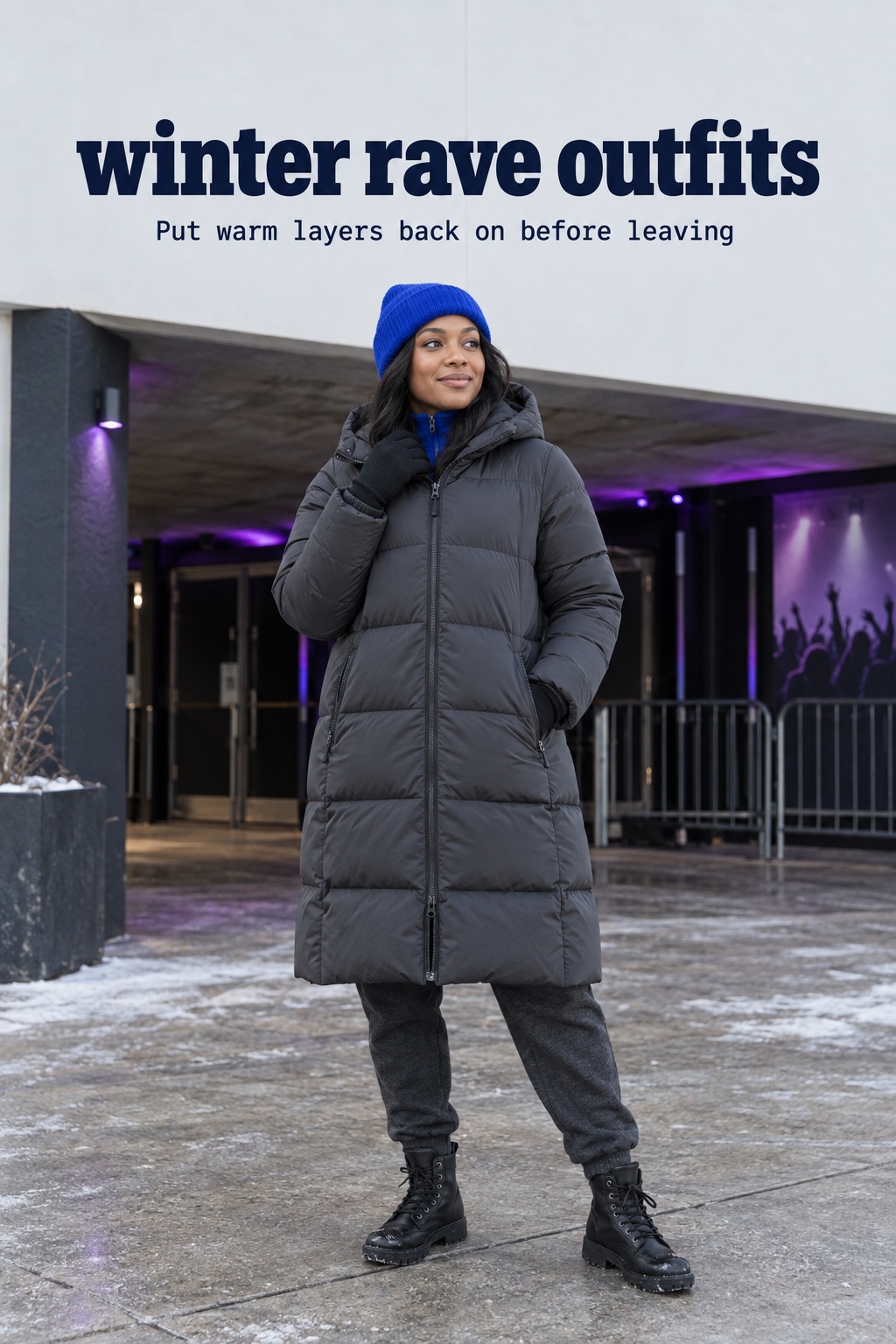
Retrieve your outerwear and put it back on before heading into the cold. Allow time for the storage service and transport arrangement, and keep the forecast for the later part of the night in mind. If clothing has become wet, follow the cold-weather guidance above and use an appropriate dry-clothing plan instead of treating it as a styling inconvenience.
You can keep the outfit expressive for the return without reopening the coat for a photo. The cobalt beanie, a visible collar, or silver trousers beneath suitable outerwear can provide that detail. The end of the night is part of the outfit’s job. A winter rave look is easier to enjoy when it also has an uncomplicated way home.
Sources and methodology
The outfit combinations are original styling suggestions. Research included the first ten organic Google US web results for the query, with retailer collections used to understand clothing options and the forum discussion used to identify recurring reader concerns. Product marketing was not treated as proof of comfort, insulation, or suitability for a specific forecast. The official venue FAQ supports one local storage example; National Weather Service guidance supports the limited cold-weather advice. No firsthand wear test, garment performance rating, or universal venue rule is claimed.
FAQ
What should I wear to an indoor rave in winter?
Choose an indoor top, bottoms, and shoes you can move in, then add an adjustable layer and appropriate outerwear for the route. Confirm where each removable piece will go. For example, a plum long-sleeve top, black track pants, and silver zip jacket can remain a complete indoor look after the winter coat is stored.
What can I do if the rave has no coat check?
Plan around keeping the outerwear you need with you, and reduce unnecessary removable pieces. Test carrying or wearing the coat with the full outfit and permitted bag. If that arrangement is not manageable, confirm a legitimate alternative or change the plan. Skipping essential winter clothing is not a workable storage solution.
Can I wear shorts or a short skirt to a winter rave?
They can be an indoor styling choice if that is what you want to dance in and the event permits it. Plan suitable coverage and outerwear for the journey, queue, and return separately. For an outdoor event or prolonged exposure, choose the clothing around the conditions rather than treating a short indoor outfit as the complete plan.
Do I need a separate jacket over my rave top?
Only if it serves a useful purpose. A front-zip top can provide an adjustment without another loose garment, while a silver jacket or blue fleece can change the visible outfit. Try the indoor combination without that layer first, then decide whether you need it and where it will go if you remove it.
What shoes work with winter rave outfits?
Use shoes you can comfortably move in and that suit the route and ground conditions. The indoor examples show low-profile sneakers and flat lace-up boots as styling options. Check them with the actual trousers and socks, and change the shoe choice when the outdoor conditions require something different. A dramatic appearance does not establish practical suitability.
Are the same outfits suitable for an outdoor winter rave?
The indoor examples need a separate outdoor plan. For an outdoor event, choose covered clothing, appropriate insulation, outerwear, and footwear for the forecast and time outside. Keep your preferred color or shine in the pieces that remain visible. Do not assume you will remove the coat for the whole event just because you are dancing.