Modern hippie mom style: Breezy Layers, Clean Lines, Polished Days
Hippie mom style, decoded for real life
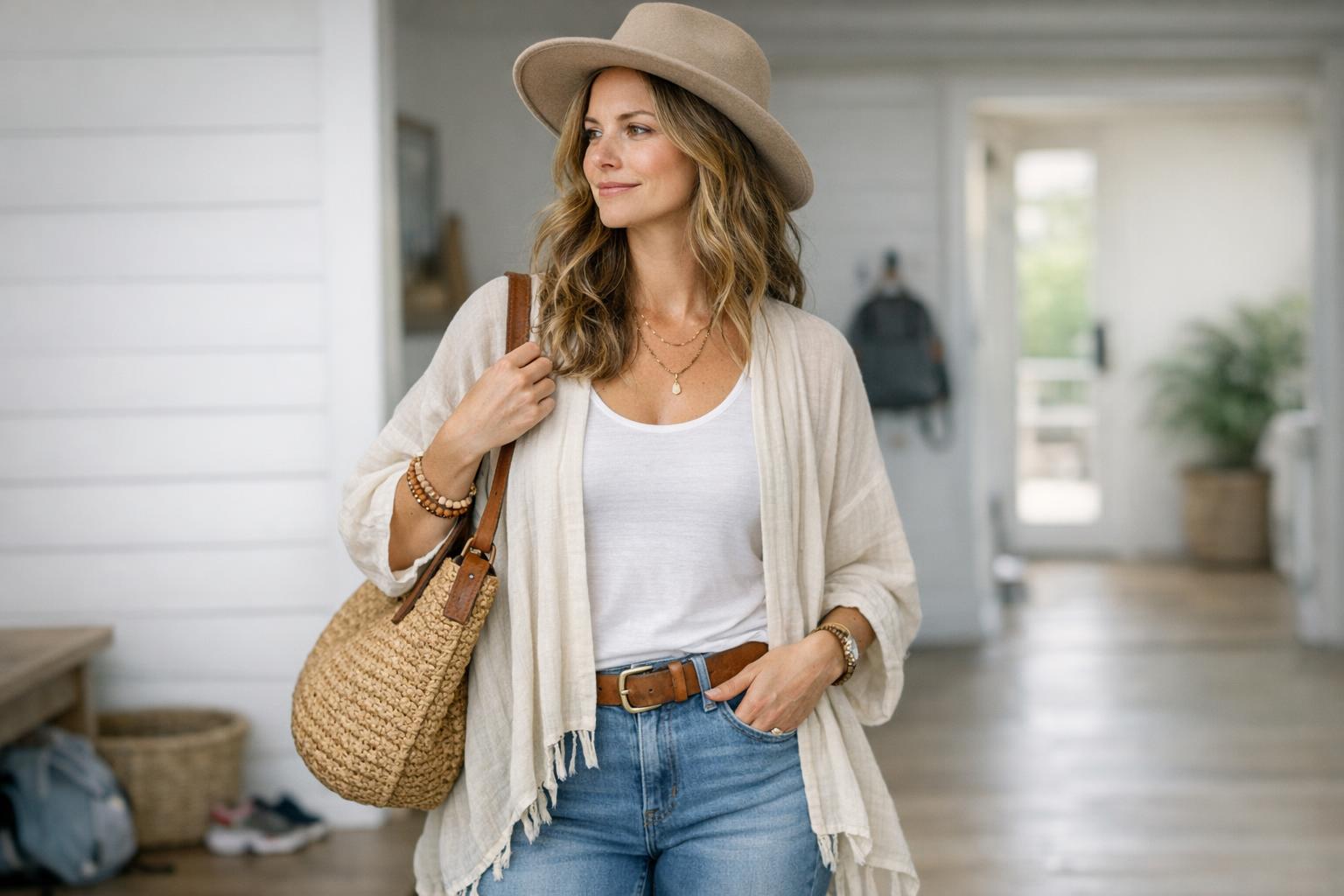
The “hippie mom style” search usually isn’t about costumes or nostalgia—it’s about solving a daily outfit equation with a specific mood: relaxed, expressive, and practical enough for real schedules. The challenge is keeping the look intentional rather than chaotic, especially when comfort and movement matter. That’s where the style logic comes in: thoughtful silhouette balance, texture contrast, and a palette strategy that makes easy pieces look styled on purpose.
This guide breaks down the hippie mom aesthetic as an outfit system: how to build it from a few repeatable components, how to adjust it for pregnancy and postpartum comfort, and how to avoid the most common composition mistakes that can make “boho mom” read messy instead of elevated. You’ll also see how to translate hippie mom outfits into different contexts—school drop-off, errands, weekends, and casual gatherings—without losing the relaxed spirit that defines the look.
What “hippie mom aesthetic” actually means in outfit composition
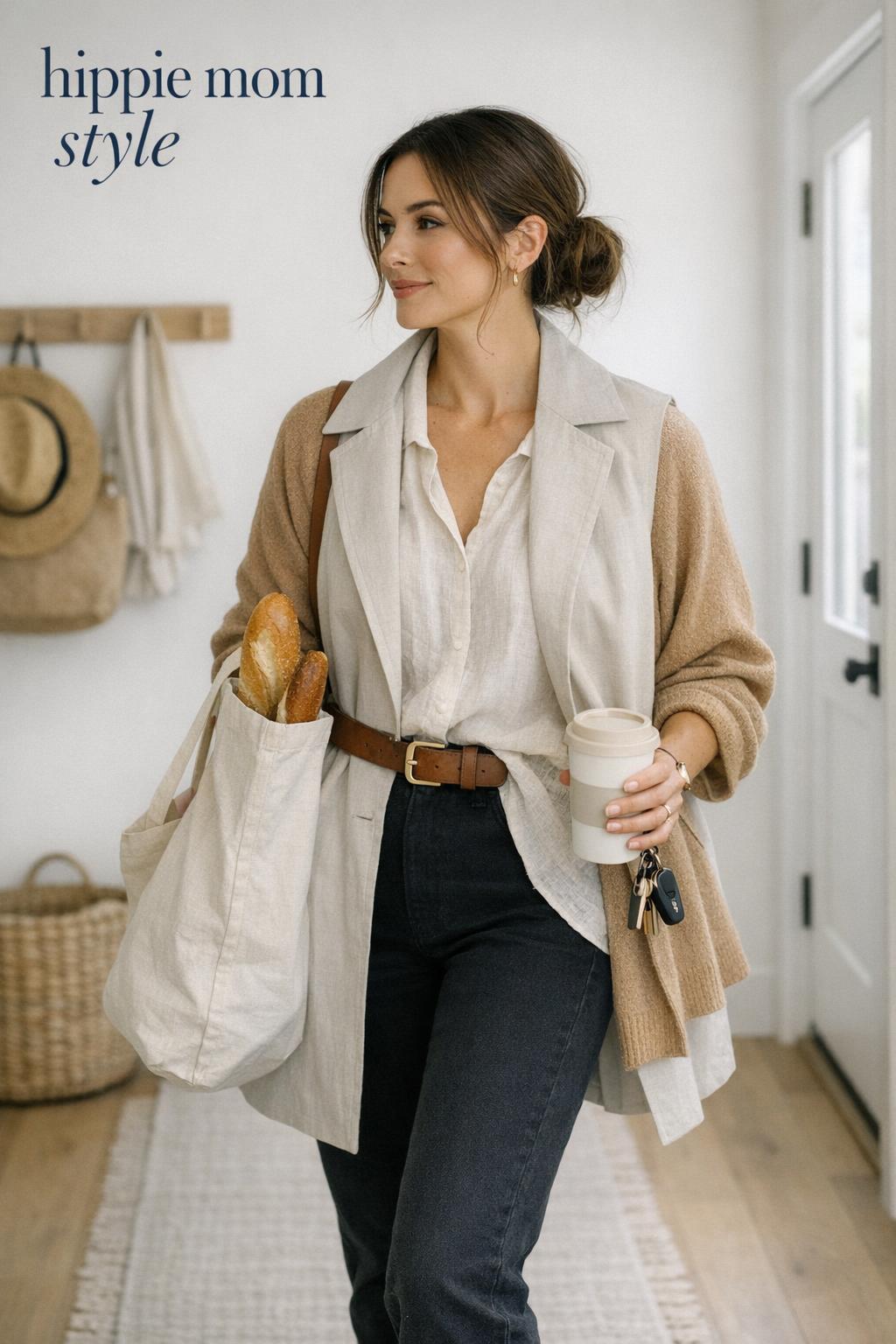
The hippie mom aesthetic is best understood as a styling framework: soft silhouettes anchored by one or two visual structures, natural-feeling textures, and a sense of ease that still looks assembled. It overlaps with the boho mom lane, but the “hippie” side typically leans more relaxed and free-form, while “boho” can skew more polished or curated depending on the pieces you choose.
To make hippie mom style look modern and wearable, treat it like an outfit composition problem: you’re building a shape, then selecting textures and color harmonies that support that shape. When the silhouette is intentional, the aesthetic reads effortless. When the silhouette is accidental, the same pieces can feel bulky, sloppy, or overly busy.
Found the dress? Keep the rest in one place.
Zarellea brings guest details, vendors, timelines, and every next step together — so your wedding plan feels as good as your look.
The three anchors that keep hippie mom outfits looking intentional
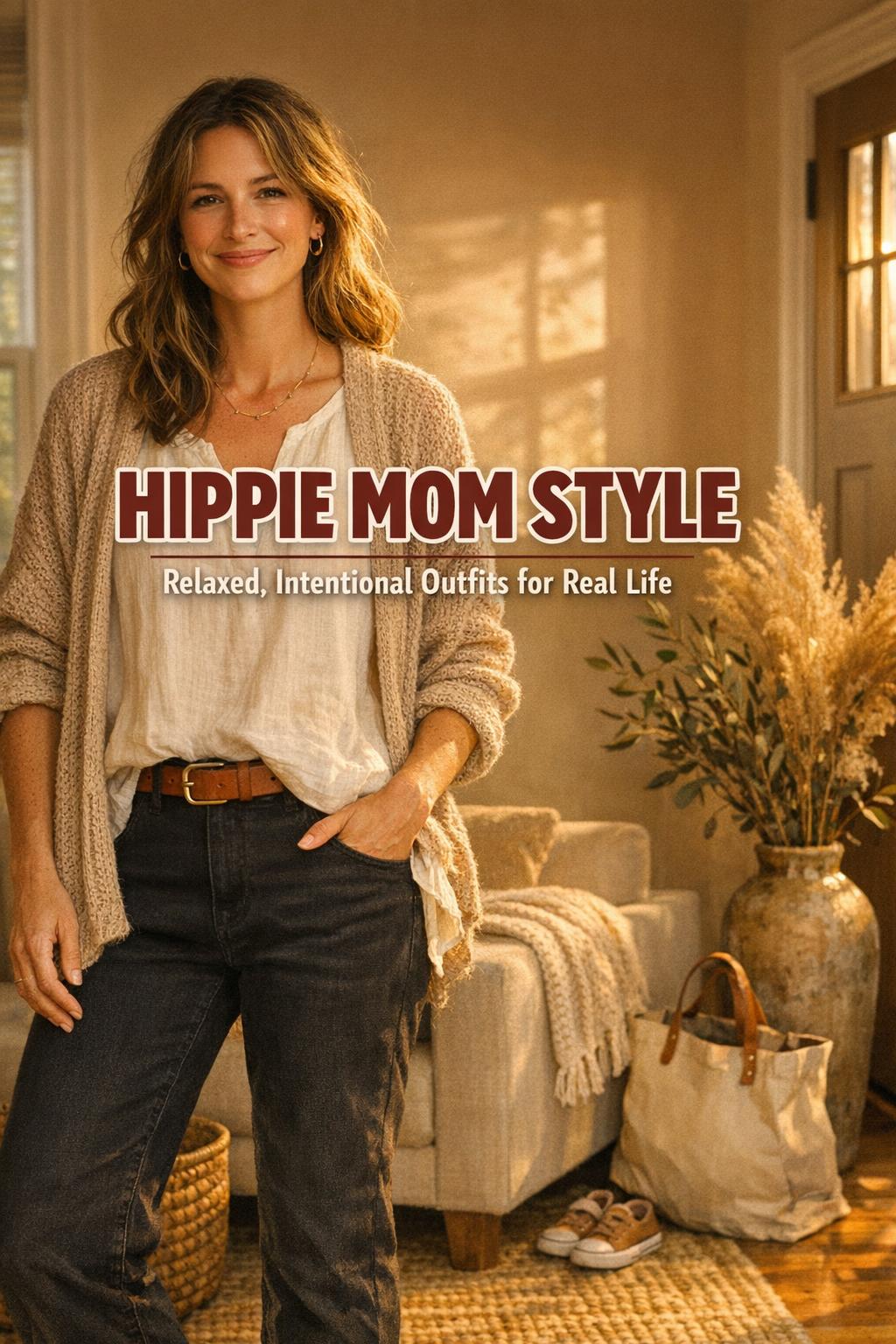
Most successful hippie mom outfits rely on a simple anchoring strategy: (1) one “volume” piece, (2) one “line” piece, and (3) one “finish” detail. The volume piece is where the flow happens (a loose top, a draped layer, a fuller skirt). The line piece gives definition (a slimmer pant, a fitted tee, a more tapered base). The finish detail is the styling signal that makes the look feel deliberate (a belt moment, a consistent color story, or a repeating texture).
- Volume: creates movement and that relaxed hippie mom aesthetic.
- Line: prevents the outfit from becoming shapeless.
- Finish: makes it feel styled, not accidental.
Core building blocks of hippie mom style (and why they work)
Think of hippie mom style as modular: a small wardrobe set that mixes into many combinations. The goal isn’t to own “more boho”; it’s to own the right shapes and textures that can be remixed while still reading cohesive.
Flow tops + clean bases: the silhouette formula that flatters and moves
A flowing top paired with a cleaner base is the easiest route to balanced proportion play. The top supplies the soft, free-spirited energy associated with hippie mom outfits. The base creates a visual line from hip to ankle (or knee) so the overall silhouette doesn’t lose structure.
Why it works: the eye gets one area of movement and one area of clarity. That contrast is what makes the aesthetic feel modern and wearable, not costume-like.
Tonal layering: the fastest way to look “styled” without trying hard
Tonal layering means keeping colors within the same family so the outfit reads cohesive even when textures vary. This is especially effective for a hippie mom aesthetic because the look often includes multiple pieces—layers, accessories, and mixed materials. Tonal dressing prevents visual noise.
Why it works: when your palette stays controlled, you can go bigger on texture contrast—soft knits against a crisp base, or a drapey layer over a simple foundation—without the outfit feeling busy.
Texture contrast: the “editorial” lever in boho mom outfits
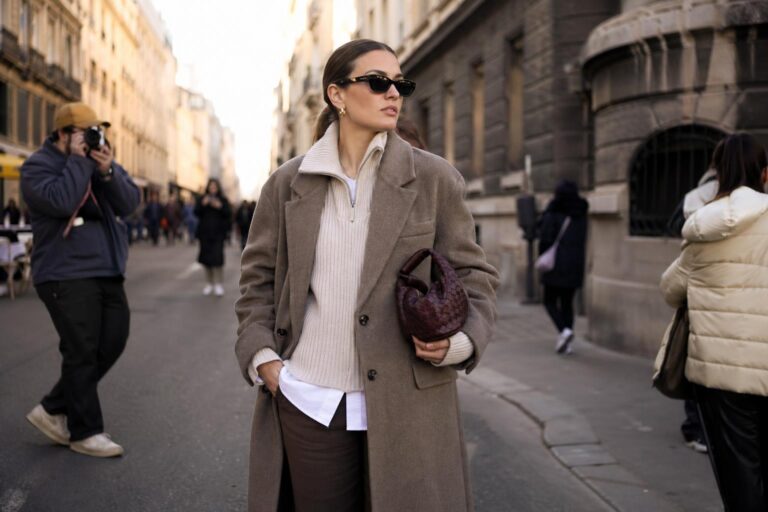
Hippie mom style is rarely about sharp tailoring; it’s about tactile richness. The editorial move is to combine textures with different “weights” so the outfit has depth. A soft, slouchy element reads intentional when it’s paired with something slightly firmer, cleaner, or more streamlined.
Why it works: texture contrast adds dimension without needing loud prints or complicated styling. It’s also forgiving for body changes and daily movement—two realities many moms are dressing for.
Hippie mom outfits for a week of real schedules
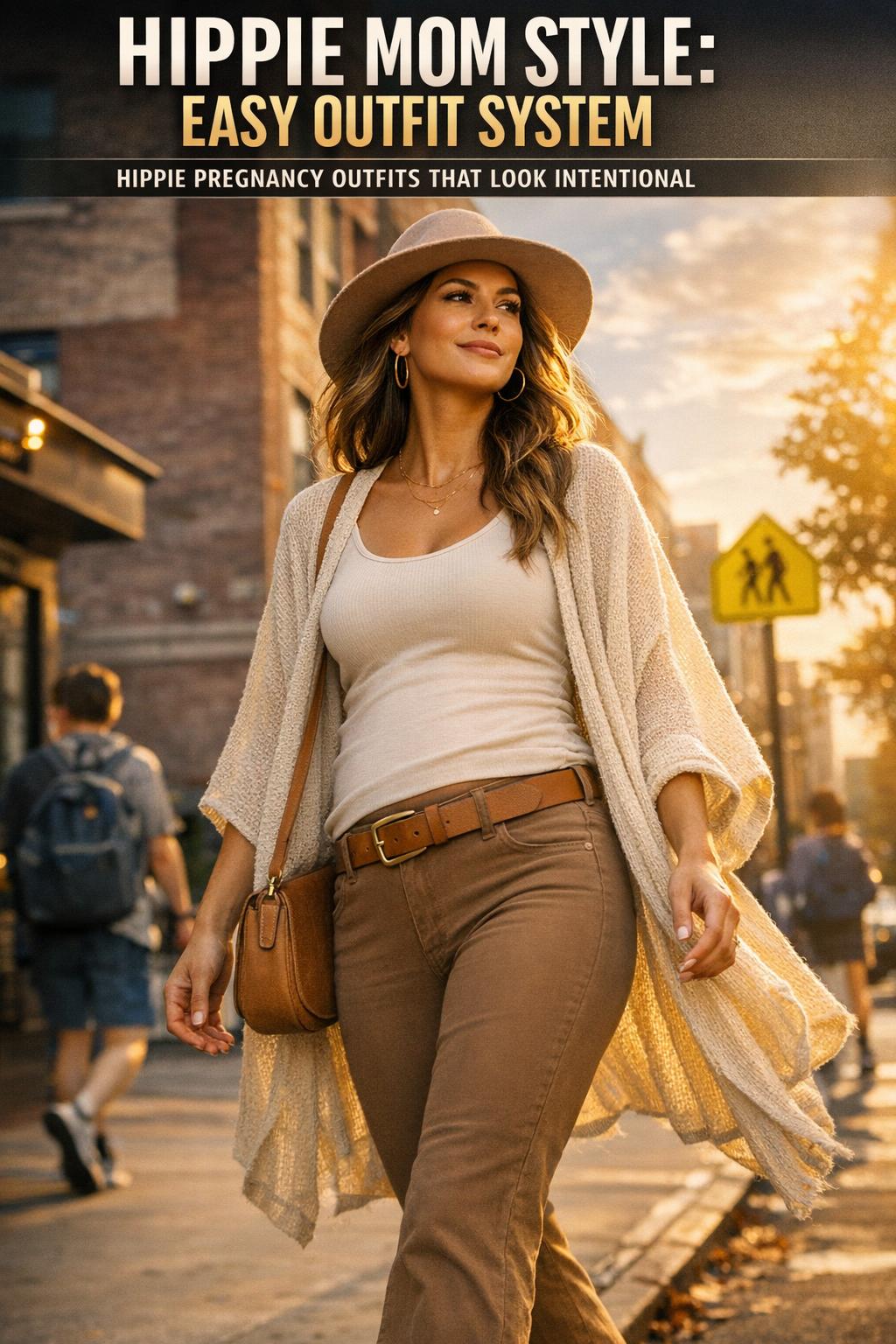
The best hippie mom outfits work across errands, school runs, casual meetings, and weekend plans. Instead of listing “looks,” the sections below show repeatable outfit structures you can adapt with what you already own. Each one is built around a clear visual anchor so the style reads consistent, not random.
The “soft volume + sharp base” errand uniform
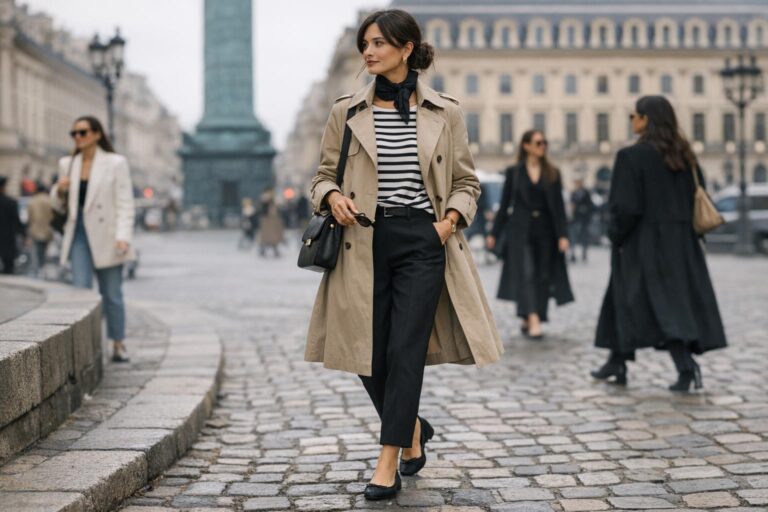
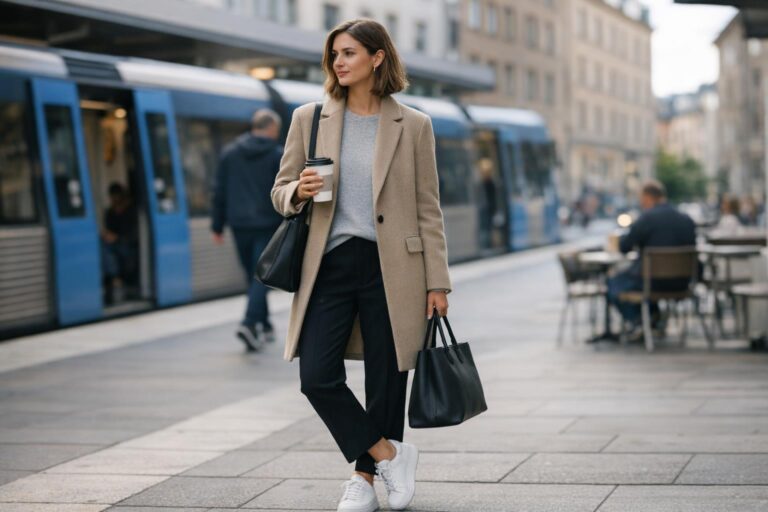
This is the most practical hippie mom style formula: a relaxed top layer that creates movement, anchored by a slimmer base that’s easy to walk in. The base keeps the outfit from feeling bulky and helps the overall silhouette photograph well (a common Pinterest-driven priority) while still being comfortable.
Why this outfit works: the volume sits up top where it feels breezy and forgiving, while the bottom half remains streamlined for mobility. The result reads purposeful, not oversized.
The “tonal set” approach for instant hippie mom aesthetic
A tonal set—two pieces that share a similar color direction—does heavy lifting for busy mornings. Even when the shapes are relaxed, the palette creates cohesion. This is one of the most efficient ways to make boho mom dressing look elevated without leaning on statement prints.
Why this outfit works: tonal continuity creates a clean vertical line, which is especially helpful if you’re working with looser fits. It’s also easy to accessorize without the outfit turning visually crowded.
The “one statement layer” school-drop-off solution
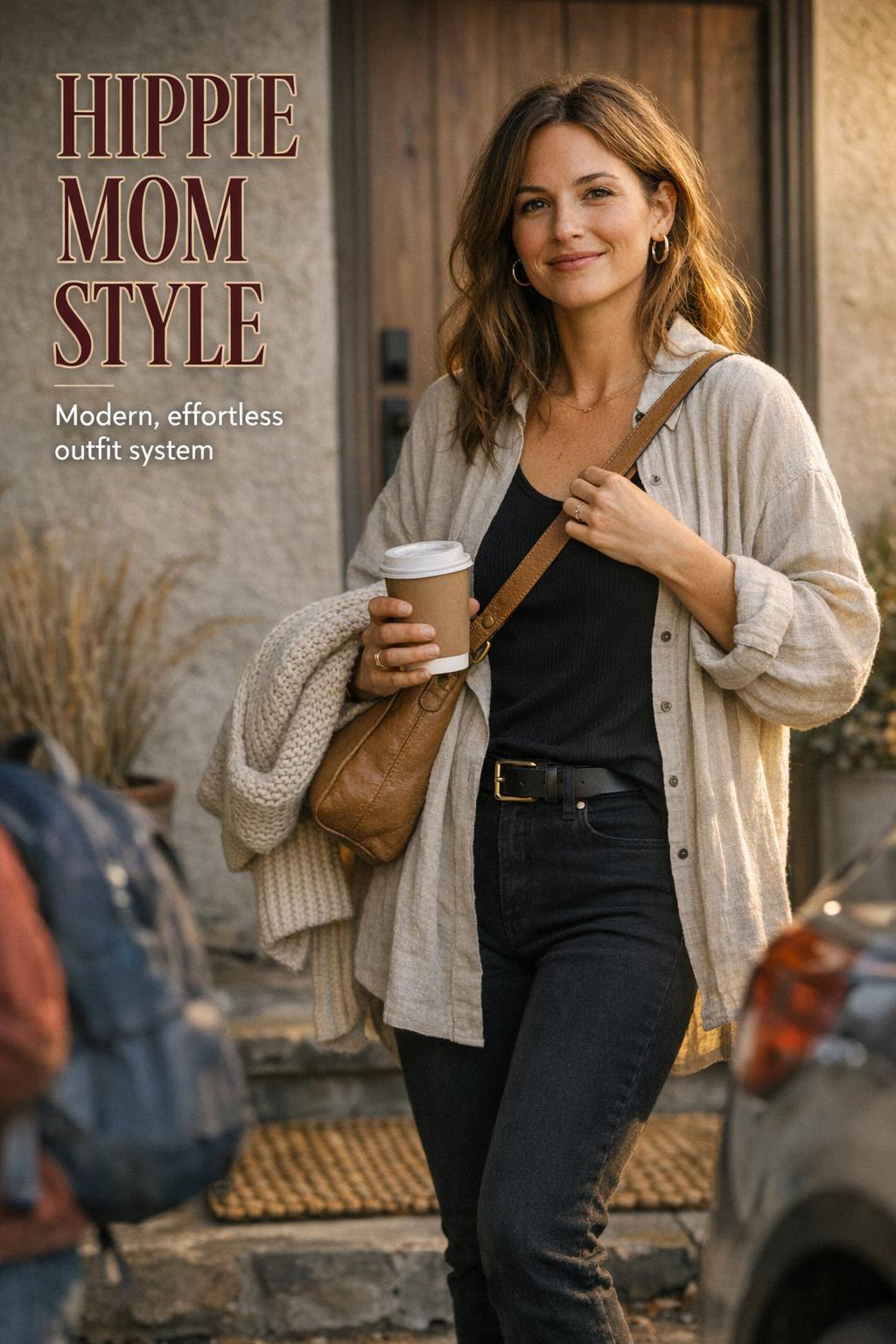
In hippie mom outfits, the statement layer is often what communicates the vibe—while the rest stays simple. The key is to keep the base minimal so the layer can act as the visual anchor. This also makes the outfit easy to adjust for changing temperatures during the day.
Why this outfit works: the statement piece carries the aesthetic signal, but your base remains functional. You get style impact with minimal complexity.
Hippie mom outfits for a week of real schedules
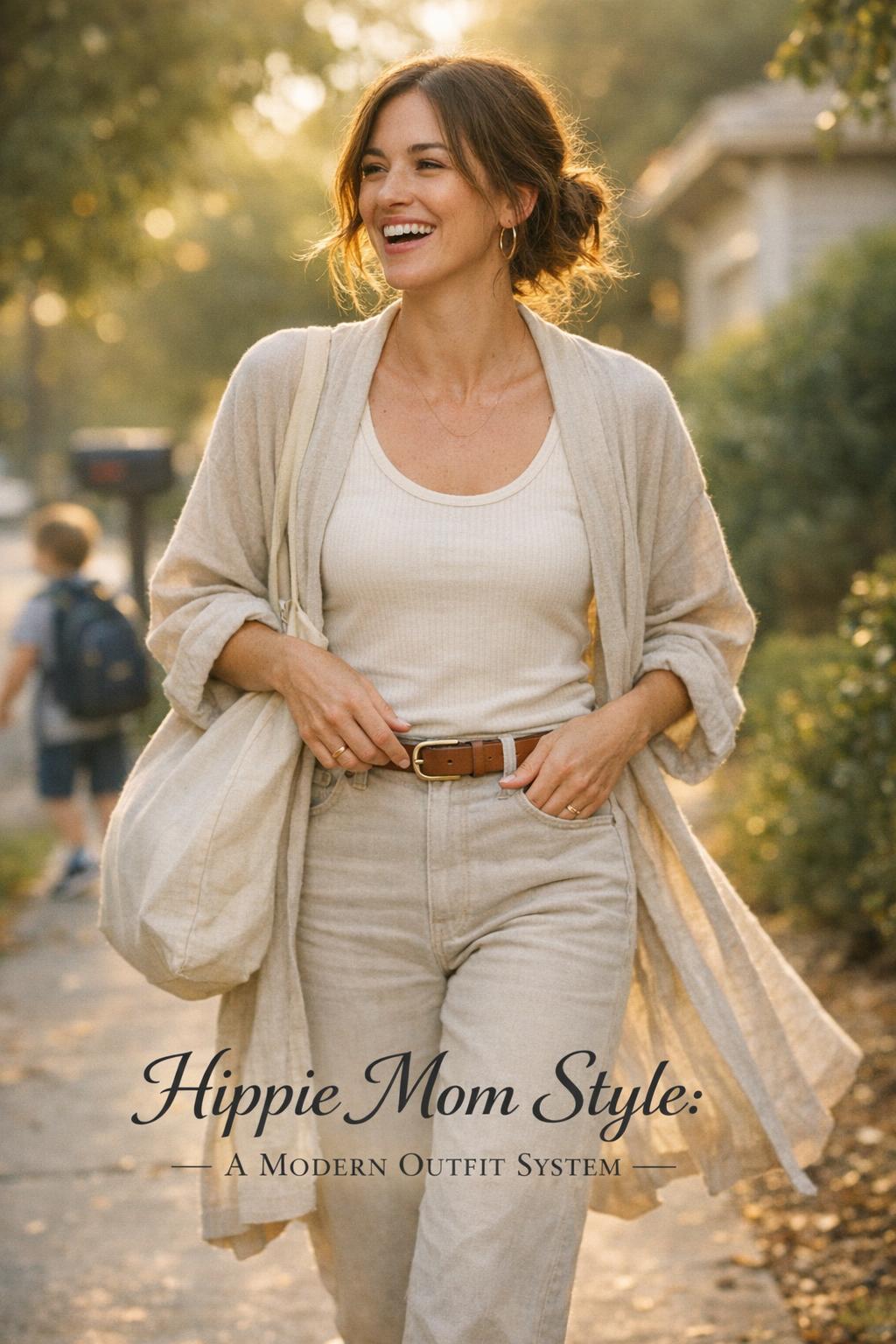
The best hippie mom outfits work across errands, school runs, casual meetings, and weekend plans. Instead of listing “looks,” the sections below show repeatable outfit structures you can adapt with what you already own. Each one is built around a clear visual anchor so the style reads consistent, not random.
The “soft volume + sharp base” errand uniform
This is the most practical hippie mom style formula: a relaxed top layer that creates movement, anchored by a slimmer base that’s easy to walk in. The base keeps the outfit from feeling bulky and helps the overall silhouette photograph well (a common Pinterest-driven priority) while still being comfortable.
Why this outfit works: the volume sits up top where it feels breezy and forgiving, while the bottom half remains streamlined for mobility. The result reads purposeful, not oversized.
The “tonal set” approach for instant hippie mom aesthetic
A tonal set—two pieces that share a similar color direction—does heavy lifting for busy mornings. Even when the shapes are relaxed, the palette creates cohesion. This is one of the most efficient ways to make boho mom dressing look elevated without leaning on statement prints.
Why this outfit works: tonal continuity creates a clean vertical line, which is especially helpful if you’re working with looser fits. It’s also easy to accessorize without the outfit turning visually crowded.
The “one statement layer” school-drop-off solution
In hippie mom outfits, the statement layer is often what communicates the vibe—while the rest stays simple. The key is to keep the base minimal so the layer can act as the visual anchor. This also makes the outfit easy to adjust for changing temperatures during the day.
Why this outfit works: the statement piece carries the aesthetic signal, but your base remains functional. You get style impact with minimal complexity.
Hippie pregnancy outfits: comfort-first, still styled
Hippie pregnancy outfits make sense because the aesthetic naturally supports comfort, movement, and softer silhouettes. The pitfall is letting “flowy” become “unbalanced.” The most flattering hippie mom style during pregnancy comes from controlling proportion and choosing details that create structure without pressure.
Where to place definition when your body is changing
During pregnancy, definition doesn’t need to mean tightness. It means giving the eye a clear focal point—often slightly above the bump or through a vertical line created by layering. A controlled focal point keeps a flowing outfit from reading like one uninterrupted volume.
Why it works: the outfit gains shape while still feeling breathable. The hippie mom aesthetic stays intact because the flow remains present, but it’s guided.
Fabric behavior matters more than trend
For hippie pregnancy outfits, fabric behavior is a practical consideration: how it drapes, whether it clings, and how it moves when you sit, bend, or carry items. Soft drape can be beautiful, but too much cling can make an otherwise relaxed look feel fussy. On the other hand, overly stiff fabric can look bulky when layered.
Styling logic: prioritize fabrics that skim rather than hug, and balance them with at least one piece that offers a cleaner line. This keeps the outfit composition polished without sacrificing comfort.
Practical tip: build “expanding outfits” with adjustable points
For pregnancy and postpartum, the most useful hippie mom outfits are the ones with adjustable points—areas that can accommodate change without requiring a new outfit strategy. Focus on pieces that allow easy fit shifts through the waist, neckline, or layering approach.
- Use layering to create vertical lines that elongate visually.
- Keep one area structured (a clean base or a defined top line) to prevent full-volume overwhelm.
- Repeat one texture or tone to maintain cohesion even as you size up or down.
Boho mom vs. hippie mom style: the difference is in the finish
In everyday use, “boho mom” and “hippie mom style” often overlap, but the difference shows up in the finishing choices. Boho mom styling typically looks more curated: a clearer “outfit idea,” slightly more polish, and more consistent coordination. Hippie mom aesthetic tends to look freer: softer structure, more relaxed layering, and a less glossy finish overall.
Neither is better—what matters is aligning your outfit composition with your day. When you need to look more “pulled together,” shift toward boho mom finishing. When comfort and ease are the priority, lean into hippie mom looseness but keep one anchor so it still reads intentional.
How to choose your finish level based on context
The context cue is simple: if you’ll be indoors and still (casual lunch, school event), you can carry more volume and detail. If you’ll be outdoors, moving, or juggling multiple tasks, keep the base simpler and let one element do the aesthetic work.
- More boho mom: tighter palette control, fewer competing textures, clearer silhouette.
- More hippie mom: softer structure, relaxed drape, a slightly undone finish that still looks cohesive.
Color strategy for hippie mom style (so it doesn’t look chaotic)
Color is where many hippie mom outfits succeed or fail. The aesthetic can handle pattern and variety, but it needs a governing logic. Without one, the outfit reads visually loud even when the pieces are individually beautiful.
The “one-strong, two-soft” palette rule
A practical way to keep the hippie mom aesthetic cohesive is to build around one stronger color moment and support it with two softer tones. The stronger color becomes the statement piece; the softer ones prevent the look from feeling costume-like. This makes the outfit feel curated while still relaxed.
Why it works: the eye knows where to land. The outfit reads expressive, but not scattered.
When monochrome is your best friend
Monochrome is a quiet power move in hippie mom style. Because the aesthetic can include layered pieces and tactile fabrics, keeping the color in a narrow range makes room for texture contrast and proportion play. It’s also a fast path to looking “done” when you don’t have time to coordinate.
Practical note: monochrome doesn’t mean identical shades. Slight tonal shifts add depth and prevent the outfit from looking flat.
Common hippie mom outfit mistakes (and what to do instead)
Because hippie mom outfits often prioritize comfort, it’s easy to accidentally remove all structure. The result can look heavy, overly layered, or visually noisy. These are fixable issues—usually with one small adjustment that reintroduces a clear focal point.
Mistake: volume everywhere
When both the top and bottom are oversized without a visual anchor, the silhouette loses intention. Instead, keep one area relaxed and one area cleaner. If you want full flow, create definition through a strong vertical line using layering or a consistent tonal palette.
Mistake: too many textures competing
Texture contrast is a strength of the hippie mom aesthetic, but too many competing textures can feel busy. Edit down to two main textures, then repeat one element (tone or material feel) to unify the look.
Mistake: accessories without hierarchy
Accessories work best when they have a job: either they provide a focal point or they reinforce the outfit’s palette. If every accessory is a statement, none of them are. Choose one statement detail and let everything else support it.
Where hippie mom style performs best: setting-based guidance
The same hippie mom aesthetic can read different depending on setting. Location and activity determine how much layering is practical, how much volume is comfortable, and whether you need a cleaner finish. Treat this as “context styling,” not “trend dressing.”
Outdoor days: prioritize movement and manage layers
For outdoor errands, park time, or walking-heavy days, hippie mom style works best when you reduce fuss. Keep the base stable—something you can move in—and let one layer deliver the aesthetic. Too many loose layers can shift while you move, making the outfit feel distracting instead of effortless.
Indoor casual events: add a “finish” detail for polish
For indoor settings where you’ll be seen up close—casual dinners, school events, meetups—the hippie mom aesthetic benefits from one clean finishing element. That could be tonal coordination, a more defined silhouette line, or a deliberate statement piece that reads as intentional styling rather than just comfort dressing.
Tips that make hippie mom style feel elevated, not costume-y
Hippie mom style becomes modern when the outfit looks edited. The goal is not to remove personality—it’s to give personality a structure. The tips below focus on styling levers you can use immediately.
Tip: choose one “hero” idea per outfit
A hero idea is the element that tells the story of the look: a statement layer, a strong tonal palette, or a single dramatic silhouette. When you pick one hero, everything else becomes support. This is the fastest way to make hippie mom outfits feel intentional.
Tip: use a clean base to protect the aesthetic
A clean base—simple shapes, minimal visual clutter—keeps the hippie mom aesthetic from tipping into “too much.” Even if the top layer is expressive and free, a calmer base creates balance and keeps the overall outfit composition wearable for everyday life.
Tip: repeat a detail to create cohesion
Repeating one detail is a stylist’s trick for cohesion: echo a tone, echo a texture, or echo a silhouette line. The repetition makes the outfit feel designed. This matters most when you’re layering, because layers can quickly read random if nothing links them.
- Repeat a tone across two pieces to unify the palette.
- Repeat a texture family to add depth without chaos.
- Repeat a silhouette line (long-over-long, short-over-long) to make layering look intentional.
How to build a small “hippie mom style” capsule without overbuying
A capsule approach works especially well for hippie mom style because the aesthetic relies on remixing. When your closet has too many statement pieces without enough anchoring basics, outfits become harder to build. A tight capsule solves this by ensuring every expressive piece has something clean to pair with.
The capsule logic: anchors first, statements second
Start with anchors that stabilize silhouette and palette, then add a smaller set of statement pieces that carry the hippie mom aesthetic. This reduces decision fatigue and makes hippie mom outfits feel consistent day to day.
- Anchor pieces: clean bases, simple layers, and tones you can repeat.
- Statement pieces: one or two flow-forward items that provide movement and personality.
- Finish elements: the details that make outfits look assembled rather than thrown on.
Trade-off to know: a capsule can feel repetitive if every piece has the same silhouette. Keep variety through proportion play—mix a longer layer with a shorter one, and keep at least one alternative silhouette so outfits don’t blur together visually.
FAQ
What is hippie mom style in simple terms?
Hippie mom style is a relaxed, expressive way of dressing built on soft silhouettes, tactile textures, and an easygoing finish, but it looks best when it includes one clear anchor—either a streamlined base, a controlled palette, or a single statement layer—to keep the outfit composition intentional.
How do I keep hippie mom outfits from looking sloppy?
Prevent sloppiness by balancing volume with a clean line (flowy top with a streamlined base), limiting competing textures to two main families, and choosing one “hero” element so the rest of the outfit supports it rather than fighting for attention.
What’s the difference between boho mom and hippie mom aesthetic?
They overlap, but boho mom styling typically looks more curated and polished through tighter color control and clearer silhouette structure, while hippie mom aesthetic leans freer and softer with a more relaxed finish—both work when the outfit still has an intentional anchor.
How can I do hippie pregnancy outfits without feeling too bulky?
Use one area of definition without tightness—like a visual focal point above the bump or a vertical line created by layering—then keep either the top or the bottom cleaner so you avoid full-volume layering that makes the silhouette feel heavy.
What’s the easiest color approach for hippie mom style?
The easiest approach is tonal layering or a simple “one-strong, two-soft” palette, because controlled color makes room for texture contrast and layering without the outfit turning visually chaotic.
How do I make the hippie mom aesthetic work for busy days?
For busy days, keep the base stable and minimal for movement, then let one statement layer or one strong palette idea carry the vibe, which delivers the hippie mom aesthetic without requiring complex layering or constant adjusting.
Can I build hippie mom style with a small wardrobe?
Yes—hippie mom style works well as a capsule if you prioritize anchor pieces first (clean bases and repeatable tones) and then add a smaller set of expressive statement items, so you can remix outfits while keeping silhouettes balanced and cohesive.
What’s the biggest mistake people make with hippie mom outfits?
The biggest mistake is stacking volume everywhere—loose top, loose bottom, and multiple drapey layers—without a visual anchor; correcting it usually takes just one change, like streamlining the base or tightening the palette so the outfit regains a clear structure.