Streetwear vs Drip Style vs Drip Fit: NYC Styling Decode
Drip style vs. streetwear vs. “drippy” hype: why these looks get blended together
Scroll through fit pics, street-style posts, or a quick group chat outfit check and you’ll see the same words recycled: drip style, streetwear, and “drippy outfit.” They’re often used as if they mean the same thing—especially when the look includes bold branding, a sharp sneaker choice, and a confident, camera-ready attitude. But these labels aren’t interchangeable. They point to different styling priorities, different “rules” of outfit composition, and different ways of signaling taste.
This breakdown compares drip style with two adjacent approaches that frequently get bundled into it: classic streetwear styling and the more trend-driven “drip fit” (the kind of outfit built for immediate impact). You’ll learn what defines each, where the visual overlap happens, and how to choose the right approach for your wardrobe and the situation—whether you’re building male drip outfits, dialing in nyc drip for city days, or trying to understand why some thug fits read intentional while others feel costume-like.
Because “drip” is used as slang for style, the most helpful way to understand it is to treat it like a styling concept—an emphasis on curated impact—rather than a single fixed aesthetic. That shift makes it easier to compare it to streetwear (a broader category) and to drippy, hype-forward outfits (a narrower, more moment-driven expression).
Style overview: drip style (as a styling concept)
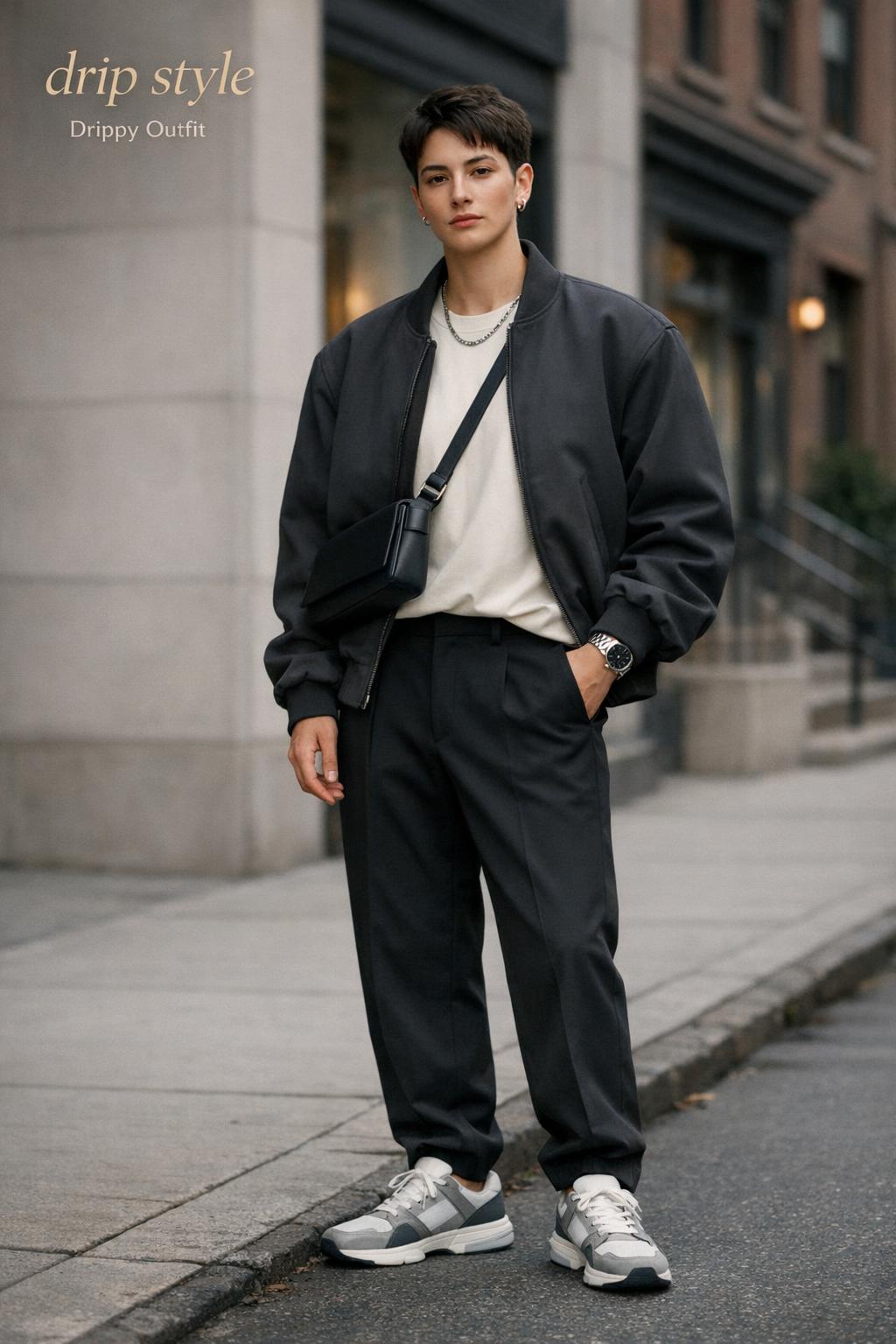
Drip style is best understood as a results-focused styling mindset: the outfit is designed to read “put together” at a glance, often through statement elements and a deliberate finish. The goal is visual authority—an impression of confidence and taste—rather than quiet neutrality. This is why drip style travels across subcultures; it can be expressed through streetwear staples, elevated basics, or more aggressive, harder-edged styling.

Found the dress? Keep the rest in one place.
Zarellea brings guest details, vendors, timelines, and every next step together — so your wedding plan feels as good as your look.
Defining characteristics: intentional coordination, noticeable focal points, and a controlled level of “loud.” The look tends to use at least one visual anchor—footwear, outerwear, accessories, or bold graphic elements—to make the outfit feel like a complete composition rather than separate pieces.
Typical silhouettes: a mix of relaxed and structured proportions—often oversized on top with cleaner lines below, or the reverse. The silhouette usually aims for presence: either wider shapes that own space, or sharp fits that look engineered.
Color palette: flexible. Drip style can be tonal and restrained or high-contrast and punchy. What matters is that the palette looks deliberate, not accidental.
Fabrics and textures: the texture story matters. A “drippy outfit” often wins through contrast—matte vs. glossy, heavy vs. smooth—because texture is one of the fastest ways an outfit reads premium and considered.
Overall mood: confident, curated, attention-aware. Drip is more about the visual message than the historical purity of a style category.
Style overview: streetwear (as a broad wardrobe category)
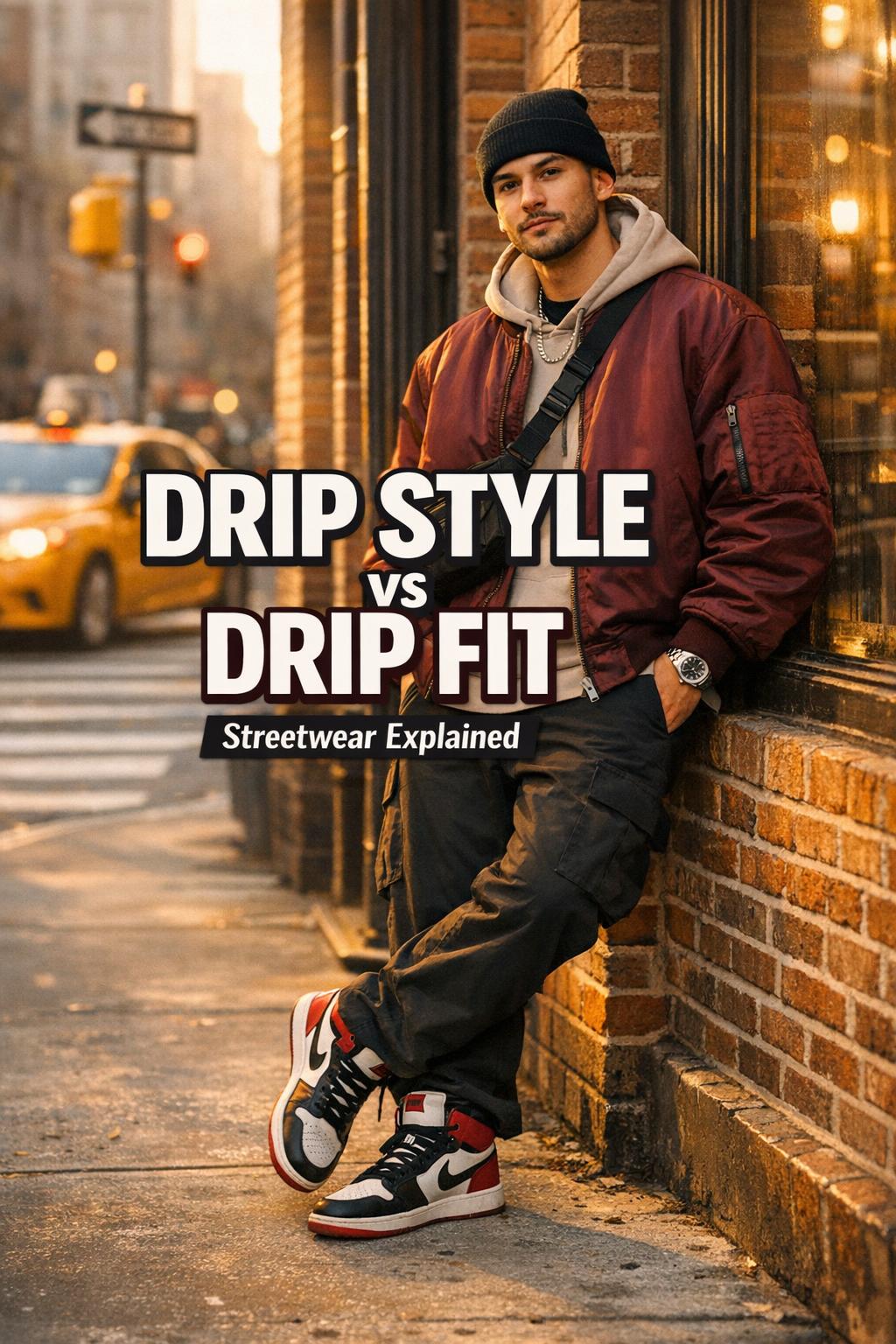
Streetwear is a wide umbrella: casual, urban-rooted clothing that’s often built around comfort, repeat wear, and recognizable staples. Streetwear can be minimal or maximal, luxury-leaning or budget-friendly, and it can be deeply personal. What unifies it is not “flash,” but an everyday system of pieces that can be remixed.
Defining characteristics: practical casual wear, an emphasis on staples, and strong outfit repetition potential. Streetwear often communicates identity through consistent silhouettes and reliable uniforms.
Typical silhouettes: relaxed fits are common, but streetwear includes everything from baggy to tailored. The key is wearability and movement—clothes designed for life, not just photos.
Color palette: often built on neutrals with occasional pops. Many streetwear wardrobes rely on black, white, gray, and earth tones because they support constant mix-and-match.
Fabrics and textures: durable cottons, fleece, denim, and other everyday materials dominate. Texture is usually secondary to comfort and layering function.
Overall mood: casual and functional, with style coming from consistency and cohesion. Streetwear doesn’t have to “flex” to be effective.
Style overview: the drippy “drip fit” (impact-first, trend-forward)
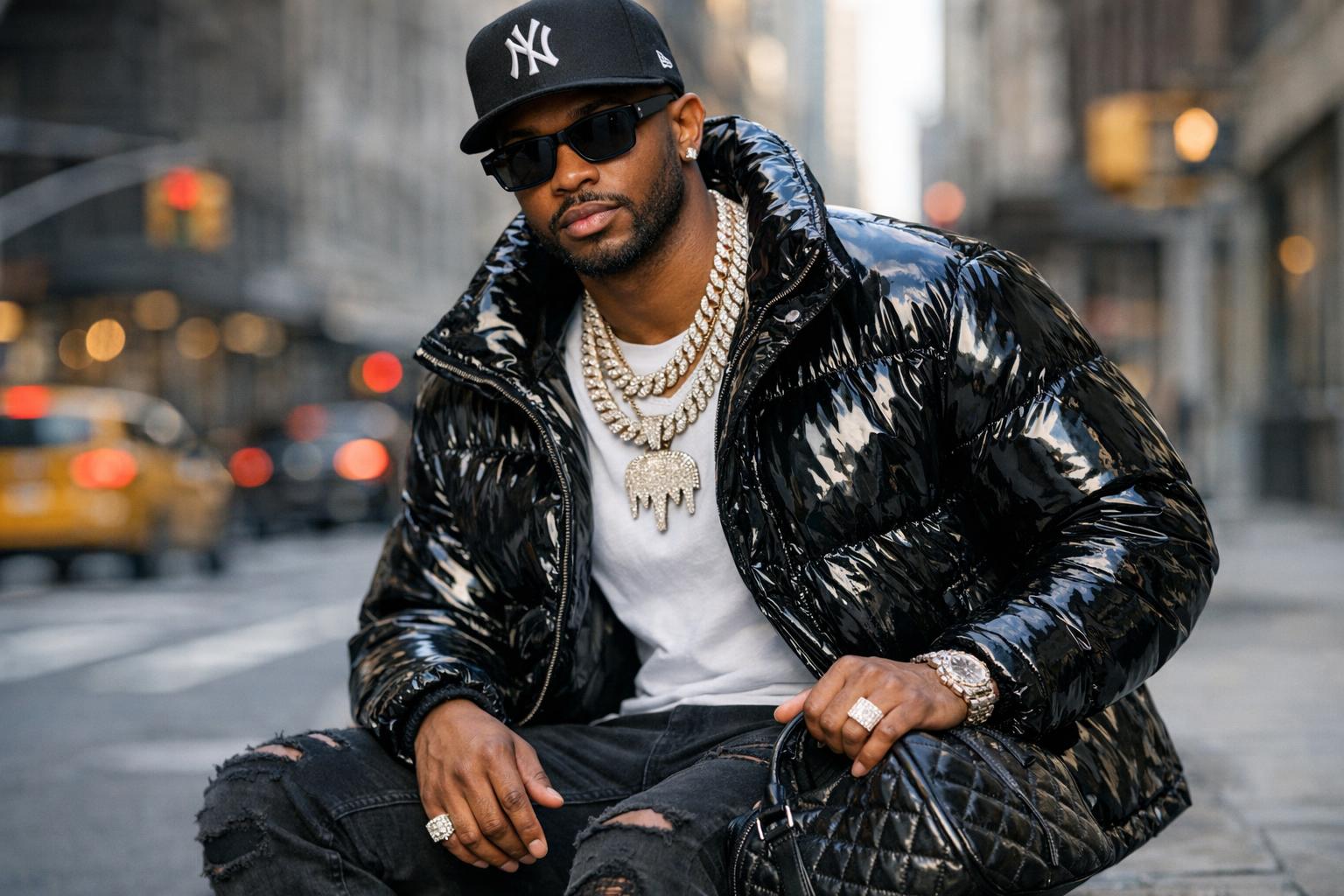
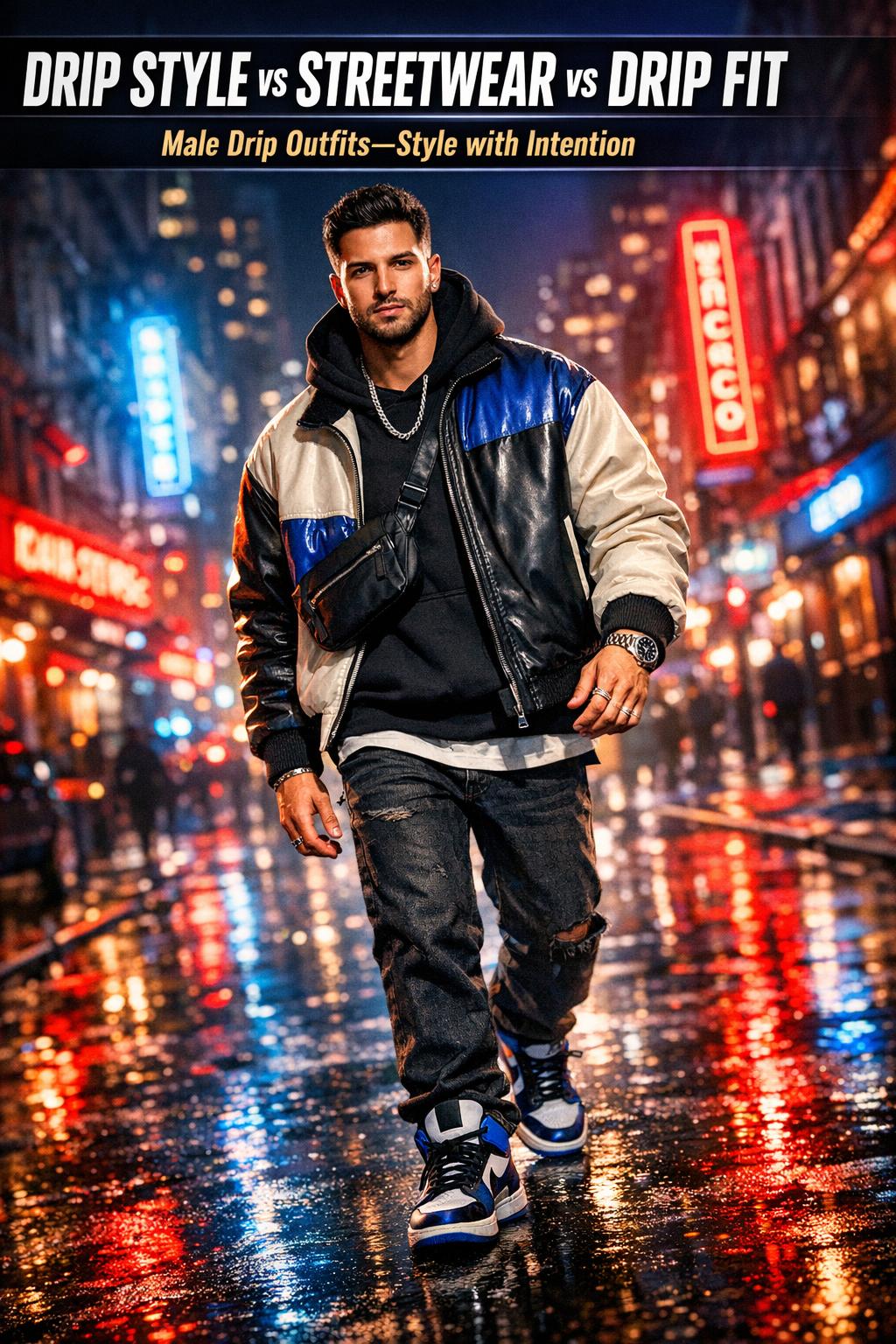
A drip fit is the more specific, high-impact subset people often mean when they say “drip.” It’s a look built to land immediately: statement-heavy, often trend-aligned, and optimized for attention. Where drip style is the concept, the drip fit is the execution style that prioritizes visible hits—strong pieces that read clearly from a distance.
Defining characteristics: high signal-to-noise styling. Every visible item feels chosen to contribute to the message: bold outerwear, standout footwear, and accessories that complete the frame.
Typical silhouettes: exaggerated proportions show up more here—oversized layers, heavy outerwear, wide pants, or very fitted looks that emphasize shape. The silhouette is a tool for presence.
Color palette: frequently high-contrast or saturated, but still coordinated. The palette is used to generate impact and memorability.
Fabrics and textures: texture becomes a headline—shine, plush, heavy knits, slick synthetics—because it photographs well and reads as “new” or “special.”
Overall mood: assertive, statement-driven, and current. This is where people sometimes fold in tougher, harder-edged references—what some call thug fits—because the mood prioritizes dominance and intensity.
The core distinction: category vs. concept vs. execution
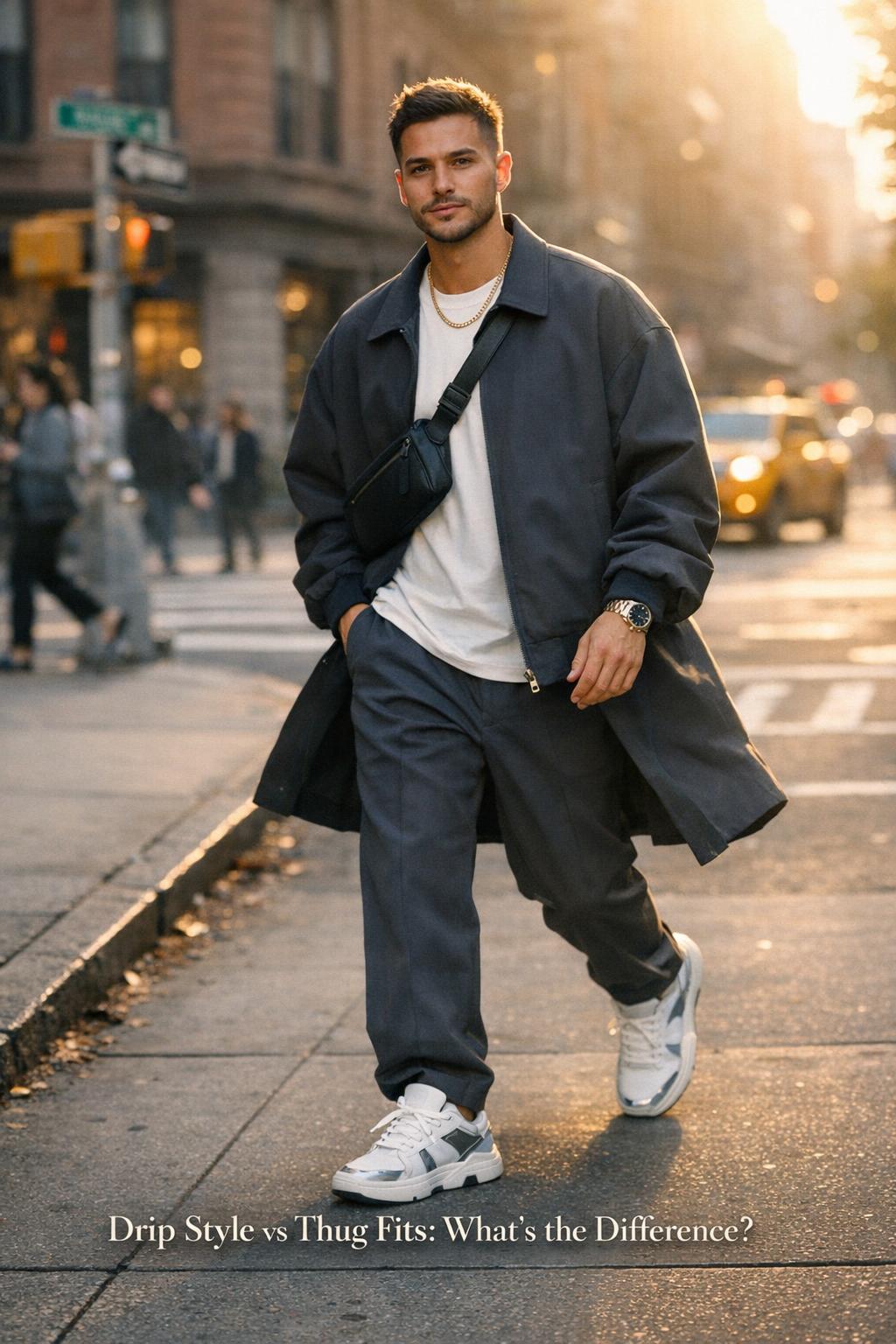
Here’s the cleanest way to separate the three without overcomplicating it: streetwear is a category of clothes, drip style is a concept of styling (how you arrange and finish pieces), and a drip fit is an execution strategy that maximizes visible impact. That’s why someone can wear streetwear without “drip,” and someone can create drip style using pieces that aren’t traditionally streetwear.
- Streetwear prioritizes wearable staples and repeatable outfits.
- Drip style prioritizes intentional composition and visual authority.
- Drip fit prioritizes bold impact and immediate readability.
Understanding this also clarifies why “drippy outfit” has become a catch-all phrase: it describes the result (the outfit reads strong), not the method (streetwear staples vs. tailored pieces) or the long-term wardrobe system behind it.
Key differences that change the whole outfit
Silhouette: relaxed functionality vs. engineered presence
Streetwear silhouettes often prioritize movement and comfort: relaxed layers that don’t demand constant adjustment. Drip style shifts the focus to silhouette balance—how the outfit fills space and frames the body. A drip fit pushes this further, leaning into proportion play that’s intentionally dramatic, even if it sacrifices some practicality.
In practice: a streetwear outfit can look “right” even when it’s thrown on quickly because the pieces are designed to be forgiving. A drip style outfit needs cleaner proportion decisions—where the volume sits, how the pant break looks, and whether the shoe choice supports the line of the leg.
Palette: easy neutrals vs. deliberate coordination
Streetwear often relies on neutral frameworks for versatility. Drip style uses color like a strategy: tonal layering for polish, or controlled contrast for impact. The drip fit approach tends to increase contrast and saturation because it’s designed to read quickly and strongly.
This is where many male drip outfits succeed or fail. The “drippy” feeling usually comes from a palette that looks decided—either a tight tonal range or a contrast that repeats intentionally (for example, a color echo between the top layer and the footwear).
Formality: casual roots vs. elevated finishing
Streetwear is inherently casual. Drip style can remain casual, but it tends to add polish through finishing: cleaner lines, sharper accessories, and a more controlled overall silhouette. A drip fit can look casual while still feeling “dressed,” because the outfit is built around visible statements rather than formal garments.
That’s also why thug fits—when done intentionally—can look more “styled” than standard casual outfits. The intensity is part of the message, but the success comes from coordination and finish, not from simply choosing tougher-looking pieces.
Styling philosophy: repeatability vs. moment-making
Streetwear wardrobes thrive on repeatability: you can rotate the same silhouettes with small changes and still look consistent. Drip style is more curated; it rewards decisions that make the outfit feel complete. The drip fit is the most moment-driven—built for a specific day, photo, or occasion where impact matters.
This is why a drip fit can be harder to sustain day after day: statement pieces demand attention and can feel repetitive faster. Streetwear, by contrast, is often designed to be a daily uniform.
Visual style breakdown: how the looks read in real life
Layering approach: functional stacks vs. visual architecture
Streetwear layering is usually functional: hoodie under jacket, tee under overshirt, added for warmth and ease. Drip style layering is more architectural. Each layer is chosen to create clean staging: collar lines that sit right, hem lengths that don’t fight each other, and a clear hierarchy from base to statement piece.
A drip fit uses layering as a spotlight tool. The outer layer is often the headline, and everything underneath exists to support it without cluttering the frame.
Garment proportions: comfort-first vs. proportion play
In streetwear, proportion choices can be softer—loose top and loose bottom can still work because the vibe is casual and relaxed. Drip style demands cleaner proportion control. If both halves are oversized, the outfit needs a stronger visual anchor to avoid looking shapeless. If the fit is slim, the outfit needs enough texture or detail to avoid looking flat.
Nyc drip often leans into bolder proportion play because city styling is competitive and visual. The key is ensuring the outfit still has structure: a defined shoulder, a clean waistline through layering, or footwear that grounds the silhouette.
Accessories: optional in streetwear, essential in drip style
Accessories are the easiest separator. Streetwear can function with minimal accessories—sometimes the clothing is the entire point. Drip style typically uses accessories to signal finish and intention. In a drippy outfit, accessories act like punctuation: they sharpen the message, define the mood, and help the outfit look complete.
The drip fit approach tends to treat accessories as part of the “impact kit.” The risk is overloading the look; the win is when accessories reinforce a single idea rather than competing.
Footwear choices: the visual anchor that decides the category
Footwear often determines whether an outfit reads as streetwear, drip style, or a drip fit. Streetwear footwear choices are usually about versatility and repetition. Drip style footwear tends to be the anchor: it locks in the silhouette and supports the palette. In a drip fit, footwear is frequently one of the loudest items—selected to be recognized, photographed, and remembered.
If you’re building male drip outfits, treat footwear as the foundation. A strong shoe choice can elevate simple pieces; a mismatched shoe can flatten even an expensive-looking outfit composition.
Comparison in action: the same scenario, three different outcomes
Scenario 1: casual day fit (streetwear vs. drip style vs. drip fit)
Streetwear approach: the goal is an easy uniform. The outfit leans on comfort and staple harmony—relaxed layers, cohesive neutrals, and a dependable shoe. It reads effortless because it’s built from pieces designed to live together.
Drip style approach: the same casual base becomes more intentional. The silhouette gets edited so it looks composed from every angle—cleaner layering lines, sharper palette control, and accessories that create a finished frame. The outfit still feels casual, but the styling decisions are more visible.
Drip fit approach: casual becomes impact-first. The fit adds at least one statement piece that changes the temperature of the whole outfit. The look is designed to be seen, not just worn, which is why “drippy outfit” is often used to describe this version.
Scenario 2: night-out styling (drip style vs. harder-edged thug fits)
Drip style approach: night-out drip tends to be clean and controlled: a sharper silhouette, darker or more deliberate tones, and details that read premium under low light. The outfit works because the palette and textures create depth without relying on chaos.
Thug fits approach: the goal is intensity and dominance in the visual message. The difference is not “more items,” but a harder mood: stronger contrast, heavier silhouettes, and bolder finishing choices. The fit works when it’s still coordinated—when the pieces reinforce the same story instead of fighting for attention.
The common failure point for thug fits is turning toughness into clutter. Drip logic still applies: one clear visual anchor, one supporting statement, and everything else edited to keep the silhouette readable.
Scenario 3: city day dressing (what “nyc drip” changes)
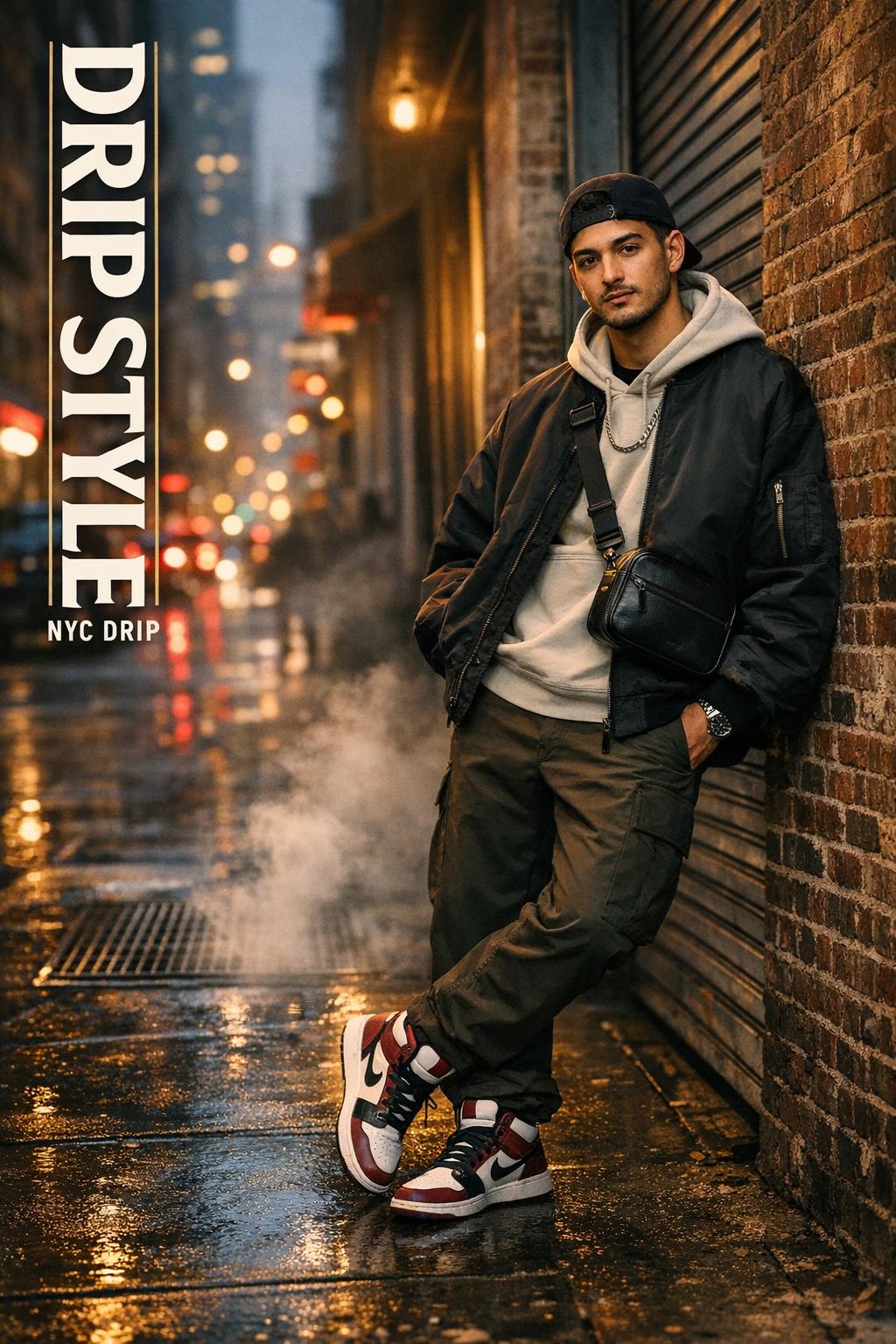
Nyc drip isn’t a separate category as much as a context that pushes styling decisions. City dressing tends to reward outfits that hold up under movement, weather shifts, and long hours—while still reading sharp. That combination naturally favors drip style: polished enough to look deliberate, functional enough to live in.
In practice, nyc drip often leans on strong outerwear and footwear as the two anchors that can survive a full day. The difference between streetwear and drip style here becomes clear: streetwear prioritizes convenience; drip style prioritizes convenience that still looks engineered.
Practical tips: how to build drip without losing wearability
Drip style is easiest to maintain when the wardrobe is built like a system: dependable staples plus a small set of statement pieces. The mistake is trying to make every item a headline. The goal is controlled contrast—one primary focal point, one secondary support, and a base that keeps the outfit coherent.
- Choose one visual anchor per fit: footwear, outerwear, or a key accessory. If you have two, keep everything else quiet.
- Use tonal layering for “expensive” energy: a tight palette instantly makes casual pieces read more intentional.
- Edit your proportions: if the top is oversized, keep the lower half cleaner, or use footwear to ground the silhouette.
- Let texture do the work: texture contrast creates depth without relying on loud color.
- Keep a repeatable base: this is how drip becomes daily drip style rather than a once-a-week drip fit.
For male drip outfits in particular, the fastest upgrade is usually proportion control. A drippy outfit rarely looks accidental; it looks adjusted. That might mean cleaner hem lengths through layering, a more deliberate silhouette, or a shoe that matches the visual weight of the outfit.
Where drip style fails: common mistakes that flatten the look
Too many statements, no hierarchy
When every piece is loud, the outfit loses its focal point and stops reading as drip style. The eye needs a clear path: one hero item, then supporting elements. This is the most common reason a drip fit looks forced—there’s no visual hierarchy, only volume.
Ignoring silhouette balance
Even expensive-looking items can fail if the silhouette collapses. Oversized on oversized can look intentional, but it needs structure—either through a sharper outer layer, cleaner pant lines, or footwear that adds a strong base. Without that, the outfit reads as “big” rather than composed.
Color chaos instead of controlled contrast
Drip style can be bold, but it’s rarely random. If the palette is high-contrast, it should repeat: a color echo in a secondary piece, a tonal bridge, or a neutral anchor. Without those links, the outfit becomes a collection of items rather than a single message.
Overdoing the “thug fits” mood without refinement
Harder-edged styling works when it still follows composition rules: clean silhouette lines, coordinated palette, and a clear anchor. The mood is intense, but the execution is disciplined. When the execution becomes cluttered or unbalanced, the look can read like costume instead of confident.
Choosing the right approach: when streetwear wins vs. when drip style matters
Everyday wear and errands: streetwear’s advantage
For everyday routines, streetwear often performs best because it’s designed for repetition, comfort, and low maintenance. If your day is unpredictable—walking, commuting, changing temperatures—streetwear staples keep you comfortable and still stylish without needing constant outfit management.
Social plans and visible settings: drip style’s advantage
When you’ll be seen—dinners, events, meetups, photos—drip style makes the difference because it looks intentional. This doesn’t require a full drip fit. Often it’s just tighter palette control, cleaner layering lines, and a more defined visual anchor.
High-impact moments: when the drip fit is the point
There are times when the outfit is the message. That’s when a drip fit makes sense: it’s built for maximum readability and presence. The trade-off is versatility. A drip fit can be less repeatable and can feel like “too much” in low-key settings. Used strategically, it’s powerful—especially in environments where nyc drip energy is normalized and style competition is real.
Style merging: how to combine drip style with streetwear without looking overstyled
The most wearable version of drip style is often streetwear with elevated composition. Think of it as upgrading your base rather than replacing it. Keep the streetwear staples for comfort, then apply drip logic: a tighter silhouette decision, cleaner palette, and one statement anchor.
A reliable formula is to keep two zones calm and one zone expressive. If the footwear is bold, keep the top and bottom clean. If the outerwear is the statement, let everything underneath act as a tonal support. This is how a drippy outfit stays readable rather than chaotic.
For people building male drip outfits, this merging strategy is the fastest route to consistency. Instead of chasing a brand-new look every time, you create a repeatable outfit framework that still lands as drip style whenever you add the anchor piece.
Conclusion: spotting drip style at a glance
Streetwear is the category—wearable, staple-driven, and built for repeat use. Drip style is the concept—intentional composition, visual authority, and a finished frame. A drip fit is the execution—impact-first, statement-heavy, and designed for immediate recognition.
The easiest way to identify the difference is to look for hierarchy and finish. If the outfit has a clear visual anchor, deliberate palette control, and clean proportion decisions, it’s operating in drip style territory. If it’s primarily built from casual staples without a strong “headline,” it’s closer to streetwear. And if every element is tuned for maximum attention, you’re looking at a drip fit—sometimes overlapping with harder-edged thug fits, especially in competitive city contexts like nyc drip.
The strongest wardrobes borrow from all three: streetwear for the foundation, drip style for the composition, and drip fits for the moments that call for impact.
FAQ
What does drip style mean in fashion?
Drip style refers to a styling concept focused on looking intentionally put together with a clear visual message—often through a strong outfit anchor, coordinated color choices, and a finished overall composition rather than purely casual dressing.
Is drip style the same as streetwear?
No—streetwear is a broad category of casual staples, while drip style describes how an outfit is composed and finished; you can wear streetwear without creating drip, and you can build drip style using pieces outside traditional streetwear.
What’s the difference between a drip fit and drip style?
A drip fit is an impact-first execution of drip styling—more statement-heavy and trend-forward—while drip style is the broader approach of intentional coordination that can be subtle, wearable, and repeated.
How do you make a drippy outfit without overdoing it?
Use one primary visual anchor (footwear, outerwear, or accessories), keep the rest of the outfit in a controlled palette, and prioritize silhouette balance so the look feels edited rather than overloaded.
What are common mistakes that stop an outfit from looking like drip style?
The biggest mistakes are stacking too many statement pieces with no hierarchy, ignoring proportion control (so the silhouette collapses), and using high contrast without any color repetition or neutral anchoring.
How can male drip outfits look intentional instead of random?
Male drip outfits look most intentional when the outfit has a clear anchor, a deliberate palette (tonal or controlled contrast), and proportion decisions that feel purposeful—such as balancing an oversized top with cleaner lines below.
What does nyc drip usually imply in styling?
Nyc drip typically implies city-ready styling that combines function with visible polish—strong outerwear and footwear as anchors, clean layering lines, and an outfit that holds up through movement and long hours while still reading sharp.
Are thug fits part of drip style?
Thug fits can overlap with drip style when the harder-edged mood is executed with disciplined coordination—clear hierarchy, controlled palette, and strong silhouette balance—rather than relying on clutter or intensity alone.