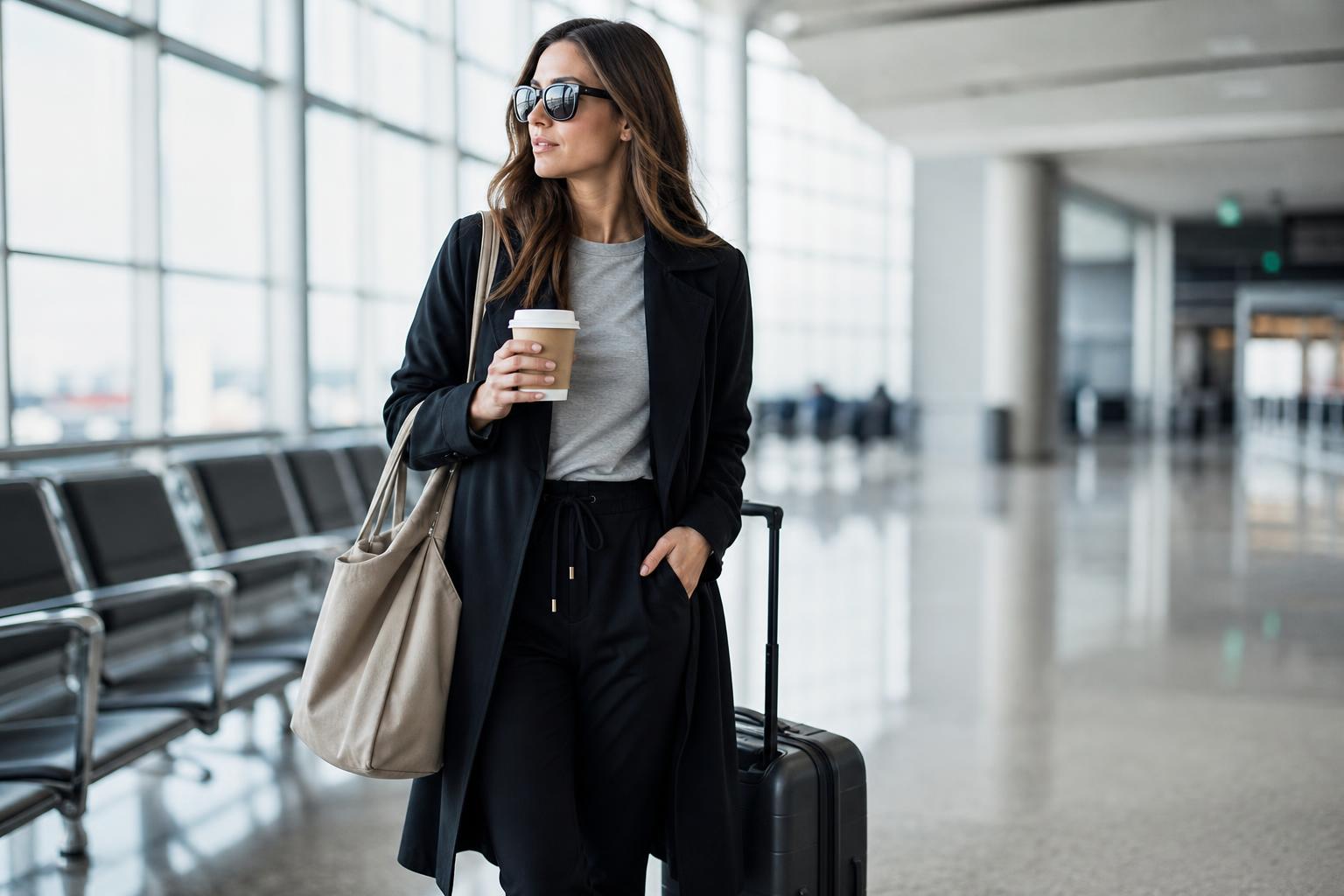
Airport Style That Feels Polished From Gate to Arrival
The hardest part of airport style is not choosing something fashionable. It is building an outfit that can survive the full travel sequence: getting to the terminal, standing in security lines, sitting through an overcooled cabin, and arriving looking pulled together rather than rumpled. That tension between comfort and polish explains why airport outfits remain such a persistent style problem.
Modern airport style sits at the intersection of travel wardrobe logic and visual refinement. Readers usually want the same outcome: a look that feels easy, looks intentional, and works across changing temperatures and long hours of wear. The most useful approach is not chasing a single celebrity outfit, but understanding why certain combinations keep appearing on frequent travelers, fashion editors, and figures like Hailey Bieber, Irina Shayk, Zoë Kravitz, and Harry Styles.
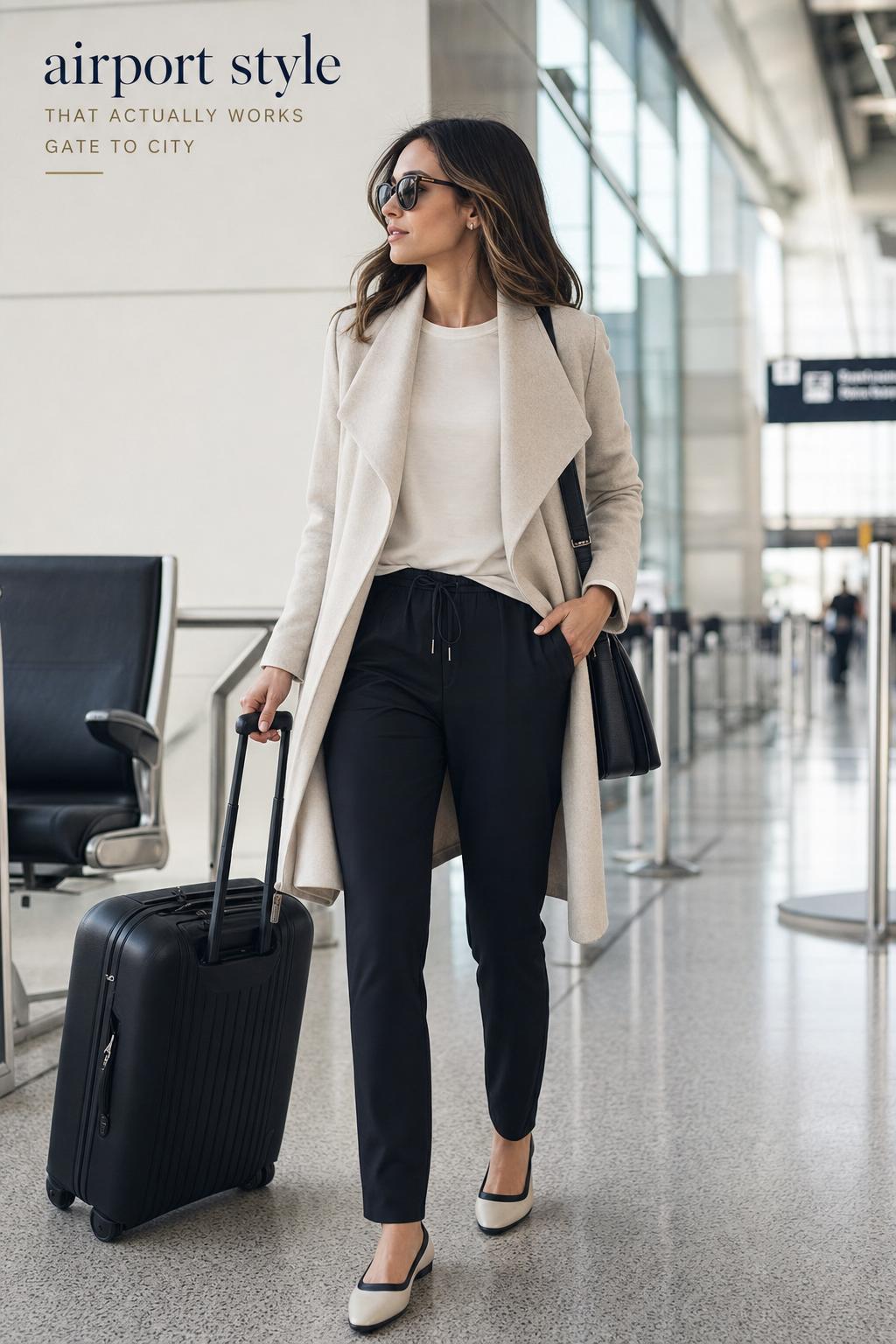
This guide breaks airport style into practical decisions: fabrics, layers, silhouette balance, footwear, accessories, and repeatable outfit formulas. The goal is simple: solve the real dressing problem behind airport fashion, so you can build chic airport outfits that are comfortable, functional, and easy to repeat.
Why airport style feels more complicated than everyday dressing
Airport dressing asks one outfit to do too many jobs at once. It needs enough structure to look presentable in public, enough softness to remain comfortable during long wear, and enough flexibility to adapt to changing conditions. A look that feels ideal at home can fail in transit if the fabric traps heat, the shoes become restrictive, or the layers are too bulky to manage.
Found the dress? Keep the rest in one place.
Zarellea brings guest details, vendors, timelines, and every next step together — so your wedding plan feels as good as your look.
This is also why the language around airport style has shifted toward phrases like comfy chic, elevated basics, travel wardrobe, and airport chic. The challenge is no longer about dressing formally for a flight. It is about creating a functional outfit composition that still reads polished. Editorial coverage from outlets such as Who What Wear, Vogue, Glamour, E! Online, and Marie Claire repeatedly circles the same idea: the best airport outfits succeed when comfort and aesthetics are treated as equal priorities.
There is another factor: airports compress different environments into a single day. Terminals can feel warm, cabins can feel cold, and arrivals may involve a city setting where an overly casual loungewear look suddenly feels underdressed. That is why frequent-traveler guidance and repeatable outfit formulas matter more than one-off styling moments.
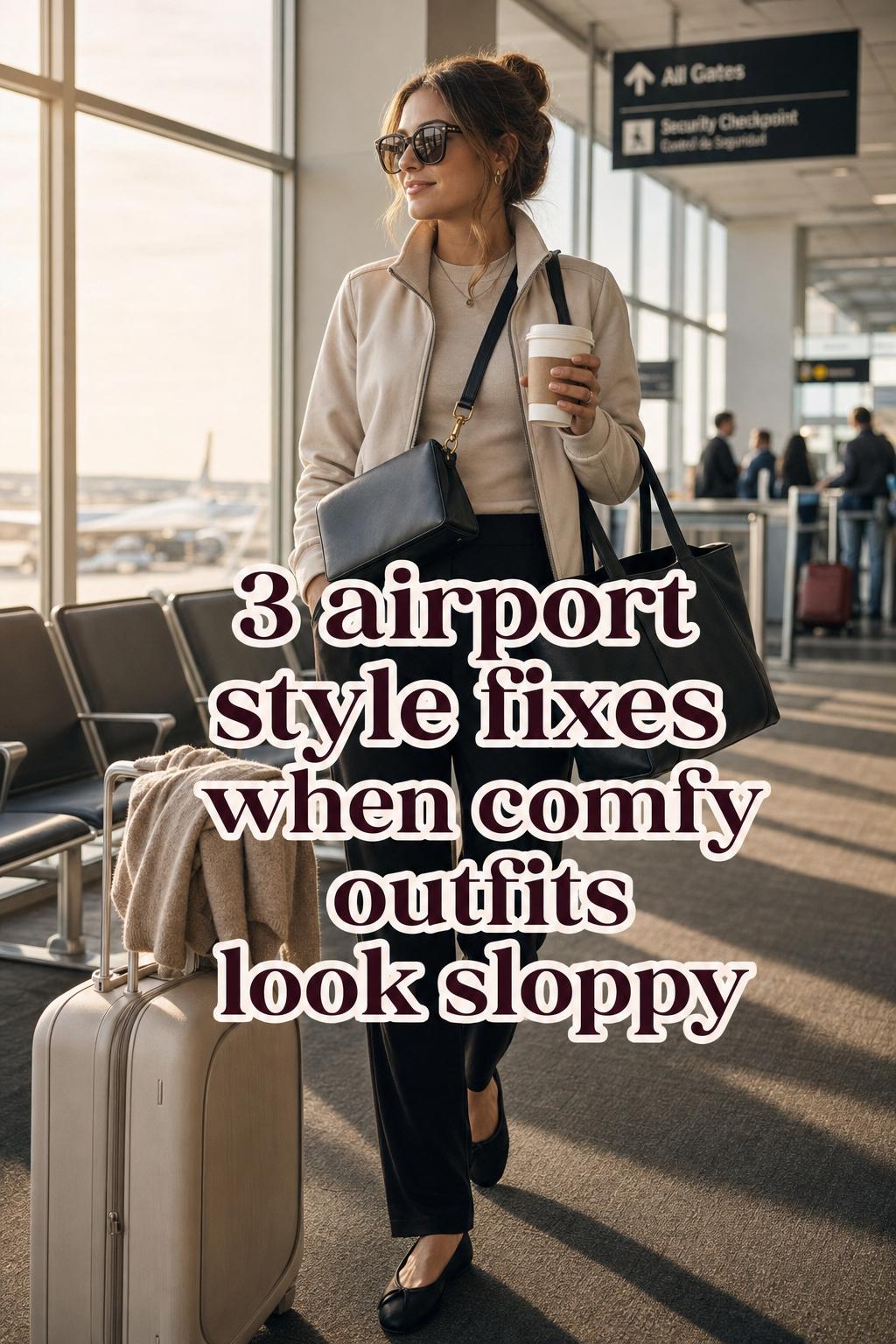
What defines airport style today
Current airport style is built on three connected ideas: comfort, function, and polished aesthetics. The polished part matters because a travel outfit still communicates intention. The functional part matters because clothing has to support movement, layering, and long wear. The comfort part matters because no amount of visual appeal compensates for an outfit that becomes irritating mid-flight.
The most visible influence on this category remains celebrity airport style. Hailey Bieber’s streamlined formulas, Irina Shayk’s shopping-guide-ready travel pieces, and the coordinated ease associated with Zoë Kravitz and Harry Styles all reinforce a modern standard: relaxed silhouettes anchored by one or two sharp elements. Even when the individual pieces differ, the structure stays consistent. There is usually a visual anchor, such as a jacket, coat, pointed-toe flat, or monochrome palette, balancing the softer elements of the outfit.
At the same time, editor-led advice from voices like Chrissy Rutherford and Sara Walker shifts the conversation away from purely aspirational dressing. Their value lies in practical repeatability. Airport style works best as a system, not a costume. That means elevated basics, lightweight layers, travel-friendly pants, and outerwear that can move between terminal, cabin, and arrival without making the outfit feel disjointed.
The core dressing principles that solve the airport outfit problem
Start with fabrics that can handle travel conditions
Fabric behavior determines whether an outfit remains wearable for hours. Travel-ready clothing works best when it includes stretch, softness, and enough resilience to keep its shape. Moisture-wicking and anti-odor qualities are especially useful because they support comfort during long transit windows. Even when a look appears simple, these material decisions improve how the outfit performs.
This is where airport style becomes more than aesthetics. A sleek silhouette built from rigid or high-maintenance fabric often breaks down in practice. By contrast, technical fabrics and soft structured knits support both movement and appearance. The outfit still looks considered, but it functions better through check-in, boarding, and arrival.
Use layering as climate control, not decoration
Layering is the central styling tool in airport fashion because temperature variation is built into the experience. The most effective layers are light enough to carry, structured enough to sharpen the outfit, and versatile enough to work on or off the body. Jackets, coats, and streamlined outerwear repeatedly show up in airport outfits for this reason.
A strong outer layer also creates silhouette clarity. It prevents soft base pieces from reading overly casual and gives the outfit a clean frame. This is one reason a cinch-waist jacket, as seen in the Hailey Bieber-focused styling formula, has such strong airport relevance. It introduces shape without sacrificing practicality.
Balance relaxed pieces with one polished element
The easiest way to create chic airport outfits is to avoid making every piece equally casual. If the base is soft and travel-friendly, one polished element should carry the visual weight. That could be a tailored jacket, pointed-toe flats, a clean monochrome color story, or a refined bag. This balance is what separates an intentional travel look from an outfit that feels unfinished.
Silhouette balance matters here. Wide or pull-on pants need visual structure above or below the waist. Loungewear-inspired bases need a smarter outerwear layer. Soft knits benefit from sleeker footwear. Airport style looks strongest when each relaxed component is offset by something more precise.
Build around repeatable wardrobe staples
The best travel wardrobe is not trend-dependent. It is modular. Frequent-traveler advice consistently points toward pieces that can be worn on repeat: lightweight layers, jackets, comfortable pants, versatile shoes, and accessories that support movement. This capsule mindset simplifies packing and reduces decision fatigue.
That repeatability also explains why airport style often leans minimalist. A tightly edited palette and a few dependable clothing categories create more outfit options than a suitcase full of disconnected statement pieces. Practical airport fashion is less about novelty than outfit composition that can be trusted.
The airport capsule that makes getting dressed easier
A reliable airport capsule is built from categories rather than one exact formula. This keeps the wardrobe flexible while preserving coherence. Think in terms of function first, then aesthetics.
- A soft, travel-friendly top that layers easily
- A comfortable bottom such as pull-on pants or another easy silhouette
- An outerwear piece that adds shape
- Footwear designed for long wear and easy movement
- A bag that supports organization and mobility
- Small travel accessories that reduce friction throughout the day
This structure aligns with the strongest airport style guidance across editorials and shopping features. It works because each category solves a different travel problem. The top provides comfort, the bottom supports movement, the outerwear manages temperature and polish, the shoes protect stamina, and the accessories organize the day.
If you want the outfit to look more elevated, focus on tonal layering and clean proportions rather than adding extra pieces. A tightly edited palette does more for airport chic than overstyling. Monochrome or near-monochrome dressing is especially effective because it creates visual continuity and packs easily.
Outfit solution: elevated athleisure that still reads polished
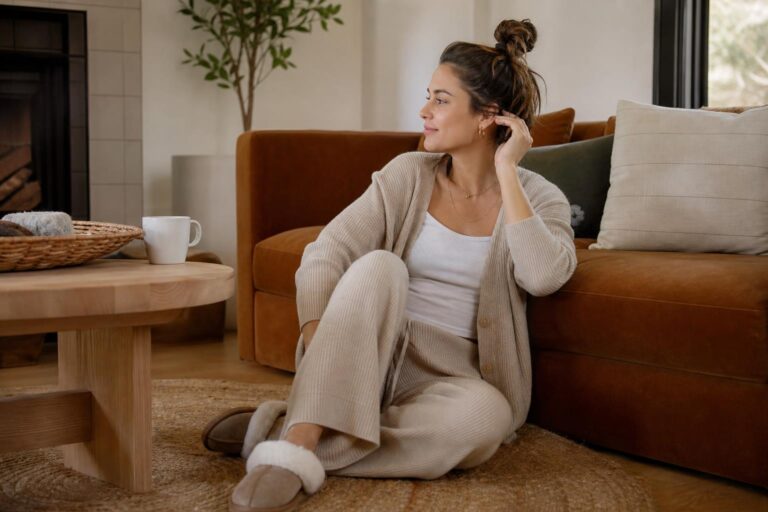
Elevated athleisure remains one of the most practical airport style solutions because it prioritizes flexibility and ease without defaulting to a sloppy silhouette. The key is controlling the balance. A soft base needs a sharper outer layer or more refined accessories to avoid looking purely lounge-focused.
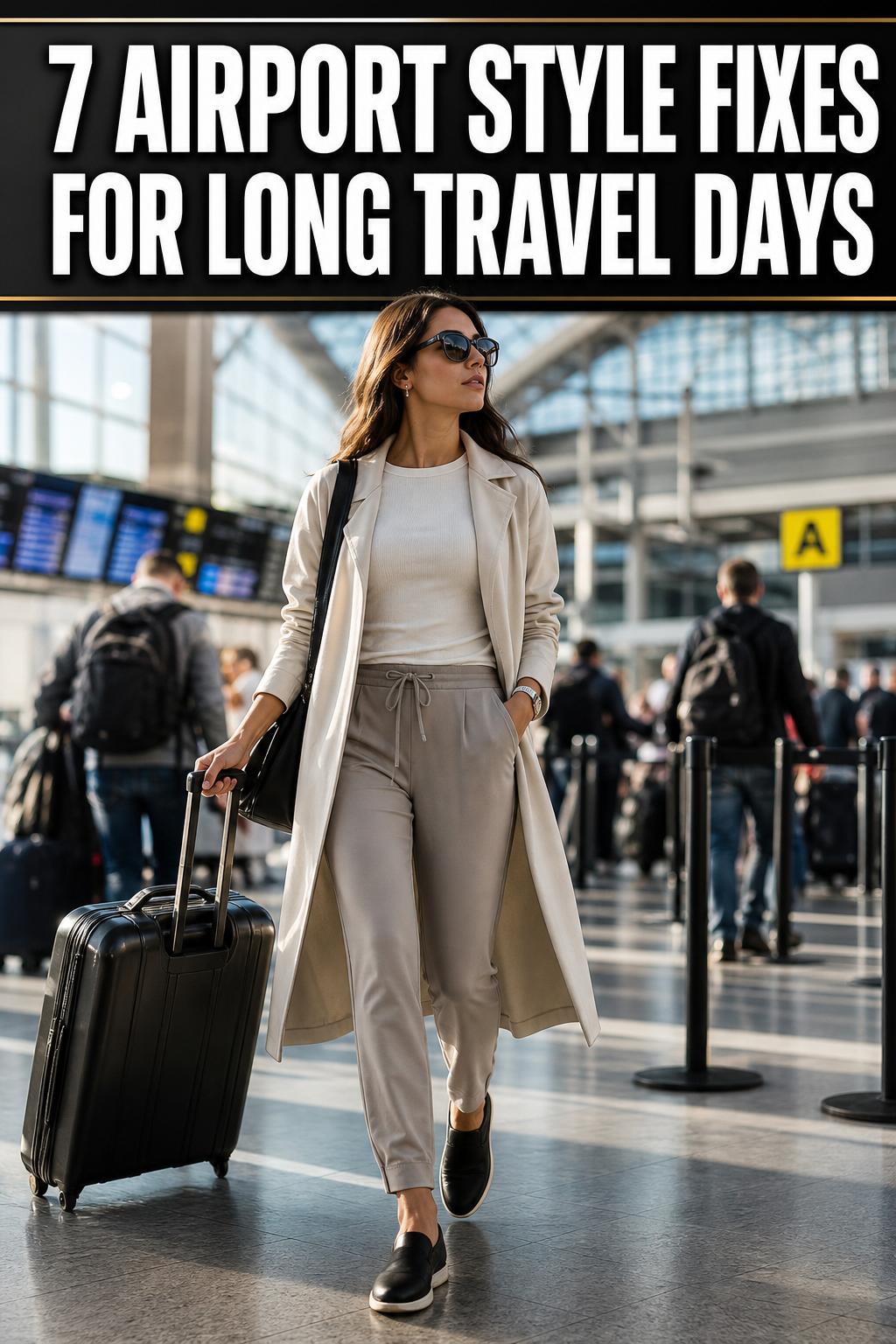
A strong version of this look includes a comfortable top, travel-friendly pants with stretch, a lightweight jacket, and footwear designed for all-day wear. The jacket acts as the visual anchor. It sharpens the outfit line, adds structure in photos and real life, and gives you a removable layer for the cabin.
This combination works because the silhouette is low-effort but not visually flat. Texture contrast matters here. Soft base layers paired with a more structured outerwear piece create a polished-relaxed tension that defines modern airport outfits. For readers who want a practical version of comfy chic, this is often the best starting point.
Why this outfit works
The formula handles movement, temperature changes, and long sitting periods well. At the same time, it preserves a styled appearance through proportion play: softer pieces are framed by cleaner lines. It is also easy to repeat, which is why variations of this approach appear so often in fashion-editor and frequent-traveler wardrobes.
Outfit solution: tailored comfort for travelers who dislike loungewear
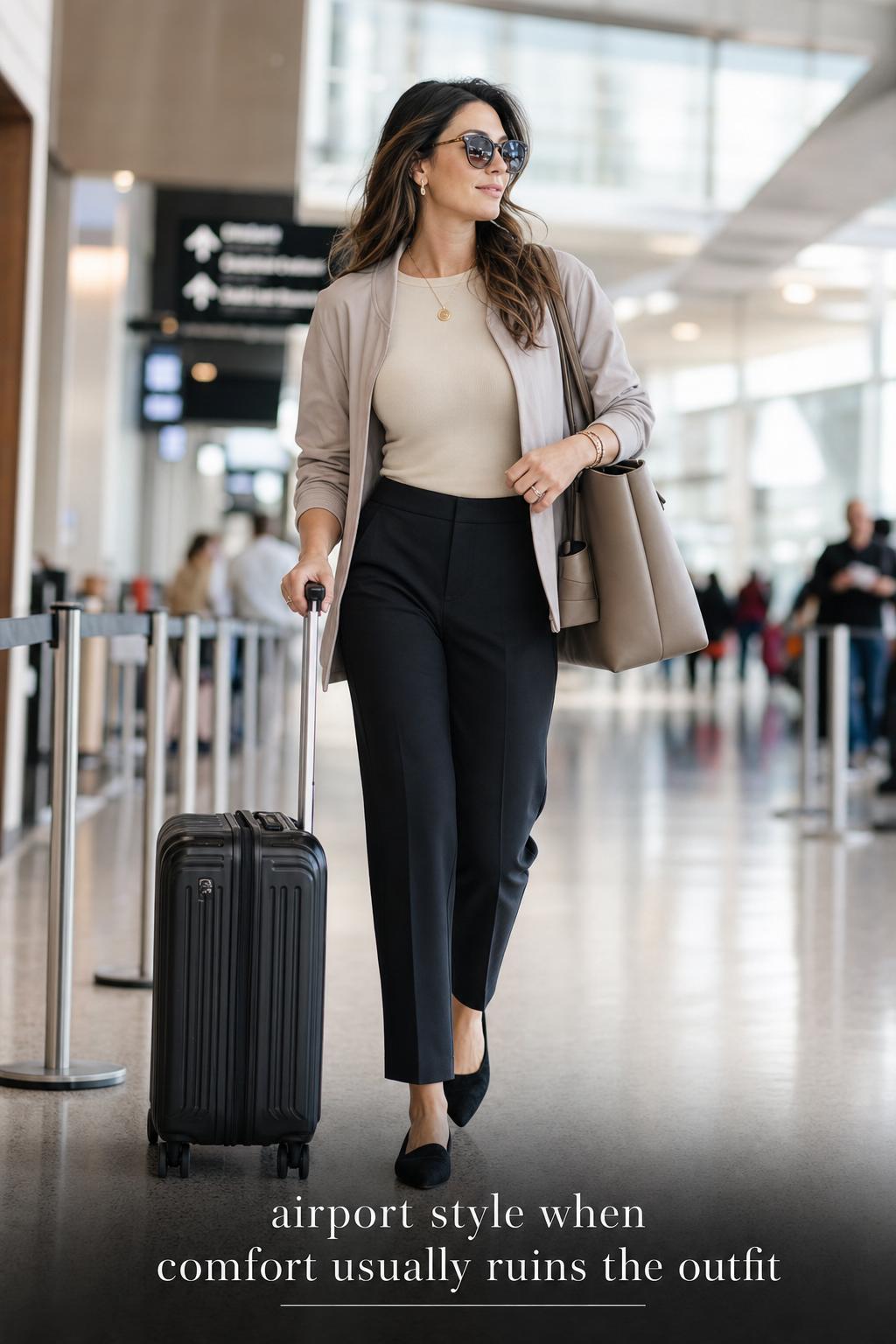
Not everyone wants airport fashion to lean casual. A tailored, travel-friendly look solves that by keeping the outfit streamlined while avoiding stiffness. This is where pieces like a cinch-waist jacket, pull-on pants, and sleek flats or low heels become useful reference points. The styling associated with Hailey Bieber illustrates the principle clearly: polished details can coexist with wearable comfort.
Start with pants that have ease through the waist and leg, rather than rigid trousers that become uncomfortable over time. Add a structured jacket to define the shape. Finish with pointed-toe flats or another sleek shoe profile if your priority is elegance over sporty ease. The result feels composed, but still aligned with real travel needs.
This outfit is especially useful if you are arriving into a city environment, heading directly to a meeting, or simply prefer airport style that feels more refined than athletic. The silhouette reads intentional because the structure sits at the jacket and shoe level, while the comfort is carried by the pants and base layers.
Best use case for this formula
This is the strongest option for travelers who want a bridge between airport outfits and smart daytime dressing. It also works well when you want your travel wardrobe to integrate with the rest of your trip without requiring an immediate outfit change upon arrival.
Outfit solution: minimalist monochrome for easy packing and visual clarity
Minimalist monochrome is one of the smartest airport style strategies because it solves several problems at once. It simplifies outfit planning, reduces visual clutter, and makes even basic pieces feel more elevated. For travelers working from a capsule wardrobe, this approach creates easy continuity between the airport and the rest of the trip.
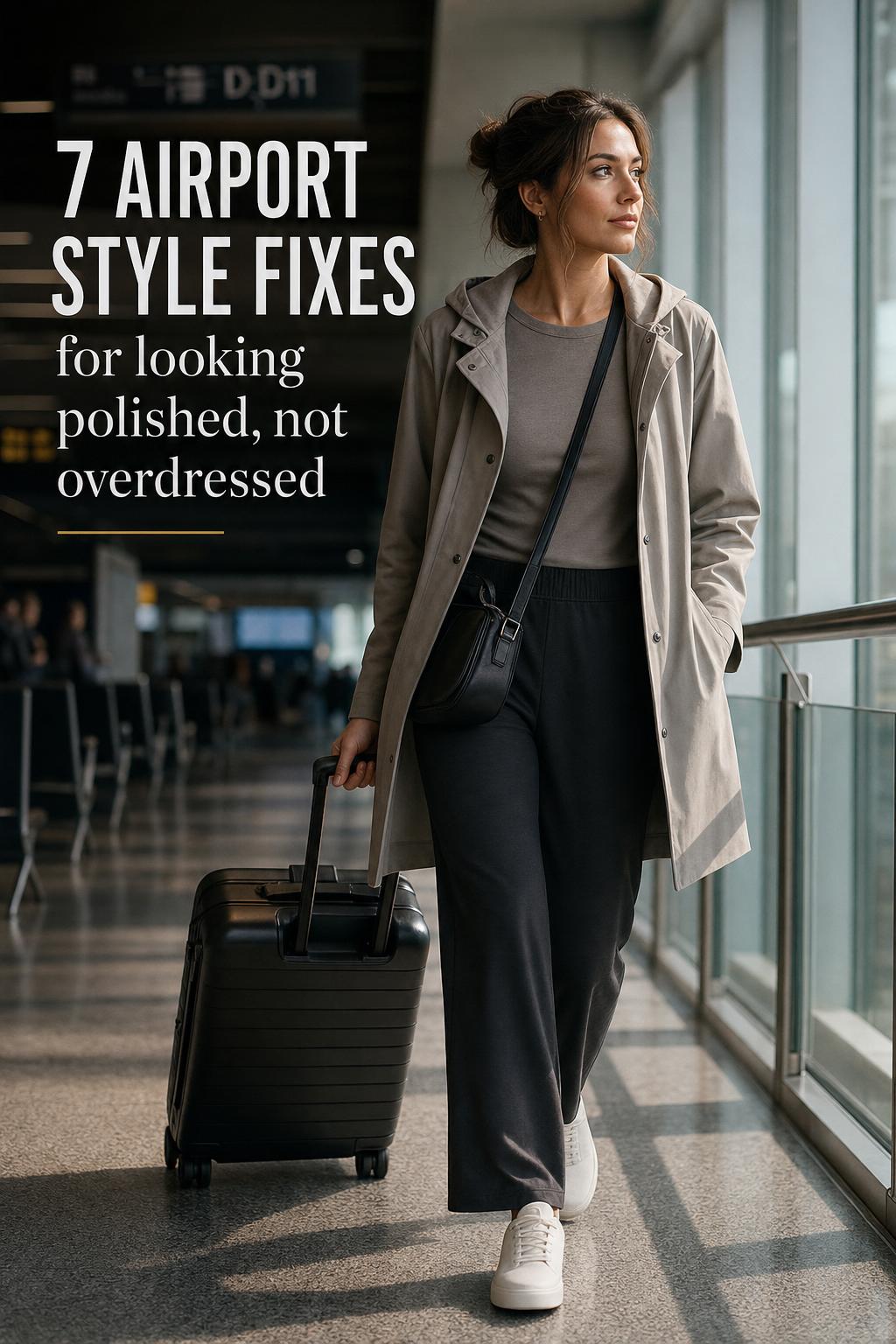
The formula is straightforward: keep the top, bottom, and outer layer within the same tonal family, then vary the textures to avoid flatness. A softer knit or jersey base paired with a cleaner jacket or coat creates enough dimension without complicating the look. Shoes and bags can either blend into the same palette or provide a quiet contrast.
This type of airport chic is effective because the eye reads the outfit as intentional and elongated. The silhouette feels calmer, which is useful in a setting already defined by visual and logistical noise. It is also adaptable across budgets, since the impact comes more from coordination than from any single high-profile purchase.
Why frequent travelers return to this idea
A monochrome or tonal travel look is easy to rewear, easy to mix into a broader travel wardrobe, and consistently polished in photographs and in person. For travelers taking multiple trips a year, that repeatability matters more than a highly specific trend-led outfit.
Outfit solution: the editor-style uniform for repeat travel days
Some of the most useful airport outfits come from the logic of a personal uniform. This is the core appeal of frequent-traveler dressing associated with figures like Sara Walker. Instead of reinventing the look for every flight, the uniform approach relies on a trusted structure: comfortable layers, dependable pants, and an outer layer that always sharpens the result.
The value of a uniform is consistency. You already know how the pieces wear over time, whether the layers work in an overcooled cabin, and how the outfit handles a long day in transit. That practical familiarity reduces the risk of making experimental styling choices on a travel day.
From a fashion perspective, the uniform also creates signature clarity. A repeated silhouette often looks more intentional than an overly varied one. In airport style, that discipline is useful. It turns dressing into a system rather than a guess.
Celebrity airport style as a useful reference, not a rulebook
Celebrity airport outfits remain popular because they compress the ideal into a clear image. Hailey Bieber’s clean combinations, Irina Shayk’s fashion-forward shopping cues, and the coordinated cool associated with Zoë Kravitz and Harry Styles all offer visual shorthand for modern travel style. But the practical lesson is not to copy every item. It is to identify the underlying formula.
Most successful celebrity airport style follows a few repeatable principles: one structured layer, one easy base, coherent color direction, and footwear chosen with clear intent. Even when the look feels effortless, the outfit composition is doing careful work. There is usually a hierarchy between pieces, which prevents the outfit from becoming visually shapeless.
Chrissy Rutherford’s framing of airport style as purposeful rather than incidental is especially useful here. Dressing up for the airport does not need to mean sacrificing comfort. It means approaching the outfit with enough strategy that it performs well and still feels elevated. That distinction is what modern airport fashion gets right.
A terminal-to-arrival approach: dress for the full sequence
One of the most overlooked airport style mistakes is dressing only for boarding. A better method is to think through the entire travel chain, from check-in to arrival. That shift changes what pieces make sense.
- For check-in and security, simple layers and easy-to-manage accessories reduce hassle.
- For the cabin, stretch, softness, and temperature adaptability become more important.
- For arrival, structure and tonal coherence help the outfit still look intentional.
This sequence-based approach also explains the value of functional travel gear integrated into airport style. Bags, passport organizers, and tech organizers are not separate from the look. They influence how smoothly the outfit performs. A bag that is easy to carry and organize supports the entire wardrobe system, not just the accessory category.
Readers often focus heavily on the clothing and underestimate the utility of the accessories. In reality, practical travel accessories make airport outfits feel calmer and more controlled, which in turn affects how polished the whole look appears.
Accessories and footwear that improve airport style rather than complicate it
Footwear carries more responsibility in airport fashion than almost any other item. The shoe has to support walking, standing, rushing between terminals, and extended wear. That is why discussions around airport outfits consistently return to comfort footwear, cushioning, and support. Even a visually refined outfit can fail if the shoes make movement difficult.
There are two strong footwear directions. The first is sleek comfort: a polished flat or similar low-profile shoe that keeps the outfit elegant. The second is sportier practicality: a travel-friendly shoe that emphasizes support and ease. The right choice depends on the rest of the silhouette. Structured outfits can handle a sleeker shoe; softer outfits often benefit from a cleaner, more grounding footwear shape.
Bags should support movement, organization, and visual balance. A travel bag that looks sharp but is difficult to navigate works against the logic of airport style. Functional details such as anti-theft features and organized compartments are useful because they reduce friction without requiring extra accessories. The same logic applies to passport organizers and tech organizers. These pieces quietly strengthen the outfit’s practicality.
Tips for choosing airport accessories
- Choose a bag that can handle documents, devices, and essentials without losing shape.
- Keep accessories streamlined so they support, rather than overcrowd, the look.
- Use organizers to reduce digging through your bag during transitions.
- Match the bag’s visual weight to the outfit so proportions stay balanced.
Airport style across different aesthetics
Airport style is not a single look. It is a styling framework that can adapt to different personal aesthetics. The common denominator is practical cohesion.
If your style leans minimalist, focus on tonal layering and elevated basics. If you prefer a more directional fashion approach, use one statement element and keep the rest restrained. If comfort is your primary priority, build around loungewear foundations but sharpen the outfit with outerwear and accessories. The point is not to abandon your style identity for travel. It is to edit it so it functions better.
This is also where broader representation matters. Airport fashion advice is most useful when it moves beyond narrow celebrity imitation and considers everyday travelers, different body types, different ages, and varied comfort needs. Practical airport style should be adaptive. The formula can stay consistent while the final expression changes.
Common airport outfit mistakes that weaken comfort or polish
Most airport outfit problems come from overcommitting to one priority and ignoring the rest. Dressing too much for style can reduce comfort. Dressing only for comfort can remove the structure that makes the outfit feel finished.
- Choosing rigid fabrics that look polished but wear poorly over long hours
- Skipping outerwear and then relying on an outfit that lacks shape
- Wearing shoes that suit the photo but not the walking distance
- Building a look with no tonal or silhouette cohesion
- Using accessories that are stylish but difficult to manage in transit
These mistakes are common because airport style can look deceptively simple. In practice, every item has to perform. A successful travel outfit usually appears effortless because the decisions were made carefully in advance.
Buying smart: how to evaluate airport clothes and travel pieces
Shopping for airport style is most effective when you evaluate pieces by cost-per-use, versatility, and travel performance rather than novelty. The strongest buys are items that can work in multiple airport outfits and also integrate into the rest of your wardrobe. This is why categories matter more than individual trend pieces.
When comparing options, consider three questions. Does the fabric travel well? Can the item layer easily? Will it work in at least three outfit combinations? If the answer is yes, it is likely a smarter investment than something visually striking but limited in use.
This logic also aligns with a more sustainable way of thinking about travel wardrobe decisions. Rewearability, versatility, and durability matter. A great airport outfit is often built from familiar pieces chosen intelligently, not from a completely separate travel closet.
Practical styling notes for different travel contexts
Not every trip asks for the same airport style solution. A short domestic flight, a red-eye, and an arrival into a dense city environment create different priorities. The most effective travel wardrobe responds to context.
For a red-eye, softness and layering take priority, with enough structure to keep the outfit from looking sleepwear-adjacent. For a day flight into an urban setting such as New York or Los Angeles, sharper outerwear and a cleaner shoe shape can make more sense. For a travel day built around leisure, a softer elevated athleisure formula may be the better fit.
This is where airport style starts to resemble a utility system rather than a single trend. The strongest dressers are not necessarily wearing the flashiest clothes. They are choosing pieces that match the travel conditions, personal comfort threshold, and arrival context while keeping the outfit visually coherent.
Quick travel-day tips that improve the final look
Keep your palette controlled, let one piece provide structure, and make sure every item earns its place. If a jacket is too heavy to carry, it is the wrong layer. If a shoe works only while seated, it is the wrong shoe. If a bag looks chic but disrupts movement, it is the wrong bag. Airport style becomes easier when each decision is filtered through real use.
How to build chic airport outfits without overthinking them
A simple framework prevents decision fatigue. Start with the bottom half, since comfort there affects the whole outfit. Add a soft top. Choose one outerwear piece that sharpens the silhouette. Finish with shoes that match your walking needs and a bag that supports organization. Then edit the palette so the outfit looks intentional rather than assembled in a rush.
This is the practical heart of airport style. Whether your inspiration comes from Vogue shopping features, Who What Wear editor formulas, Glamour’s comfort-first approach, E! Online’s accessible outfit ideas, or Marie Claire’s celebrity references, the strongest looks all resolve the same equation: comfort plus structure plus repeatability.
Once you understand that logic, airport outfits become easier to assemble and easier to refine. You do not need a dramatic reinvention for every trip. You need a dependable system with enough flexibility to adapt.
FAQ
What is airport style?
Airport style is a travel-focused way of dressing that balances comfort, function, and a polished appearance. It usually relies on elevated basics, easy layers, comfortable footwear, and a coherent silhouette that can handle terminal movement, cabin temperatures, and arrival.
How do I dress for the airport and still look chic?
The easiest method is to combine soft, travel-friendly pieces with one polished element such as a structured jacket, sleek flats, or a tonal palette. Chic airport outfits work because they balance relaxed comfort with clear visual structure.
What are the best fabrics for airport outfits?
The most practical fabrics are those that offer stretch, softness, and durability over long wear. Moisture-wicking, anti-odor, and other technical fabric qualities are especially useful because they improve comfort without compromising the outfit’s appearance.
Are loungewear-based airport outfits still stylish?
Yes, if they are styled with intention. A loungewear foundation can still feel polished when it is paired with structured outerwear, refined accessories, and a clean color story. The goal is to avoid a completely shapeless composition.
What shoes work best for airport style?
The best travel shoes support walking, standing, and extended wear. Some travelers prefer sleek flats for a more refined look, while others choose more supportive comfort footwear. The right option depends on how polished or relaxed the rest of the outfit is.
How can I make airport outfits easier to repeat?
Use a capsule mindset. Build around repeatable staples such as lightweight layers, comfortable pants, one dependable outerwear piece, and versatile accessories. A consistent formula reduces stress and usually produces stronger airport style than constant experimentation.
Why do celebrity airport outfits look so put together?
They usually rely on strong styling structure rather than excess detail. Figures like Hailey Bieber, Irina Shayk, Zoë Kravitz, and Harry Styles often wear easy base pieces anchored by one sharp layer, clean footwear, or a controlled palette, which makes the outfit feel composed.
What should I wear to the airport for a red-eye flight?
Prioritize softness, layering, and ease of movement. A red-eye outfit should feel comfortable enough for long seated wear while still including one element of structure, such as a jacket or clean outer layer, so the look remains polished before and after the flight.
Do accessories matter in airport fashion?
Yes. Bags, passport organizers, and tech organizers influence how smoothly the outfit functions throughout the day. The best accessories support movement, organization, and visual balance instead of adding bulk or inconvenience.
How do I build a travel wardrobe that works beyond the airport?
Choose pieces that can transition from the airport into the rest of your trip. Pull-on pants, lightweight layers, structured jackets, and versatile shoes are strong choices because they work in multiple settings and support a more cohesive, repeatable travel wardrobe.