Paris Street Style, The French Girl Style Way to Get Dressed Fast
French girl style, solved: how to look polished in Paris outfits without overthinking
The real problem with french girl style isn’t finding a striped shirt or a blazer. It’s getting the balance right: looking intentional without looking overstyled, especially when your day includes walking, weather changes, and the practical demands of real life. Many “Parisian chic” mood boards skip the hard part—how to build outfits that move with you, hold up for hours, and still read as effortless.
This guide treats french girl style like a system, not a costume. You’ll get a clear definition (including the difference between “French girl style” and “French woman style”), a capsule logic built around proven staples like the Breton stripe top, the blazer, and the leather jacket, plus outfit solutions that work for city days, smart-casual needs, and seasonal transitions such as tendances mode automne. The goal: reliable Paris outfits and looks street style energy you can repeat, refine, and actually live in.
Expect fashion analysis, not fashion mythology. We’ll anchor the look to Paris and France as the cultural locus, connect it to names and touchpoints that shape the modern conversation (from Coco Chanel to Balenciaga campaigns, from Isabelle Huppert to Philippine Leroy-Beaulieu), and ground every idea in wearable outfit composition.
Understanding the styling challenge: why “effortless” is hard in real life
French-girl dressing is often described with phrases like “je ne sais quoi” and “insouciant,” but the daily reality is more technical. The look depends on controlled simplicity: a narrow palette, clean lines, and a few visual anchors. When any part of the equation gets noisy—extra trends, too many statement items, fussy fits—the effect turns from understated to overdone.
Found the dress? Keep the rest in one place.
Zarellea brings guest details, vendors, timelines, and every next step together — so your wedding plan feels as good as your look.
Practical constraints make it even trickier. A city day (think long walking blocks and temperature swings) demands layers you can add or remove without disrupting the outfit architecture. Comfort matters: a blazer that restricts your shoulders or a leather jacket that feels stiff will read “trying” because you’ll adjust it all day. And if you’re dressing for work, travel, or dinner, you need versatility—pieces that can shift context without a full change.
That’s why the strongest modern interpretations—often seen in Paris street style and editor-led guides—rely on a small set of staples and disciplined styling rules. The challenge isn’t access to items; it’s building combinations that stay coherent across time, movement, and setting.
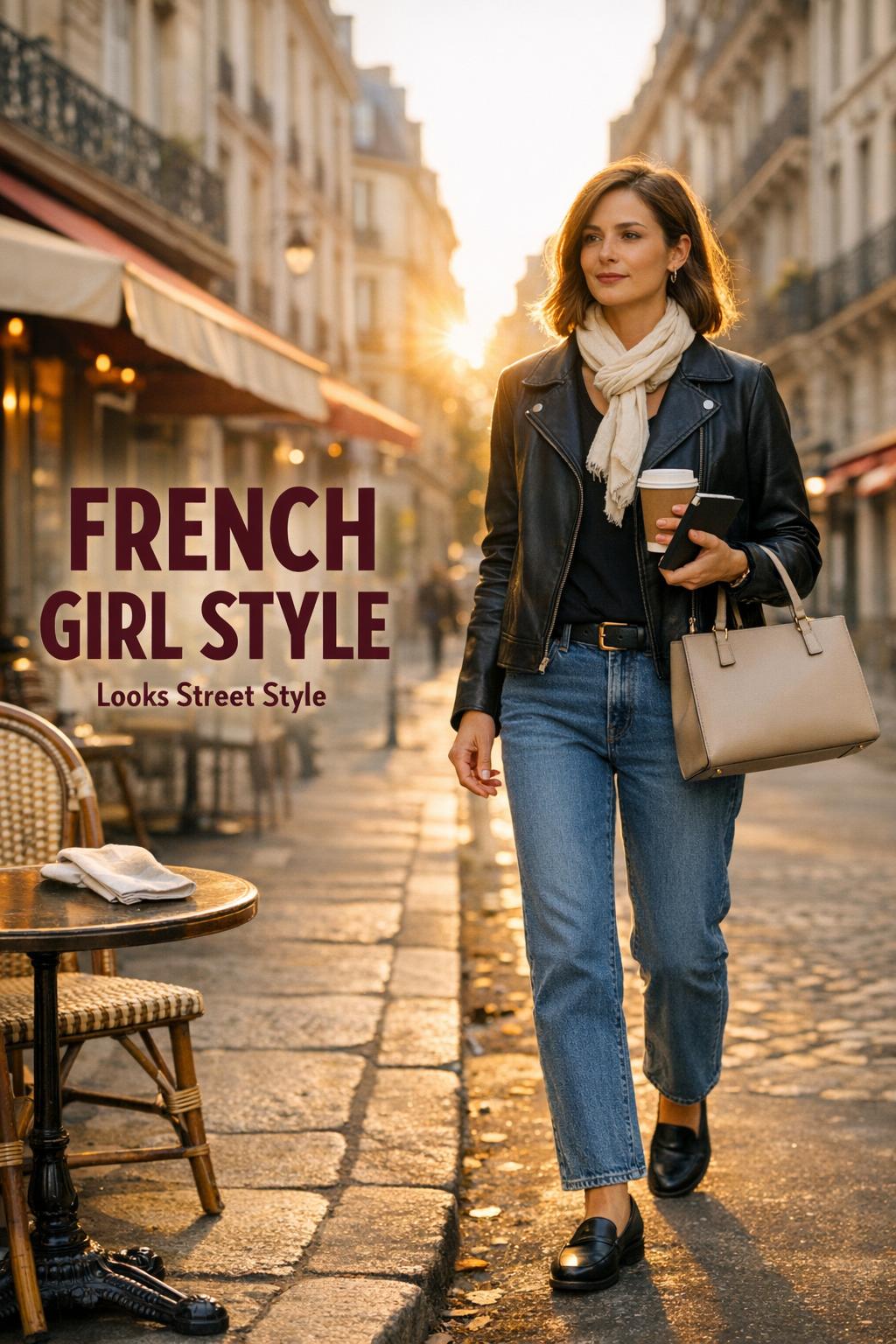
The core logic of french girl style: the dressing principles that make it work
French-girl style is best understood as outfit engineering. The formula is repeatable: classic staples, balanced proportions, and controlled texture contrast. It’s also aligned with the “quiet luxury” idea seen in modern brand roundups—less flash, more fit and finish—without requiring a single price tier.
Principle 1: build around a few “visual anchors,” not a full trend stack
A visual anchor is the piece your outfit composition revolves around—like a Breton stripe top, a sharp blazer, or a leather jacket. In french girl style, you typically pick one anchor and keep the supporting cast clean. This is why the Breton stripe is so powerful: it reads instantly, but it’s still a basic, so it doesn’t fight the rest of your look.
Principle 2: silhouette balance beats decoration
Instead of adding “cute” details, the look leans on proportion play: structured over relaxed, slim with straight, or crisp with soft. A blazer (structure) over denim (ease) creates a polished-but-not-stiff silhouette. A leather jacket adds edge and sharpness, turning even simple basics into a finished outfit.
Principle 3: tonal layering creates depth without clutter
Because french-girl outfits often live in neutrals and darker tones (a common guideline in “less is more” style rules), depth comes from layering and texture contrast, not loud color. Think smooth leather against cotton basics, or tailoring against denim. This reads refined in photos and in motion—ideal for looks street style inspiration and mode inspo boards that still need to function in daily life.
Principle 4: quality-over-quantity is a practical strategy, not a slogan
Quality matters most in items that take stress: jackets, blazers, and daily shoes. This is where brand examples—from premium references like Céline and Balenciaga to more accessible staples from Madewell, Sézane, COS, and even The Row as an aspirational benchmark—become useful. The point isn’t “buy expensive.” It’s “choose pieces that hold their shape,” because shape is the style.
The wardrobe blueprint: staples that consistently deliver Paris outfits
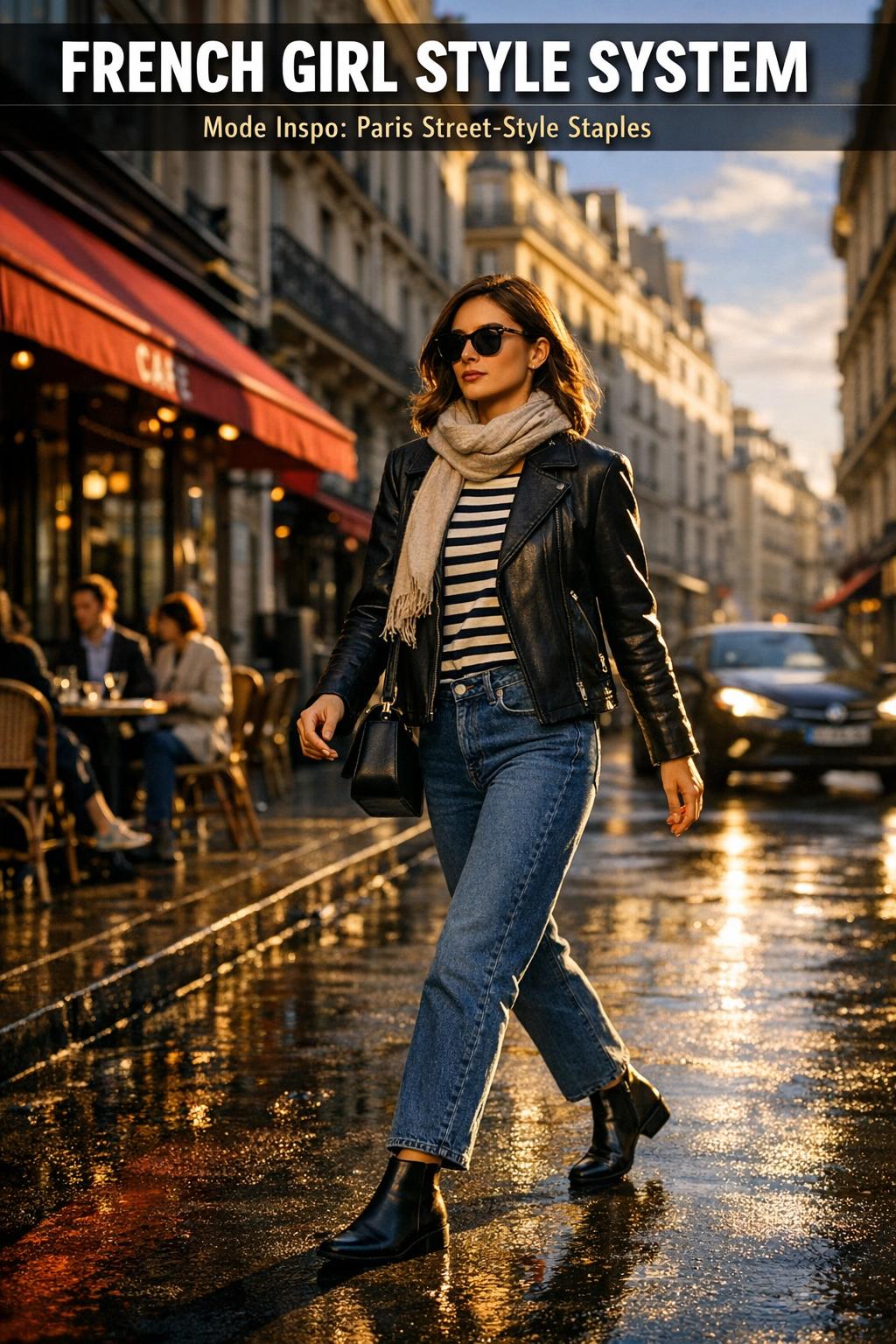
Across the most repeated french-girl wardrobe frameworks, a small core shows up again and again: the Breton stripe top, a blazer, and a leather jacket. Other pieces rotate, but these three control the silhouette and instantly signal Parisian chic. Use them as the backbone of your capsule wardrobe logic, then add a few supporting items to match your lifestyle.
The Breton stripe top: the instant Parisian signal
The Breton stripe top is more than a pattern; it’s a visual shorthand for french girl style. It’s also one of the few staples with a widely referenced origin story in modern fashion context: Coco Chanel is often credited with introducing the Breton stripe into the fashion conversation, cementing it as a “timeless” item rather than a seasonal print.
Style logic: the stripe acts like a built-in accessory. It adds structure and rhythm to the outfit without requiring extra jewelry, loud bags, or trend-heavy styling. That’s why it works for both minimal wardrobes and busy schedules: it’s already doing the visual work.
The blazer: the smart-casual converter
A good blazer is the fastest way to make basics look deliberate. It’s frequently named as a core french-girl staple because it solves multiple real-world scenarios: office-friendly, dinner-ready, and travel-polished. In brand terms, a Céline-style blazer represents the premium end of the silhouette—clean lines, understated authority—while brands like Madewell and Sézane are often positioned as accessible routes to that same tailored effect.
Style logic: tailoring adds vertical structure to the torso and defines the shoulder line. That structure makes denim look “elevated,” makes a tee look “intentional,” and keeps the overall look refined even if your hair, makeup, or accessories are minimal.
The leather jacket: effortless edge that still reads classic
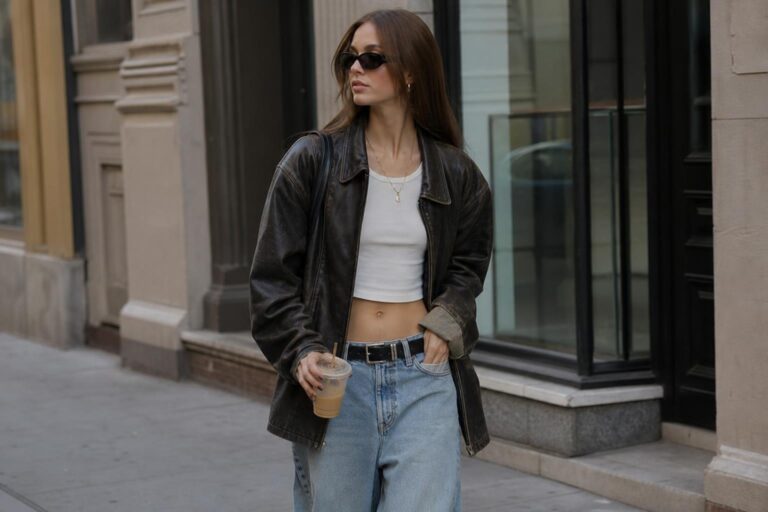
The leather jacket is the counterbalance to the blazer. Where tailoring signals polish, leather signals ease. It’s repeatedly positioned as seasonless because it layers well and instantly sharpens basics. It also pairs cleanly with the “devil-may-care” attitude often associated with french-girl styling—without becoming costume-y.
Style logic: leather functions as a texture statement piece. Because the texture is strong, everything else can stay simple: denim, a Breton stripe, a plain tee. That’s the essence of french-girl outfit composition—one strong note, the rest controlled.
The “extra” staple that’s quietly powerful: scarves
If you want an accessory that looks intentional but stays practical, a scarf is one of the most consistently recommended choices in french-girl tip lists. It’s functional in transitional weather, adds face-framing color or pattern without disrupting a neutral base, and can shift an outfit from casual to styled in seconds.
Style logic: scarves work because they live near the portrait zone (neck and face), which means they show up in photos and conversations—ideal for subtle look di moda impact—without requiring a full outfit change.
Brands that map to the look: premium vs accessible, and how to mix them
French-girl style is often presented as “timeless,” but the shopping reality is a high-low mix. Many guides name premium fashion houses as reference points and then offer accessible labels as practical entry routes. This is useful because it separates silhouette targets from budget constraints.
Premium reference points: Chanel, Balenciaga, and the polish of The Row
Chanel sits in the background of french-girl style through foundational ideas—like Coco Chanel’s association with the Breton stripe narrative—more than through literal head-to-toe branding. Balenciaga appears as a contemporary touchpoint through campaign references that keep French style in the modern conversation. The Row shows up in wardrobe discussions through ultra-clean outerwear, like a cape jacket, that communicates understated luxury through proportion and fabric rather than logos.
How to use these references: treat them as design cues. Aim for clean lines, strong outerwear structure, and minimal fuss. Even if you never buy these brands, they help you identify what “refined” looks like in cut and finish.
Accessible building blocks: Sézane, Madewell, Clare V., and COS
Accessible doesn’t mean trend-only. Labels frequently named in french-girl brand roundups—Sézane, Madewell, Clare V., and COS—fit the aesthetic because they support wardrobe fundamentals: wearable tailoring, strong basics, and bags that read classic. Clare V. is especially useful when you want one accessory that adds design character without turning the look into a statement outfit.
Shopping strategy: prioritize the pieces that control your silhouette. If your blazer and jacket are strong, your base layers can be simpler. This is the practical side of “quiet luxury”: your outfit looks expensive when the structure looks intentional, regardless of labels.
The people who shape the modern conversation: muses, actors, and the myth check
French style has public faces, and that matters because “french girl style” is partly a media-created shorthand. When Vogue draws a line between “French girl style” and “French woman style,” it’s a reminder that the trope can flatten real variation. Using a few well-known figures as reference points helps you choose a direction instead of chasing an abstract vibe.
Jeanne Damas: the modern wardrobe-staple translator
Jeanne Damas is often referenced in modern “French-girl staples” contexts because she represents a wearable, repeatable version of the aesthetic—less about novelty, more about a consistent uniform. Whether you’re building a capsule wardrobe or just trying to simplify your daily decisions, that “uniform thinking” is the hidden advantage of french-girl style.
Isabelle Huppert and Philippine Leroy-Beaulieu: the “French woman style” lens
Isabelle Huppert and Philippine Leroy-Beaulieu are used in editorial discussions to illustrate a more mature, nuanced frame—often labeled “French woman style.” The takeaway isn’t age; it’s intention. This lens emphasizes assured tailoring, restraint, and presence. If “French girl style” feels too playful or too trope-y for your life, this is the pivot: keep the staples, sharpen the structure, and let the outfit be quieter.
Paris context matters: how looks street style influences outfit choices
Paris is not just a backdrop; it’s a functional style environment. City walking encourages stable footwear and layers. Café-to-meeting schedules favor outfits that can look appropriate without a full change. That’s why the most repeated Parisian chic elements are not fragile: blazers, leather jackets, denim, simple tees, and strong accessories.
Editorial takes often reference Paris neighborhoods like Le Marais and Saint-Germain-des-Prés as shorthand for street-level style cues. Whether or not you’re actually in those districts, the practical lesson transfers: dress for movement, keep the palette cohesive, and let one piece carry the fashion message. That’s how you get mode inspo that still feels real.
Campaign culture also shapes perception. Balenciaga campaigns, for example, show how French style tropes get reframed in modern fashion media. Use that as a reminder: the “rules” are flexible. The discipline is in the outfit composition, not in copying a single era.
Outfit solutions for real life: repeatable combinations that deliver french girl style
Below are outfit solutions designed for the most common constraint: you want Paris outfits that look polished, but you also need comfort, walkability, and easy temperature control. Each solution uses the core wardrobe anchors (Breton stripe top, blazer, leather jacket, scarf) and keeps the styling logic transparent so you can adapt it.
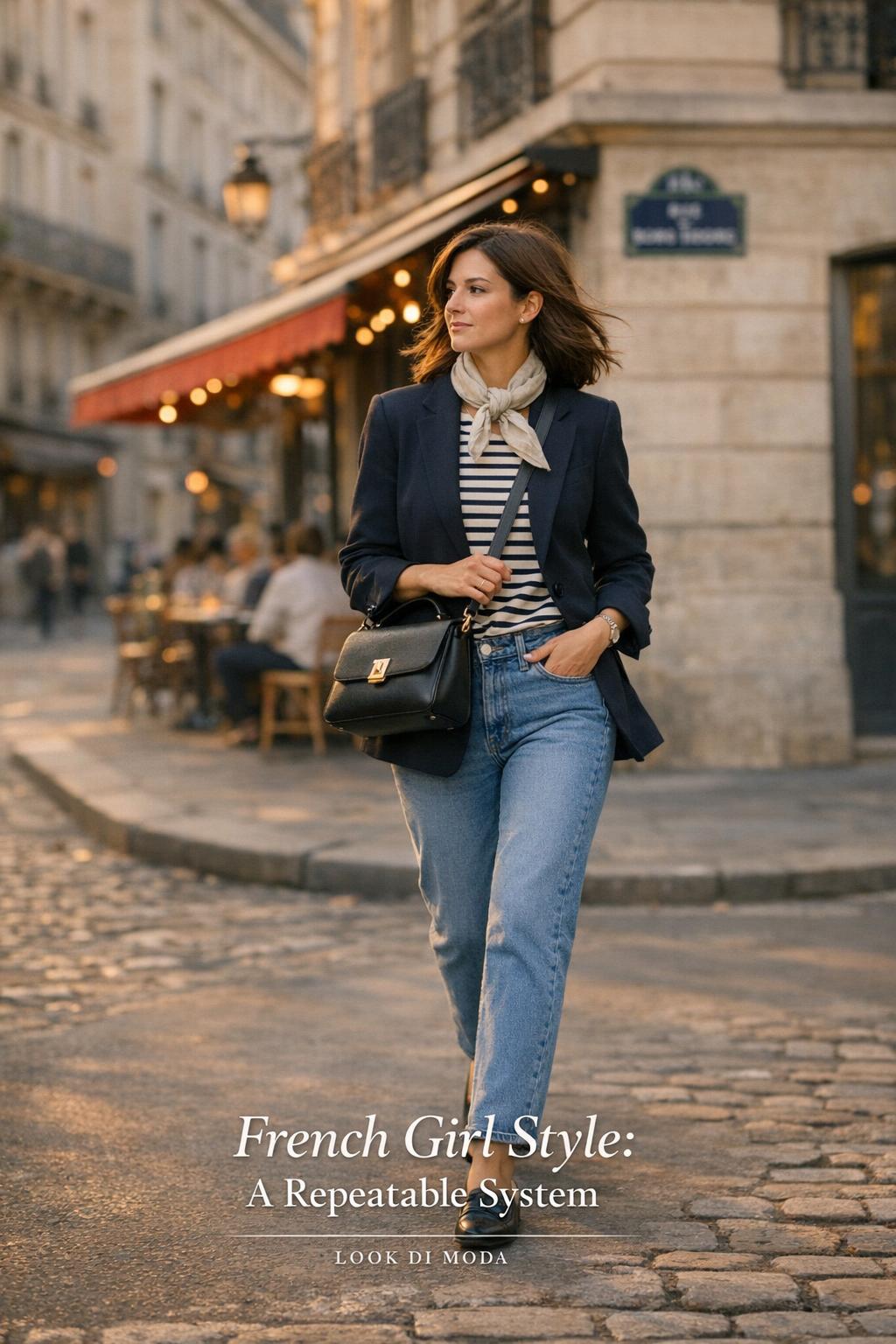
Outfit solution: the “Breton + blazer” smart-casual balance
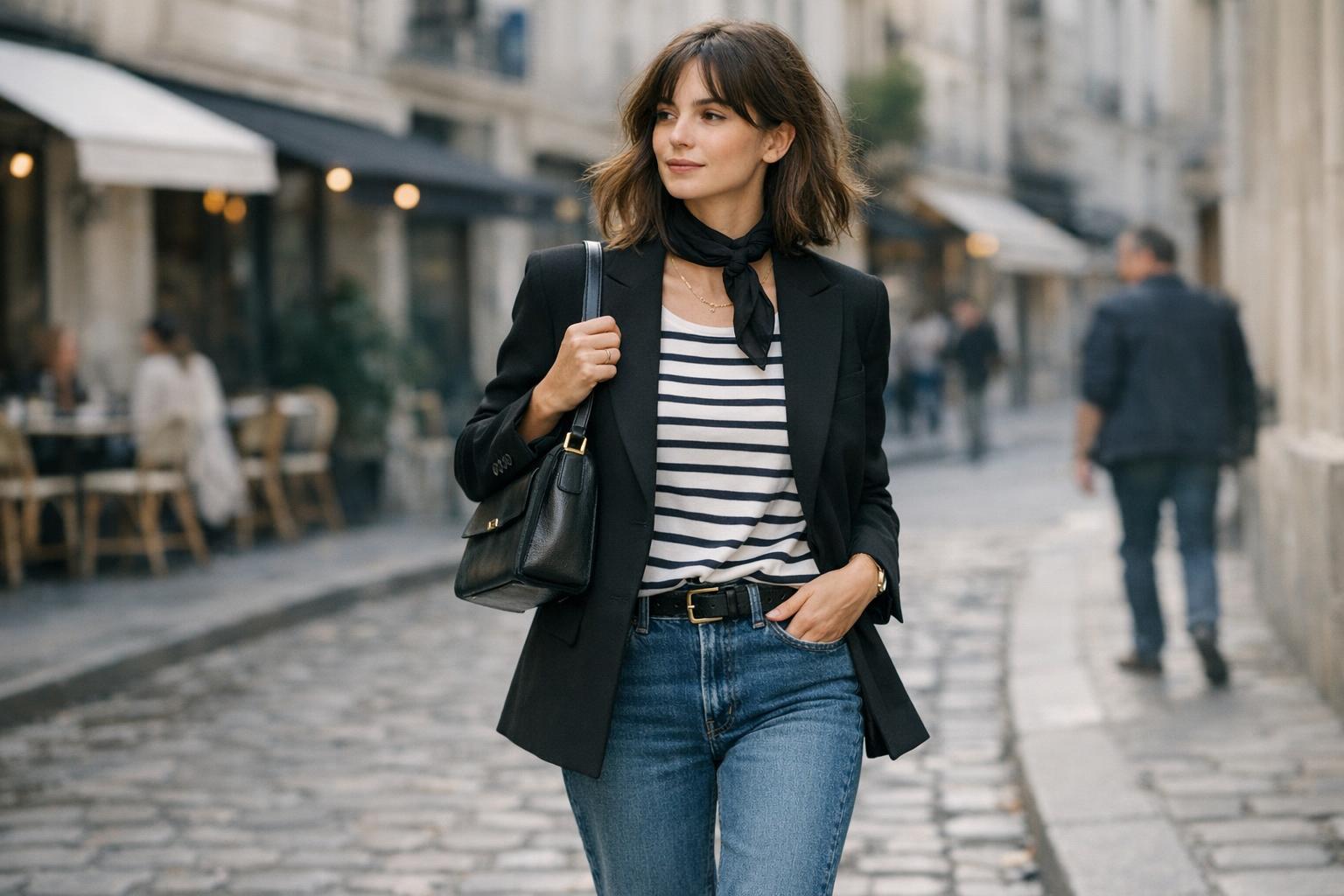
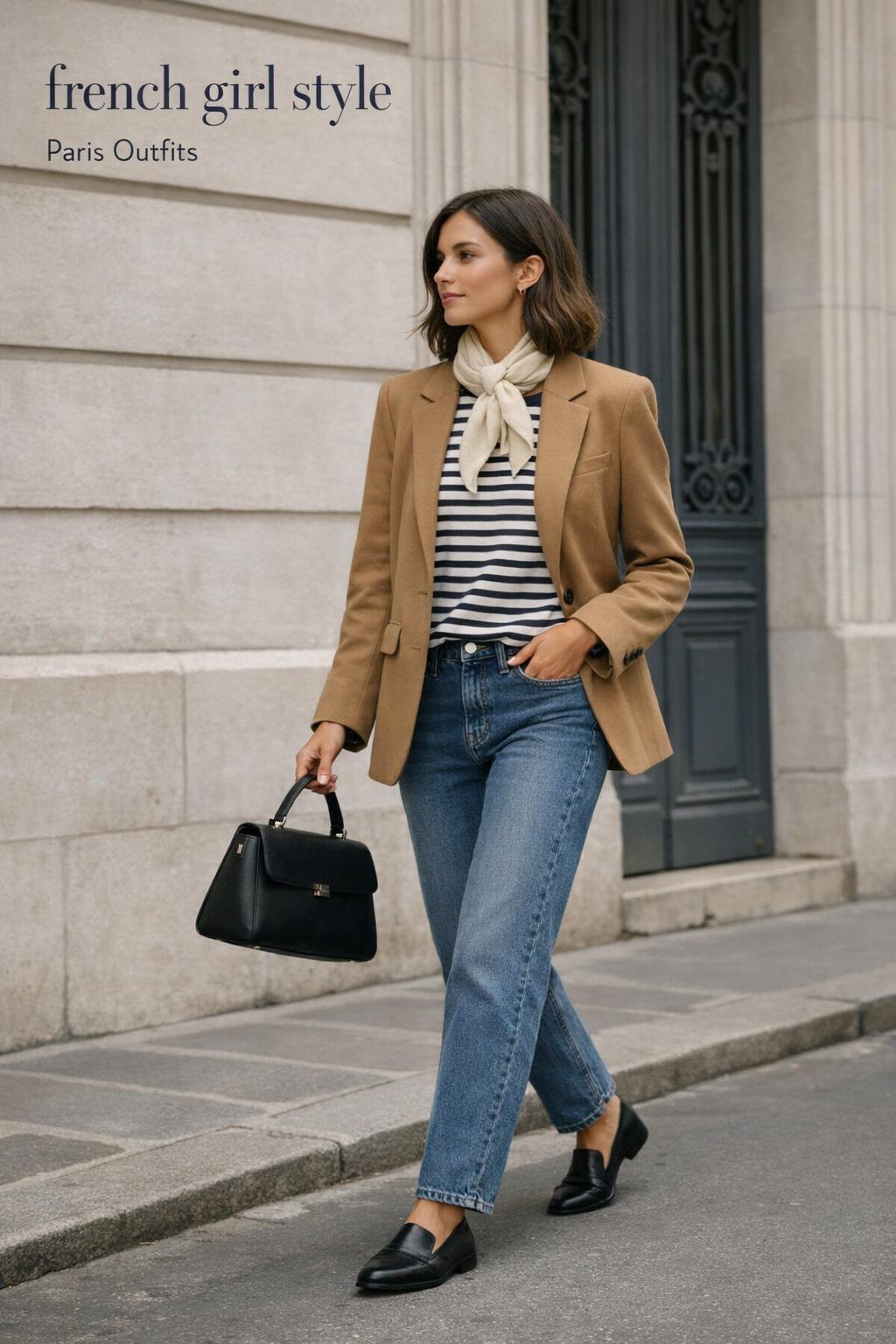
Key pieces: Breton stripe top, tailored blazer (think Céline-inspired structure), straight-leg denim, minimal bag (Clare V. is a common style match), optional scarf.
Why this works: the stripe provides visual rhythm while the blazer adds architectural structure. Denim keeps the outfit grounded and wearable, preventing the blazer from feeling corporate. The result reads like Paris street style because it’s built on contrast—tailoring versus casual texture—without extra decoration.
When to wear it: work-from-anywhere days, casual meetings, museum afternoons, travel days when you want to look put together on arrival.
Outfit solution: the leather jacket “effortless edge” uniform
Key pieces: leather jacket, simple tee or Breton stripe, denim, streamlined shoes, optional scarf for temperature shifts.
Why this works: the leather jacket acts as the statement piece through texture, not print. That keeps the outfit inside the french-girl restraint zone. The jacket also performs: it holds up in wind, adds warmth, and maintains its silhouette even when you’re moving. This is the kind of look di moda impact that doesn’t require constant adjusting.
When to wear it: evenings out, casual dinners, gallery openings, and any day when you want to look sharper with minimal effort.
Outfit solution: the cape as a polished outerwear statement (without looking “done”)
Key pieces: cape outerwear (with reference points like a The Row cape jacket silhouette or a COS cape option), slim-to-straight base layers, simple top, minimal accessories.
Why this works: a cape creates a strong top-line silhouette with very little styling input. It’s an outerwear-first strategy: let the outer layer carry the fashion message, keep everything underneath quiet and streamlined. This approach is especially effective when you want elegance but don’t want to rely on overtly “dressy” items.
When to wear it: transitional weather, city events, and moments when you want immediate polish over basics. It’s also a clean alternative to a blazer when you want movement and softness.
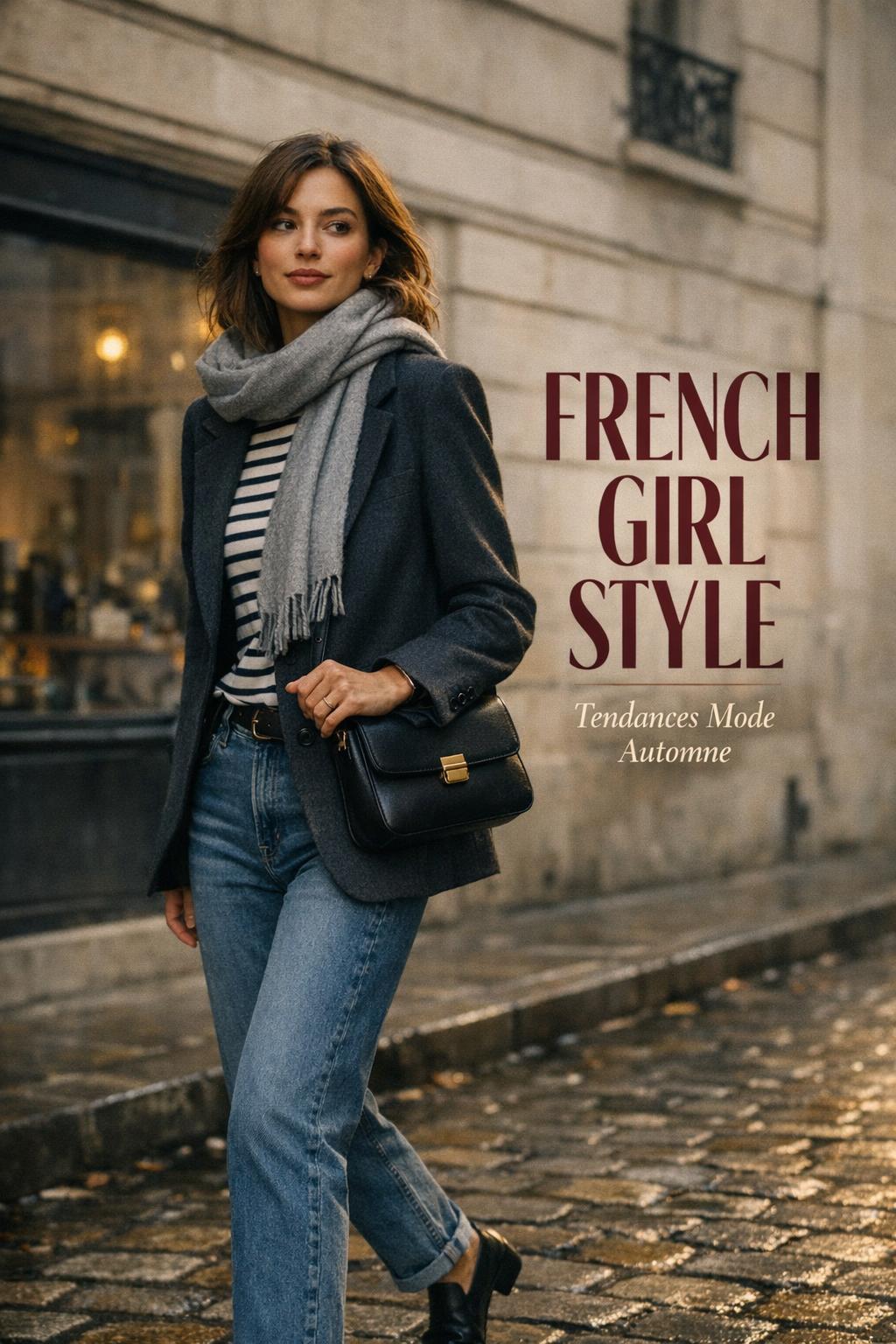
Outfit solution: tendances mode automne layering that stays sleek
Key pieces: blazer plus scarf, or leather jacket plus scarf; neutral base layers; denim as the stabilizer; minimal bag.
Why this works: autumn transitions demand flexibility. The scarf becomes a modular warmth layer that doesn’t add bulk the way heavy knits can. Keeping the base neutral supports tonal layering, and the jacket or blazer maintains structure—critical for that “effortless but intentional” line french-girl style depends on.
When to wear it: unpredictable mornings, long outdoor walks, commuter days, and any schedule that goes from daytime casual to evening plans.
Outfit solution: modern Paris outfits with a trend insert (tube tops, but controlled)
Key pieces: tube top as a trend insert, blazer as the structure layer, denim or clean trousers, minimal accessories.
Why this works: trend pieces can fit french-girl dressing if they’re framed by classics. Here, the blazer does the heavy lifting—controlling the silhouette and keeping the look refined. The tube top stays a supporting note rather than the whole story, which is the difference between “trend outfit” and “Parisian chic with a current edge.”
When to wear it: warm evenings, vacations, or social plans where you want something current without abandoning the core wardrobe language.
Outfit solution: warm-weather french-girl footwear logic (sandals and espadrilles)
Key pieces: simple summer base outfit (tee or Breton stripe and denim), sandals or espadrilles, light jacket layer for late-day temperature drops.
Why this works: french-girl warm-weather styling often stays minimal in clothing and lets footwear signal the season. Sandal trends and espadrilles can read distinctly “French” in a way that still feels practical for walking. Keep the rest of the outfit clean so the shoe choice feels intentional rather than busy.
When to wear it: city summers, travel days, weekend plans, and any situation where you want looks street style energy without heavy layers.
Tips that make french girl style feel natural (not like a costume)
French-girl styling succeeds when it looks like your default, not your performance. That comes down to small technical decisions: fit, repetition, and editing. Use these tips to make your wardrobe feel coherent across days.
- Choose one hero layer per outfit. If you’re wearing a blazer, keep the rest quiet. If you’re wearing a leather jacket, skip extra “statement” moves.
- Repeat your best formulas. French-girl wardrobes are built around a few reliable combinations—Breton + denim + blazer is a repeatable template, not a one-time look.
- Keep accessories functional. A scarf adds warmth and finish. A structured bag (often the role Clare V. plays in brand roundups) adds polish without noise.
- Use brands as fit references. Céline and The Row can guide the silhouette you’re aiming for; COS, Madewell, and Sézane can help you execute it in a more accessible way.
Tip for mode inspo overload: if a Pinterest board is pulling you in ten directions, reduce it to one jacket silhouette (blazer or leather), one stripe (Breton), and one accessory (scarf). That edit alone usually brings the outfit back into focus.
Common mistakes that break the Parisian chic illusion
Most french-girl outfit misses come from understandable instincts: adding more to feel “styled,” or chasing a trope instead of building a silhouette. Correcting these mistakes is often the fastest upgrade.
Mistake: over-accessorizing to “prove” the look
Why it happens: french girl style is associated with signature touches, so it’s tempting to stack them—scarf, hat energy, bold bag, loud jewelry—on top of already strong pieces. The result competes with itself. The fix: let one item speak. A scarf is enough if your blazer is sharp; a great jacket is enough if your base is clean.
Mistake: ignoring fit in favor of the “right” item
Why it happens: you can buy the Breton stripe top and still miss the effect if the blazer pulls, the leather jacket is too tight, or the proportions feel off with your denim. The fix: prioritize comfort and mobility—especially in shoulders and waist—because confident movement is part of the “effortless” read.
Mistake: treating “French girl style” as one uniform for every person and age
Why it happens: the trope is packaged as a single vibe. But editorial discussions make it clear there’s “French girl style” and “French woman style,” with different emphasis. The fix: decide which lens matches your life. If you want sharper authority, take cues from the Isabelle Huppert and Philippine Leroy-Beaulieu framing—same restraint, more tailored confidence.
A quick decision framework: build your outfit like a Paris editor
When you’re short on time, a decision framework prevents overthinking. Use this to assemble Paris outfits that still feel personal.
- Start with the anchor: Breton stripe top, blazer, leather jacket, or cape.
- Choose the stabilizer: denim is the most common, because it neutralizes both blazer polish and leather edge.
- Add one functional finisher: scarf for temperature shifts or a structured bag for polish.
- Stop there: if you keep adding, you dilute the “je ne sais quoi” restraint.
This framework also helps you shop better. Instead of buying random “French” pieces, you’re filling functional roles: anchor, stabilizer, finisher. That’s how capsule wardrobes become realistic rather than aspirational.
Bringing it all together: your french-girl capsule wardrobe, without the clutter
French-girl style works best when it reduces decisions. The Breton stripe top gives you instant identity, the blazer gives you instant polish, and the leather jacket gives you instant edge. A scarf adds a practical styling lever, and brand choices—from Chanel as historical influence to Balenciaga as modern media touchpoint, from The Row and COS to Sézane, Madewell, and Clare V.—help you navigate price and finish without changing the core logic.
Use Paris as a functional reference: walkable outfits, layered comfort, and disciplined editing. Whether your inspiration board reads “mode inspo,” “look di moda,” or “looks street style,” the most reliable results come from the same principle: one strong anchor, clean supporting pieces, and a silhouette that holds up all day.
FAQ
What is french girl style, in practical terms?
French girl style is a wardrobe system built around a few classic staples—most notably the Breton stripe top, a blazer, and a leather jacket—styled with restraint so the outfit looks intentional but not overworked, often described as “je ne sais quoi” or Parisian chic.
How do I dress like a French girl without buying a whole new wardrobe?
Start with one anchor piece (Breton stripe top or a structured blazer), pair it with simple denim as the stabilizer, and add one functional finisher like a scarf or a structured bag; the effect comes from silhouette balance and editing, not from owning dozens of “French” items.
Why is the Breton stripe top considered iconic?
The Breton stripe top is a recurring French-girl wardrobe staple and is widely linked in fashion context to Coco Chanel introducing the Breton stripe into the style conversation, which helped cement it as a timeless Paris-associated visual signature.
What are the core french-girl wardrobe staples?
The most consistent core staples are the Breton stripe top, a well-fitting blazer, and a leather jacket, supported by versatile basics like denim and a few purposeful accessories such as scarves that add function and polish without clutter.
Which brands are associated with french-girl style?
Brand references often range from premium houses and cues like Chanel, Balenciaga, and The Row to more accessible wardrobe builders such as Sézane, Madewell, Clare V., and COS, all used to illustrate how the same silhouette logic can be achieved at different price points.
What’s the difference between “French girl style” and “French woman style”?
French girl style is commonly framed as playful, insouciant, and effortlessly casual, while “French woman style” is often discussed as a more nuanced, assured version of the same restraint—frequently illustrated through figures like Isabelle Huppert and Philippine Leroy-Beaulieu with an emphasis on confident tailoring and presence.
How can I make a blazer look Parisian instead of corporate?
Use denim as the casual counterbalance and keep the rest of the look clean—Breton stripes or a simple tee underneath, minimal accessories, and a structured silhouette; this tailoring-versus-denim contrast is a core Paris street style formula.
How do I adapt french-girl style for tendances mode automne?
Build flexible layers by using a blazer or leather jacket as your main outer layer and adding a scarf for modular warmth; keeping the base outfit neutral helps tonal layering look intentional even as temperatures shift throughout the day.
Can trend pieces like tube tops still fit french-girl style?
Yes, if the trend is treated as a controlled insert: pair a tube top with a structured blazer and simple denim so the outfit stays anchored in classic proportions and doesn’t rely on multiple trend signals at once.