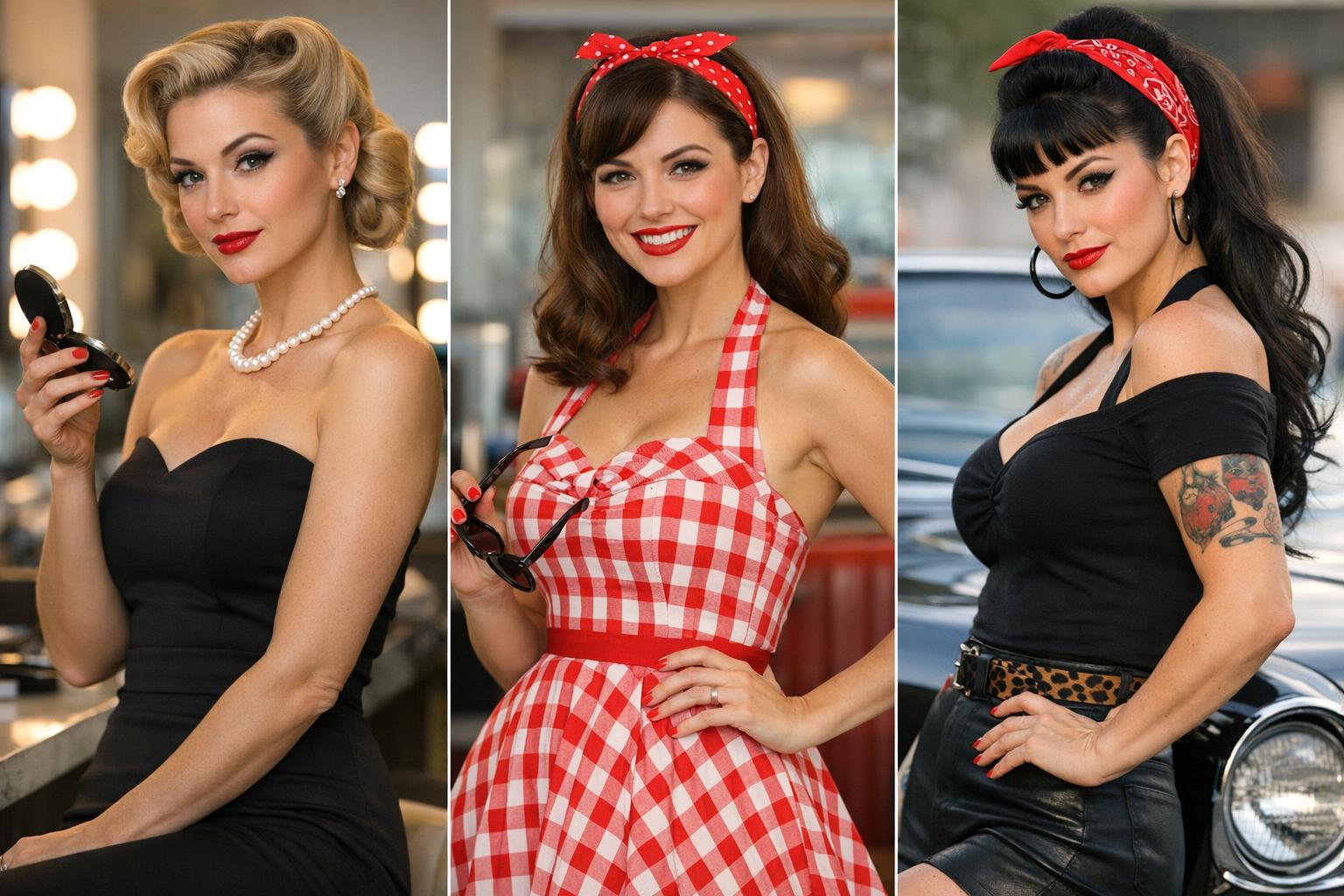
Classic vs Retro vs Rockabilly: Finding Your Pin Up Style
Pin up style vs. retro pin-up vs. rockabilly: why these aesthetics blur together
Pin up style is one of those fashion languages people recognize instantly—high-waisted silhouettes, polished hair and makeup, and a confident, playful glamour that reads as unmistakably mid-century. But in modern closets and on social feeds, “pin up,” “retro pin-up,” and “rockabilly” are often used interchangeably, even though they don’t always produce the same outfit composition or mood.
The confusion makes sense. All three aesthetics pull from vintage and retro fashion, especially the 1940s–1950s era, and they share key wardrobe geometry: fitted bodices, waist emphasis, and iconic dress shapes like the pencil dress and circle dress. Add in cultural shorthand icons—Bettie Page and Rita Hayworth come up constantly as reference points—and the lines can feel even thinner.
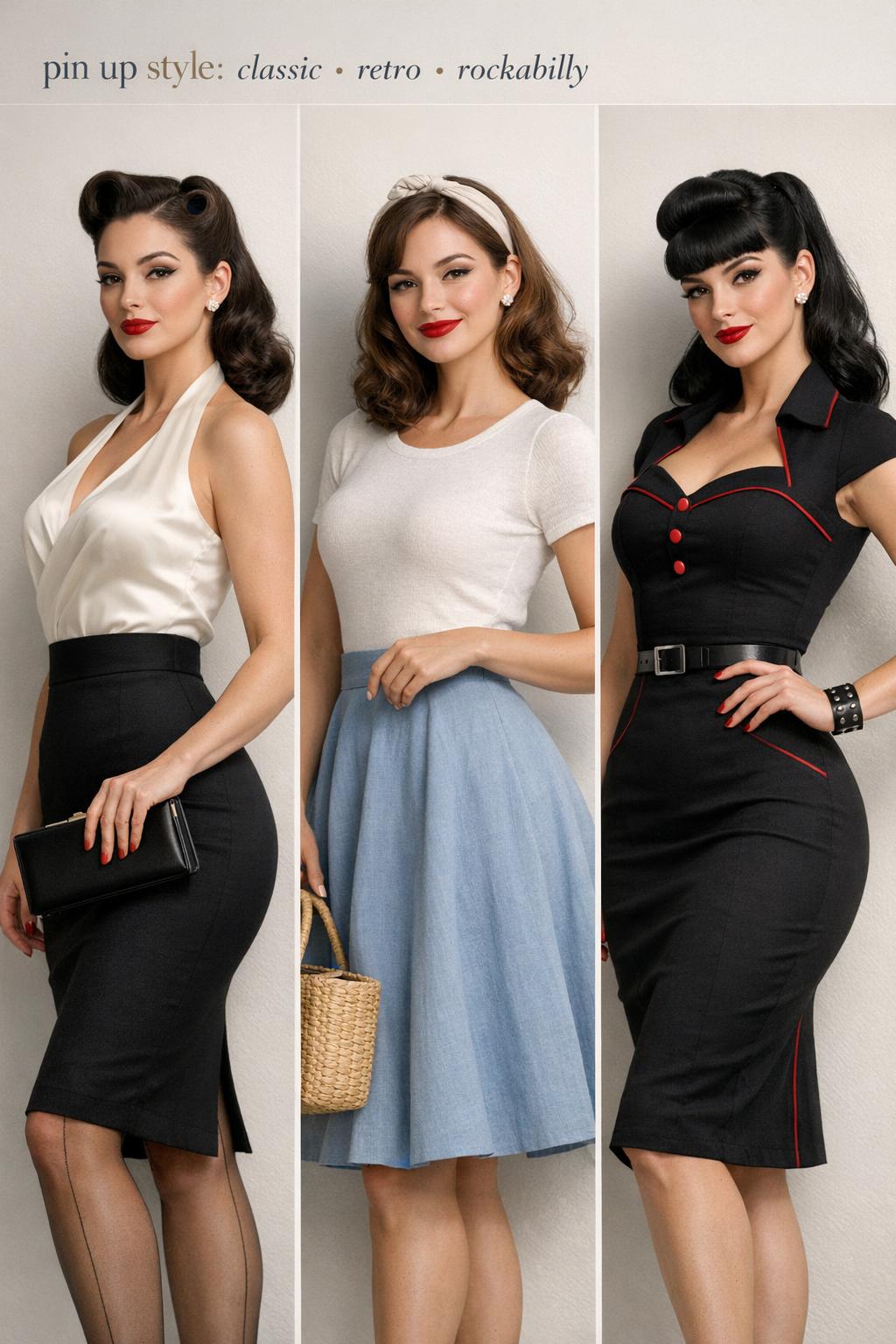
This comparison breaks down the pin up aesthetic through a practical lens: silhouettes and structure, hair and makeup cues like winged eyeliner and red lipstick, accessories and footwear, and where modern brands and collections fit in (including Los Angeles-rooted Pinup Girl Clothing and the pin-up inspired design language of Malone Souliers). You’ll also get pinup outfits ideas and pin up photoshoot ideas that clarify how each style behaves in real life—casual, work-appropriate, or statement occasions—so you can choose intentionally rather than just dressing “retro.”
Style overview: classic pin up style (the 1940s–1950s glamour blueprint)
Classic pin up style centers on a controlled silhouette with a deliberately feminine structure: a defined waist, fitted bodice, and either a narrow line (pencil dress, wiggle dress, high-waist pencil skirt) or a full shape (circle dress). The aesthetic is not only about clothing; it’s a complete styling system where hair, makeup, and accessories are expected to finish the look rather than merely “match” it.
Found the dress? Keep the rest in one place.
Zarellea brings guest details, vendors, timelines, and every next step together — so your wedding plan feels as good as your look.
Color and print tend to feel graphic and intentional within the pin up aesthetic—polka-dot elements are a recurring visual cue—and the overall mood is polished and camera-ready. Even when the outfit is simple, the style logic usually adds one or two strong visual anchors: a high waistline, a halter neck, or a statement lip.
Because pin up style is often referenced through iconic figures, it also carries a clear beauty direction. Bettie Page and Rita Hayworth are frequently cited as inspiration points; in practice, that translates to a beauty focus on precision: red lipstick, winged eyeliner, and hair that looks shaped on purpose rather than casually undone.
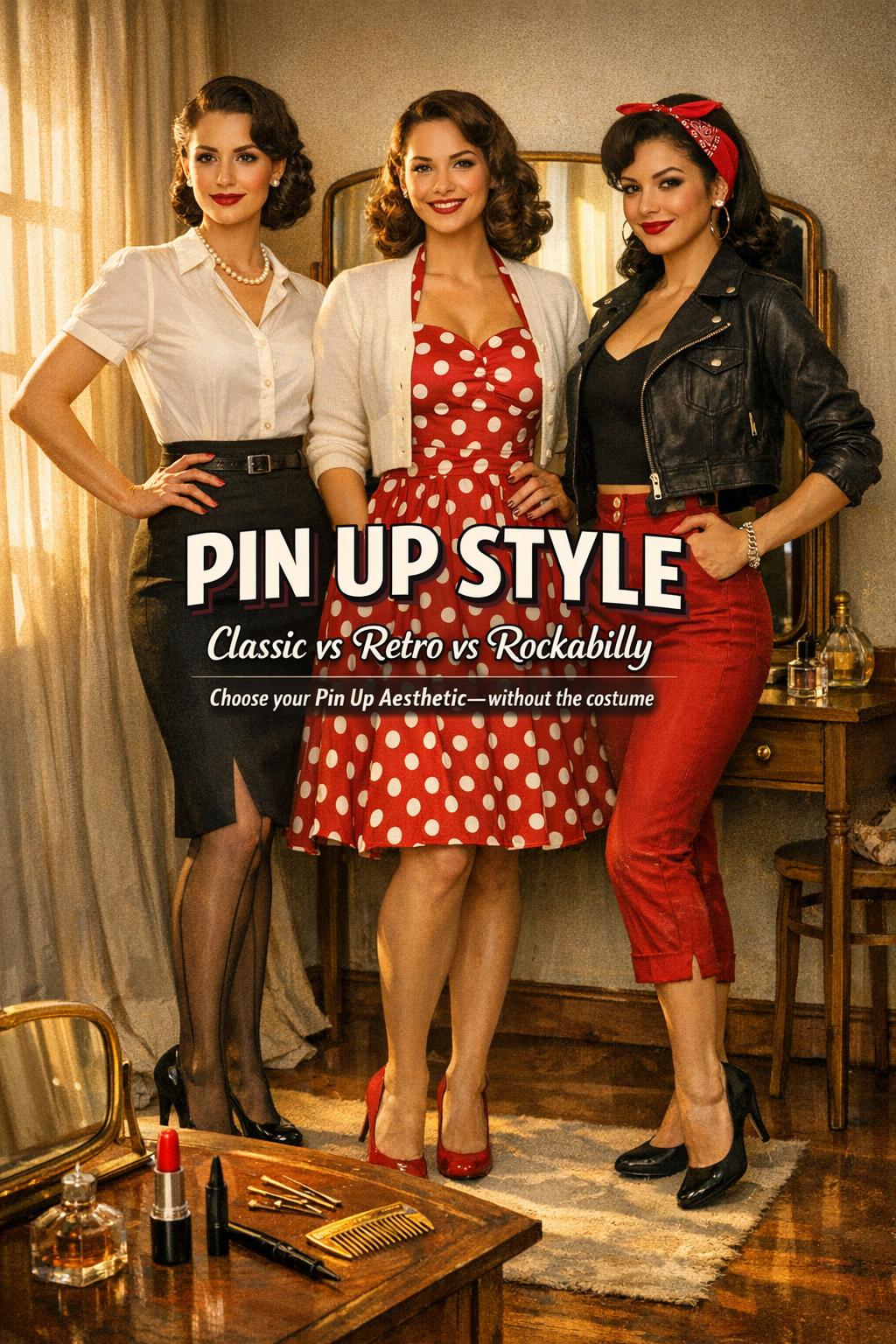
Style overview: retro pin-up (modern reinterpretation and everyday translation)
Retro pin-up uses the same core vocabulary—1950s silhouettes, high-waisted fashion, and recognizable pin-up beauty cues—but the intention shifts. Instead of strict period fidelity, retro pin-up prioritizes “the vibe” and adapts it for modern wardrobes, modern fabrics, and mixed styling contexts (casual errands, dinner plans, portraits, or themed events).
In practical terms, retro pin-up is more forgiving about how many elements must be present at once. You might keep the silhouette (a fitted wiggle dress) but simplify the accessories; or keep the makeup cue (winged eyeliner and red lipstick) while wearing a more modern version of a pencil dress. The result still reads pin-up, but less like a complete costume and more like an integrated personal style.
This is also the space where photography and portraits become a major driver. Retro pin-up content often emphasizes how the look translates on camera—hair and makeup clarity, outfit readability, and “iconic looks to recreate”—which influences fabric choice, contrast, and accessory scale.
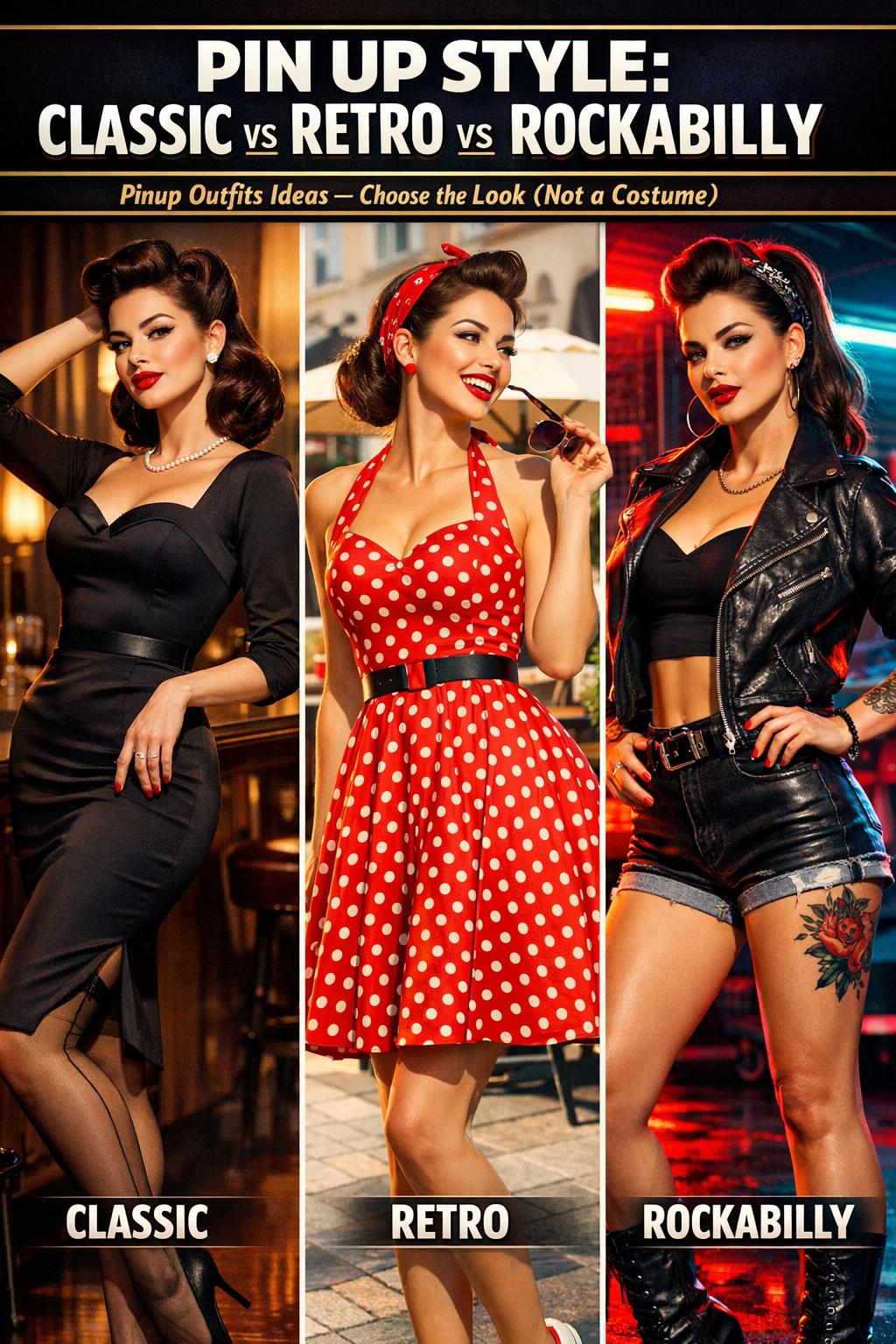
Style overview: rockabilly influence (pin-up silhouettes with an edge)
Rockabilly influence frequently overlaps with pin up style, but it changes the styling philosophy. Where classic pin-up leans into polished glamour, rockabilly brings a tougher, more subculture-coded energy to the same mid-century silhouette toolkit. The overlap is real—high waistlines, fitted dresses, and vintage styling cues—yet the outfit balance often feels bolder and more attitude-driven.
Because the shared foundation is the 1950s silhouette, rockabilly influence can still produce textbook pinup outfits ideas: a high-waisted skirt with a fitted top, or a halter neck dress with defined waist emphasis. The differentiator is how the look is “punctuated”—through sharper contrast, more statement-driven accessory choices, and a styling stance that can feel less “Hollywood glamour” and more “retro scene.”
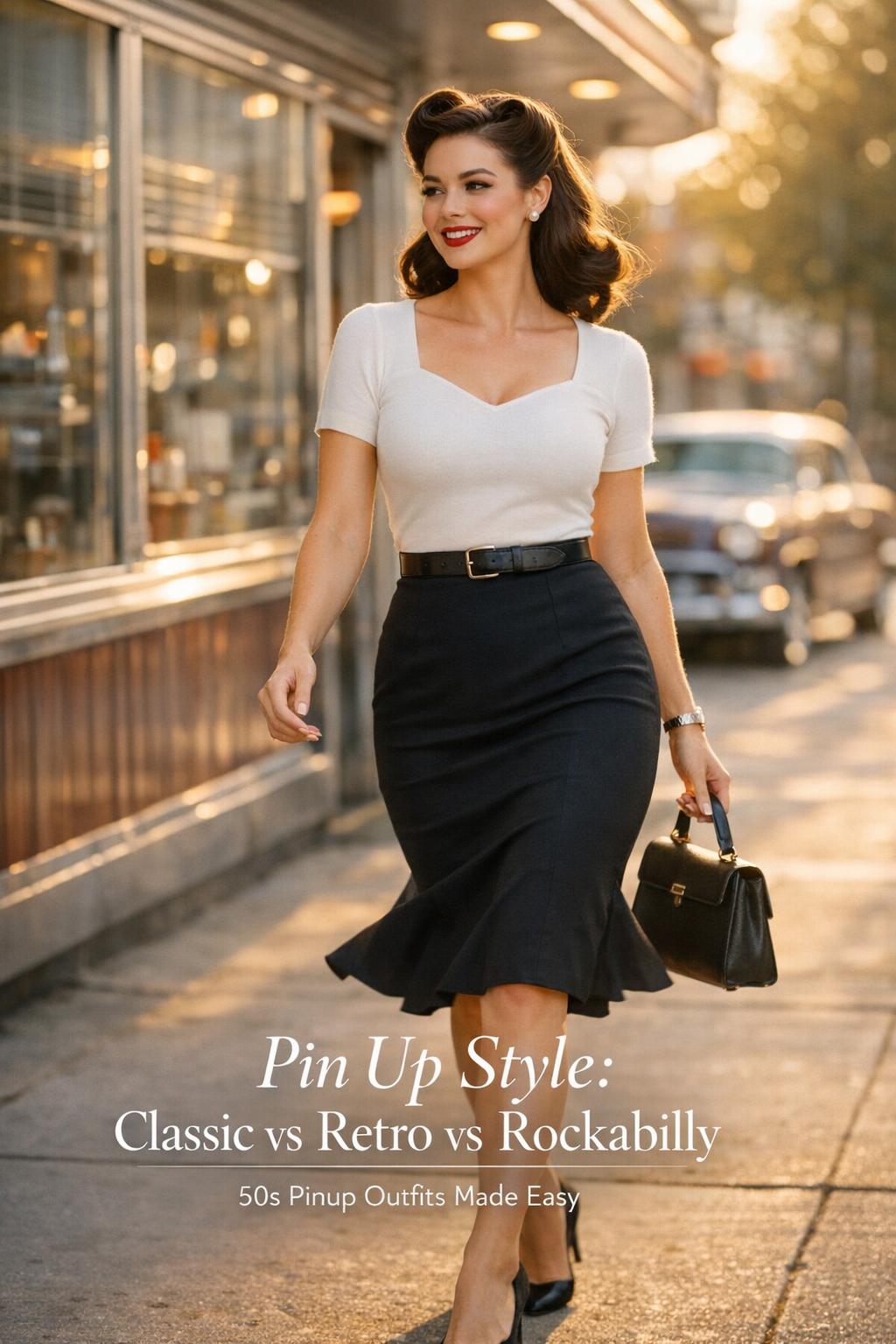
Key differences that change the entire outfit composition
Silhouette control: sculpted glamour vs. flexible retro vs. attitude-led styling
Classic pin up style typically treats silhouette like architecture. A pencil dress or wiggle dress is chosen because it creates a clean vertical line and a defined waist; a circle dress is chosen because it creates a deliberate hourglass proportion play. Retro pin-up keeps those shapes but relaxes the rules: the silhouette still matters, but you can choose one “hero” element rather than building a fully period-synchronized look. With rockabilly influence, the silhouette may still be 1950s, but the styling tension becomes part of the design—less about pristine smoothness and more about boldness as a visual signature.
Beauty direction: precision cues vs. selective cues
Pin up style is heavily signaled through hair and makeup: winged eyeliner and red lipstick aren’t just optional; they’re high-impact identifiers that make the outfit read “pin-up” even at a glance. Bettie Page and Rita Hayworth are not only references—they represent a consistent beauty discipline: structured hair, defined liner, and a lip color that holds its own as a statement piece. Retro pin-up often uses these cues selectively (for example, the red lip without the full hair set), while rockabilly influence may keep the classic makeup but push it into higher contrast styling choices so the beauty feels more graphic than soft-glam.
Formality and context: editorial polish vs. wardrobe integration
Classic pin-up reads more formal because it’s inherently complete: outfit, hair, makeup, and accessories behave as a coordinated system. Retro pin-up is easier to integrate into everyday wear because it allows a modern “capsule” approach—one or two pin-up elements anchored by simpler pieces. Rockabilly influence tends to signal a scene-adjacent look, so it can read more statement-driven in casual settings even when the garments overlap with 50s pinup outfits.
Wardrobe pieces: same categories, different priorities
All three aesthetics rely on a similar wardrobe roster—high-waisted skirts, pencil dresses, circle dresses, wiggle dresses, and halter neck lines—but they rank them differently. Classic pin up style prioritizes pieces that create clean, unmistakable vintage geometry. Retro pin-up prioritizes versatility: the same high-waist pencil skirt can work with a fully styled pin-up look or a minimal modern top. Rockabilly influence often treats those pieces as a base layer for a stronger statement, where the “edge” becomes as important as the silhouette itself.
Visual style breakdown: how the differences show up in real outfits
Proportions and balance: the waist is the visual anchor
Across the board, the waistline is the central visual anchor, but how it’s emphasized changes the read. In pin up style, the waist is highlighted with clean garment lines: a fitted bodice meeting a high-waisted skirt, or a wiggle dress that maintains a continuous, controlled silhouette. In retro pin-up, the waist emphasis can be a single strong component—like a high-waisted skirt—while the rest stays simpler. With rockabilly influence, the waist is still a focal point, but the total look can feel more contrast-driven; the waist emphasis becomes part of an overall high-impact composition rather than the sole point of refinement.
Layering approach: minimal layers, maximum clarity
Pin-up styling tends to avoid heavy layering because the silhouette is the message. Too many layers can blur the fitted bodice and interrupt the clean lines that make a pencil dress or circle dress look intentional. Retro pin-up may allow light layering if it doesn’t disrupt proportion—think of layering as a framing device rather than warmth-first styling. Rockabilly influence can tolerate more visual interruption because the aesthetic accepts a more statement-driven, less “clean line” philosophy, but the best looks still protect the waist definition to keep the mid-century shape readable.
Accessories: punctuation marks, not noise
In classic pin up style, accessories behave like punctuation marks: they finish the look without competing with the silhouette. Hair bows, seamed stockings, and carefully chosen details reinforce the era cue and create a cohesive “mise-en-scène.” Retro pin-up often uses fewer accessories but chooses them for impact—one hair detail, one strong lip, one deliberate shoe. Rockabilly influence tends to treat accessories as part of the attitude layer: the accessory story can be bolder, but the strongest outfits still avoid clutter that distracts from the defined waistline.
Footwear as a style translator: vintage glamour vs. modern reinterpretation
Footwear is where modern reinterpretation becomes obvious. A brand-led perspective like Malone Souliers’ “the art of pin-up” framing shows how pin-up glamour can be translated through design language and silhouette references, especially when styling modern pieces back to 1950s-inspired outfits. In classic pin up style, shoes typically support the vintage composition; in retro pin-up, shoes can be a modern anchor that keeps the look from feeling costume-like; with rockabilly influence, footwear can lean into the statement energy while still complementing the vintage silhouette.
Pinup outfits ideas through a comparison lens (not just a list)
Outfit planning is where these aesthetics diverge most clearly. The same occasion can be styled three different ways simply by changing how strictly you enforce silhouette discipline, how many beauty cues you include, and whether you prioritize polished glamour or a more attitude-driven finish. Use the comparisons below as styling logic templates: each one shows how the same “slot” in your life—casual, polished, photo-ready—shifts depending on the aesthetic.
Example comparison: casual daytime (errands to brunch)
Classic pin up style approaches casual as “scaled-down polish.” A high-waist pencil skirt or high-waisted skirt becomes the foundation, paired with a fitted top that keeps the waist definition crisp. The beauty cues stay present—winged eyeliner and a controlled lip—because they do much of the aesthetic work even when the outfit is simple. Retro pin-up keeps the same waist-first logic but may relax the full styling stack: you could keep the high waist and add red lipstick, while letting hair and accessories stay minimal. Rockabilly influence keeps the silhouette but pushes contrast: the outfit reads bolder through stronger visual punctuation, so even a simple silhouette can feel more statement-forward.
Example comparison: “50s pinup outfits” for a polished dinner
For a dinner look, classic pin up style typically chooses a pencil dress or wiggle dress because the continuous line reads formal without needing heavy embellishment. The outfit composition relies on clean structure, then completes the picture with accessories that reinforce the era—seamed stockings, a hair detail, and a precise red lip. Retro pin-up can achieve the same dinner polish with a more flexible formula: a fitted dress with a clear waist plus one iconic beauty cue (often winged eyeliner) can be enough to signal the aesthetic while still feeling modern. Rockabilly influence may keep the wiggle silhouette but shift the mood from “glamour” to “edge,” often through sharper styling contrast and bolder finishing choices.
Example comparison: circle dress styling for movement and comfort
A circle dress is the movement-friendly option across pin-up adjacent aesthetics because it creates dramatic shape without the restrictive feel some people experience in a wiggle dress. In classic pin up style, the circle dress is styled as a complete silhouette story: fitted bodice, defined waist, intentional accessories, and hair/makeup that reads coherent at a distance. Retro pin-up treats the circle dress as a versatile hero piece—you can keep the waist definition and pair it with simpler accessories for an everyday translation. With rockabilly influence, the circle dress can become a high-impact base layer; the look tends to feel more statement-driven, but the best results still respect the waist as the outfit’s structural core.
Example comparison: halter neck styling as a neckline strategy
The halter neck is one of the most efficient ways to make an outfit read pin-up because it frames the shoulders and directs the eye toward the waist. In classic pin up style, a halter neck dress works best when the rest of the styling stays clean—this preserves the neckline as a focal point and keeps the overall silhouette controlled. Retro pin-up uses the halter neck as a shortcut: even if other elements are modern, that neckline can instantly pull the outfit into pin-up territory. Rockabilly influence also uses halter neck lines effectively, but the overall composition tends to heighten contrast and attitude rather than staying purely glamour-coded.
Hair, makeup, and accessories: the pin up aesthetic as a system
Pin-up styling is often misunderstood as “just vintage clothing.” In practice, the aesthetic is a system where hair, makeup, and accessories clarify the era reference and control how the silhouette reads. Without those elements, a 1950s silhouette can look simply “retro” rather than distinctly pin-up.
Beauty cues that signal pin-up instantly
Winged eyeliner and red lipstick are the highest-return beauty cues because they create immediate contrast and definition, even in low-effort outfits. They also connect directly to the widely referenced inspiration set (Bettie Page and Rita Hayworth), which is why these cues carry so much recognition. Hair styling—often discussed through recognizable retro shapes—operates as the third pillar: it frames the face in a way that matches the deliberate structure of the clothing.
Accessory discipline: how to avoid diluting the look
Accessories should reinforce the silhouette, not compete with it. Seamed stockings and hair bows can be effective precisely because they’re readable and era-linked without adding bulk at the waist. The most common styling misstep is adding too many “cute” elements that fragment the outfit into unrelated details; pin-up works best when each accessory has a clear job in the composition.
Tips: build a pin-up beauty baseline you can repeat
- Choose one signature lip approach (often red lipstick) and keep it consistent so outfits look intentional even when the clothing is minimal.
- Treat winged eyeliner as an outline that sharpens the entire face; it pairs especially well with high-waist silhouettes because both emphasize structure.
- If you’re simplifying for everyday wear, drop extra accessories before you drop the waist emphasis—silhouette is still the core identifier.
Iconic figures as reference points: how Bettie Page and Rita Hayworth change the styling read
Pin-up icons function like style shorthand. Bettie Page is frequently associated with the graphic, high-contrast side of pin-up glamour; Rita Hayworth is often referenced for a more classic, Hollywood-adjacent polish. You don’t need to replicate any one person’s wardrobe to benefit from the reference—what matters is understanding how “icon cues” guide your styling decisions.
If you’re aiming for a more classic pin up style, the lesson from these anchors is coherence: the outfit, hair, and makeup should appear designed together. If you’re working in retro pin-up, the takeaway is selectivity: you can borrow one recognizable cue (a red lip, a strong liner, a sculpted silhouette) and let the rest be modern. For rockabilly influence, these icons still matter, but their cues are often intensified—more contrast, more statement energy—so the look reads bolder rather than purely glamorous.
Modern interpretations and brand signals: where Pinup Girl Clothing and Malone Souliers fit
Modern pin-up doesn’t exist in a vacuum; brands and collections actively shape how the aesthetic is worn now. Two very different examples show the range: Pinup Girl Clothing and Malone Souliers. They don’t do the same thing, but both connect to pin-up glamour through silhouette and design language.
Pinup Girl Clothing: LA-rooted pin-up wardrobe building
Pinup Girl Clothing is closely tied to product-driven styling and brand storytelling, anchored by founder Laura Byrnes and a Los Angeles base. In practical wardrobe terms, this type of brand hub approach matters because it reinforces consistent silhouettes—1940s–1950s cues, defined waists, and dress shapes that align with classic pin up style. For someone building repeatable 50s pinup outfits, that consistency reduces guesswork: the pieces are designed with the silhouette logic already baked in.
Malone Souliers: pin-up glamour translated through footwear
Malone Souliers’ “spring 2025 — the art of pin-up” framing shows how a brand can treat pin-up as a design motif rather than a strict wardrobe template. This matters for styling because shoes can either lock an outfit into a vintage read or modernize it instantly. If your dress silhouette is strongly 1950s—like a pencil dress or circle dress—modern footwear can keep the look from feeling like a costume while still honoring the pin up aesthetic.
Tips: use brand signals without turning your look into a billboard
Use brands as reference frameworks rather than rigid prescriptions. A silhouette-focused retailer can help you understand shape and fit; a design-led collection can help you understand how pin-up inspiration translates into modern lines. The goal is still outfit composition: clean waist emphasis, deliberate proportions, and finishing details that support the story.
Pin up photoshoot ideas: how style shifts when the camera is the audience
A pin-up look that works in motion (walking, sitting, dancing) isn’t always the same look that reads best in a still image. That’s why portraits and photography are such a recurring theme in retro pin-up coverage: the camera rewards clarity—clean lines, readable contrast, and styling choices that hold their shape.
Outfit readability: prioritize silhouette first, detail second
For a pin-up photo shoot, a wiggle dress or pencil dress creates a strong, uninterrupted line that reads immediately. A circle dress creates movement and shape, which can look dramatic in posed portraits. In both cases, avoid cluttering the waist area with too many competing elements; the waist definition is what translates “pin-up” at first glance.
Beauty contrast: winged eyeliner and red lipstick are camera-efficient
Winged eyeliner and red lipstick are not just era cues; they are contrast tools that keep facial features crisp on camera. This is one reason Bettie Page and Rita Hayworth-inspired references persist: the beauty direction is structured enough to remain visible in portraits, even when lighting or distance changes.
Tips: practical pin up photoshoot ideas that reduce stress on set
- Choose one “hero” silhouette (wiggle/pencil for clean lines, circle for movement) and build everything else to support it.
- Pack a small touch-up kit focused on the two highest-visibility cues: lipstick and eyeliner.
- Keep accessories intentional and limited so the image reads as pin-up, not as scattered vintage styling.
Common styling mistakes that make pin-up look like a costume (and how to fix them)
The quickest way to miss the pin up aesthetic is to treat it as a checklist of “retro items” instead of a silhouette-and-finish system. When the outfit lacks a clear waist focus, or when accessories are added without hierarchy, the look can drift into generic vintage rather than pin up style.
Mistake: losing the waistline under competing details
If you’re wearing a high-waisted skirt but the top is loose, the silhouette message gets blurred. The fix is structural: keep the bodice fitted, or choose a dress that already integrates the fitted bodice and defined waist. Pin-up is visually organized; the eye should know where to land.
Mistake: mixing too many era cues without a dominant silhouette
Polka-dot elements, hair bows, seamed stockings, and bold makeup can all work—until they compete. When everything is “vintage,” nothing is the statement. The fix is to let the silhouette lead: pick a circle dress or wiggle dress as the central idea, then add only the accessories that reinforce that choice.
Mistake: underestimating hair and makeup as structural elements
Many people try to achieve pin up style with clothing alone, then wonder why it reads incomplete. Hair and makeup are the finishing architecture. Even a simple, modernized retro pin-up outfit becomes more legible with winged eyeliner and red lipstick because the face becomes part of the era reference.
When to choose each style in a real U.S. wardrobe
Choosing between classic pin up style, retro pin-up, and rockabilly influence isn’t about authenticity tests—it’s about function. Consider your day: how much time you have for beauty styling, how much movement you need, and whether the setting calls for polish or statement energy.
Everyday wear: retro pin-up as the most adaptable option
For commuting, errands, or casual social plans, retro pin-up integrates most easily. You can build a capsule around high-waisted fashion—one high-waist pencil skirt, one circle dress, one fitted dress silhouette—and rotate beauty cues depending on time. This approach keeps the pin up aesthetic present without requiring a full styling production every day.
Polished occasions: classic pin up style for controlled glamour
When you want a look that reads intentionally styled—dinners, themed events, or moments when you’ll be photographed—classic pin up style performs. A wiggle dress or pencil dress paired with winged eyeliner and red lipstick creates a cohesive impression with minimal need for extra layers. The trade-off is comfort and time: fitted silhouettes can limit movement, so consider your plan for sitting, walking, and long wear.
Statement casual: rockabilly influence when you want the edge to lead
Rockabilly influence is a strong choice when you want the same 1950s silhouette base but a bolder styling stance. It can be especially effective in casual settings where polished glamour might feel overdressed. The key is still silhouette discipline: the outfit remains strongest when the waist and structure stay clear, even if the finishing choices push more contrast.
How to blend styles without losing the pin-up signal
Mixing aesthetics works best when you protect the core relationship: pin-up fashion is defined by silhouette—high waist, fitted bodice, and the choice of pencil/circle/wiggle shapes—then completed by accessories and beauty cues. That relationship is what keeps experimentation grounded. If you keep the silhouette readable, you can modernize footwear, simplify accessories, or selectively apply makeup without losing the pin up style identity.
A practical blending strategy is to decide what role pin-up plays in the outfit: is it the full concept (classic pin-up), a highlight (retro pin-up), or a base layer under a stronger attitude (rockabilly influence)? Once you choose the role, the styling decisions become easier—and your pinup outfits ideas stop feeling random.
Where to shop and what to look for (brand-led vs. brand-independent choices)
Shopping for pin-up is less about chasing a single “perfect” retailer and more about learning the product categories that consistently deliver the silhouette. Brand-led hubs like Pinup Girl Clothing, with its Los Angeles roots and Laura Byrnes’ founder narrative, can be useful when you want pieces built specifically around 1940s–1950s styling cues. On the other hand, design-led interpretations like Malone Souliers show how pin-up inspiration can appear in modern collections, especially through footwear that updates the overall look.
Whether you shop through a pin-up-dedicated brand or build a mixed wardrobe, focus on garment types that repeatedly define the aesthetic: high-waisted skirts, pencil dresses, circle dresses, wiggle dresses, and halter neck lines. Then evaluate each piece by how clearly it supports the waist-focused silhouette that makes pin up style instantly recognizable.
Tips: a fast “fit check” for pin-up purchases
- If the waist isn’t clearly defined, the piece will be harder to style as pin-up without extra tailoring or styling tricks.
- If the bodice fit is loose, the look can drift into generic vintage rather than a pin up aesthetic.
- If the silhouette is strong, you can modernize elsewhere—especially through footwear and simplified accessories.
Closing comparison: the simplest way to identify each aesthetic at a glance
Classic pin up style is the most system-driven: 1950s silhouettes, high-waist structure, and finishing cues like winged eyeliner and red lipstick work together as a cohesive package. Retro pin-up keeps the same foundation but translates it into everyday wear, allowing you to choose a few high-impact signals rather than committing to full styling every time. Rockabilly influence shares the silhouette foundation but shifts the mood toward a more attitude-led, statement-driven finish.
If you want to blend elements, keep the waist-focused silhouette as the anchor, then decide whether your finishing touches should read polished glamour (classic pin-up), modern ease (retro pin-up), or bold contrast (rockabilly influence). That single decision will make your pinup outfits ideas more coherent—and your pin up photoshoot ideas more visually consistent.
FAQ
What is pin up style, in practical terms?
Pin up style is a vintage-inspired fashion and beauty system rooted in 1940s–1950s pop culture, defined by waist-emphasized silhouettes (like pencil, wiggle, and circle dresses), plus finishing cues such as winged eyeliner and red lipstick that make the look instantly recognizable.
How do I dress like a real pin-up girl without looking like I’m in costume?
Prioritize one strong 1950s silhouette (high-waisted skirt, pencil dress, wiggle dress, or circle dress) and pair it with one or two clear beauty cues (often red lipstick and winged eyeliner), then keep accessories intentional and limited so the outfit reads cohesive rather than overloaded.
What are the key wardrobe pieces for a pin up aesthetic?
The most consistent building blocks are high-waisted skirts, pencil dresses, circle dresses, wiggle dresses, and halter neck styles, because these pieces create the structured waist-and-bodice proportions that define pin-up fashion.
What’s the difference between classic pin-up and retro pin-up?
Classic pin-up aims for a fully coordinated, polished look where silhouette, hair, makeup, and accessories act as a complete system, while retro pin-up uses the same elements more selectively to integrate pin-up cues into modern, everyday outfits.
Is rockabilly the same as pin up style?
No—rockabilly influence often overlaps with pin-up through shared 1950s silhouettes and vintage styling cues, but it typically shifts the mood toward a bolder, more attitude-led finish rather than the classic glamour emphasis associated with pin up style.
Which hair and makeup details matter most for pin-up?
The highest-impact details are winged eyeliner and red lipstick because they create clear contrast and instantly communicate the era-inspired direction, especially when paired with a structured hairstyle that looks deliberately shaped rather than accidental.
Who are the most referenced pin-up inspirations?
Bettie Page and Rita Hayworth are commonly referenced as style anchors, and their influence shows up in the emphasis on defined silhouettes, polished hair, and classic makeup choices that help modern outfits read as pin-up rather than generic vintage.
What are practical pin up photoshoot ideas that work for beginners?
Choose one strong silhouette that reads clearly on camera (a wiggle/pencil dress for clean lines or a circle dress for movement), keep the waist definition unobstructed, and use camera-efficient beauty cues like winged eyeliner and red lipstick to maintain strong facial contrast in portraits.
Which modern brands connect to pin-up style?
Pinup Girl Clothing, founded by Laura Byrnes and based in Los Angeles, is closely associated with vintage-inspired silhouettes and styling guidance, while Malone Souliers has explored pin-up glamour as a design inspiration in collections such as “spring 2026 — the art of pin-up,” particularly through footwear that can modernize the look.