Jacquard Fabric Dress: Texture Statement or Quiet Luxury?
Jacquard fabric dress style decoding: texture-led statement vs clean-lined polish
A jacquard fabric dress shows up in more wardrobes than people realize—often under different labels: “jacquard-weave,” “woven jacquard,” “floral jacquard,” even “jacquard embroidered.” On the rack, these dresses can read as equally “dressy,” equally patterned, and equally structured. In practice, they split into two distinct styling approaches that influence everything from silhouette choice to accessories to where the dress actually performs best across a long day.
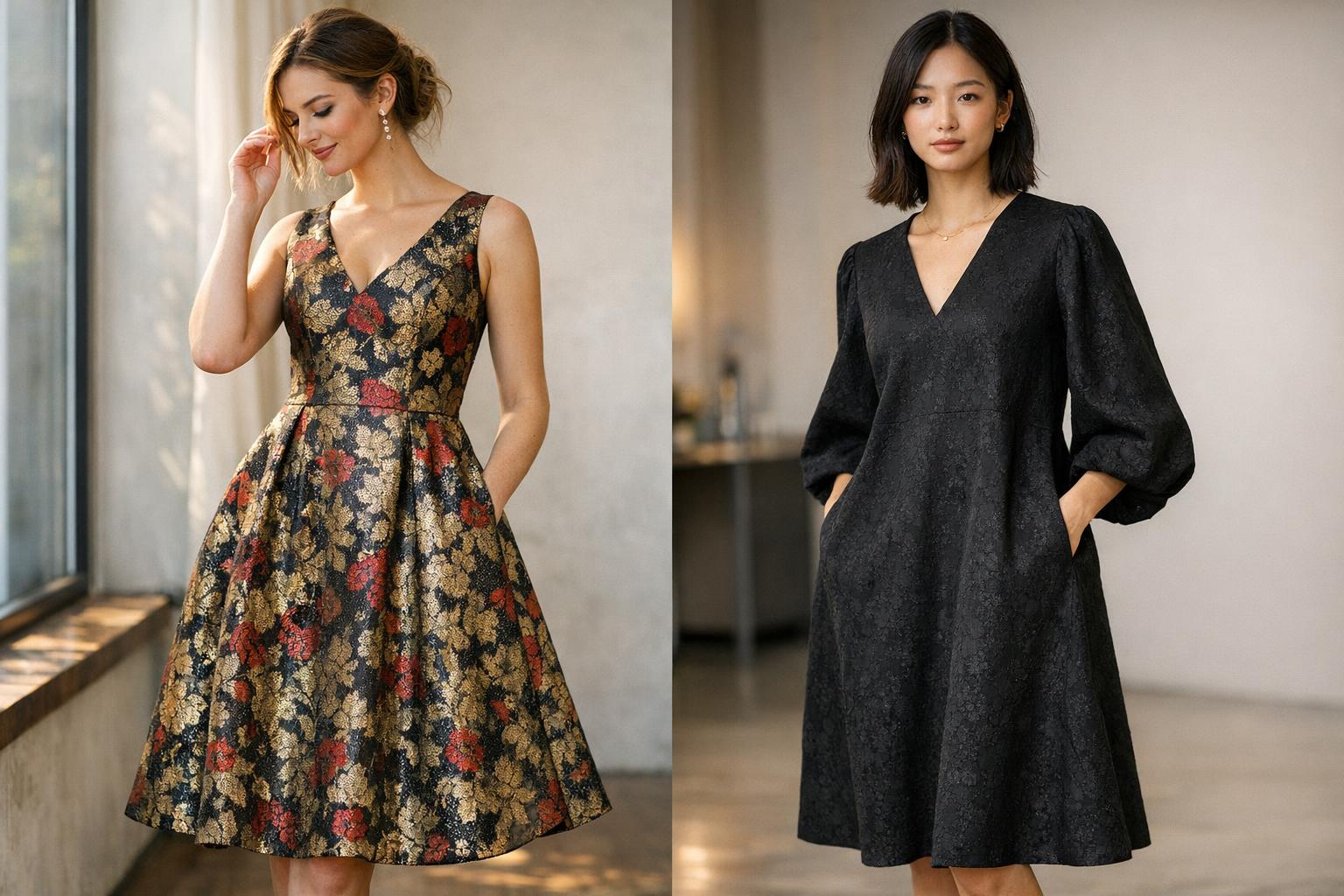
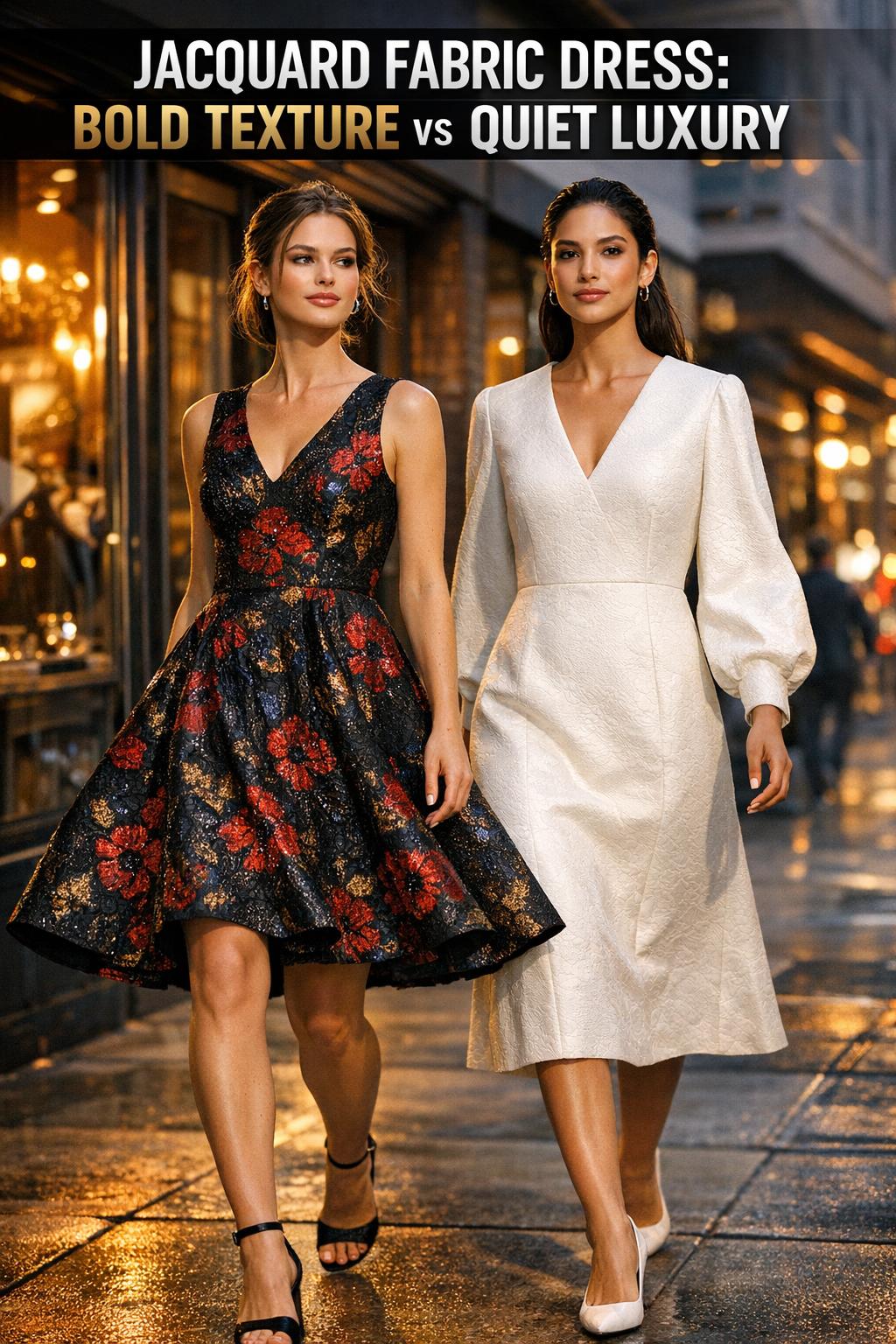
This breakdown compares two aesthetics that frequently get discussed together because they share the same foundation: the jacquard weave and its inherently elevated texture. The first is a pattern-forward, texture-first approach—think floral motifs, metallic or lurex shimmer, and visible surface detail. The second is a silhouette-forward, polish-first approach—where jacquard becomes a quiet luxury texture supporting a chic silhouette, often in streamlined midi lengths.
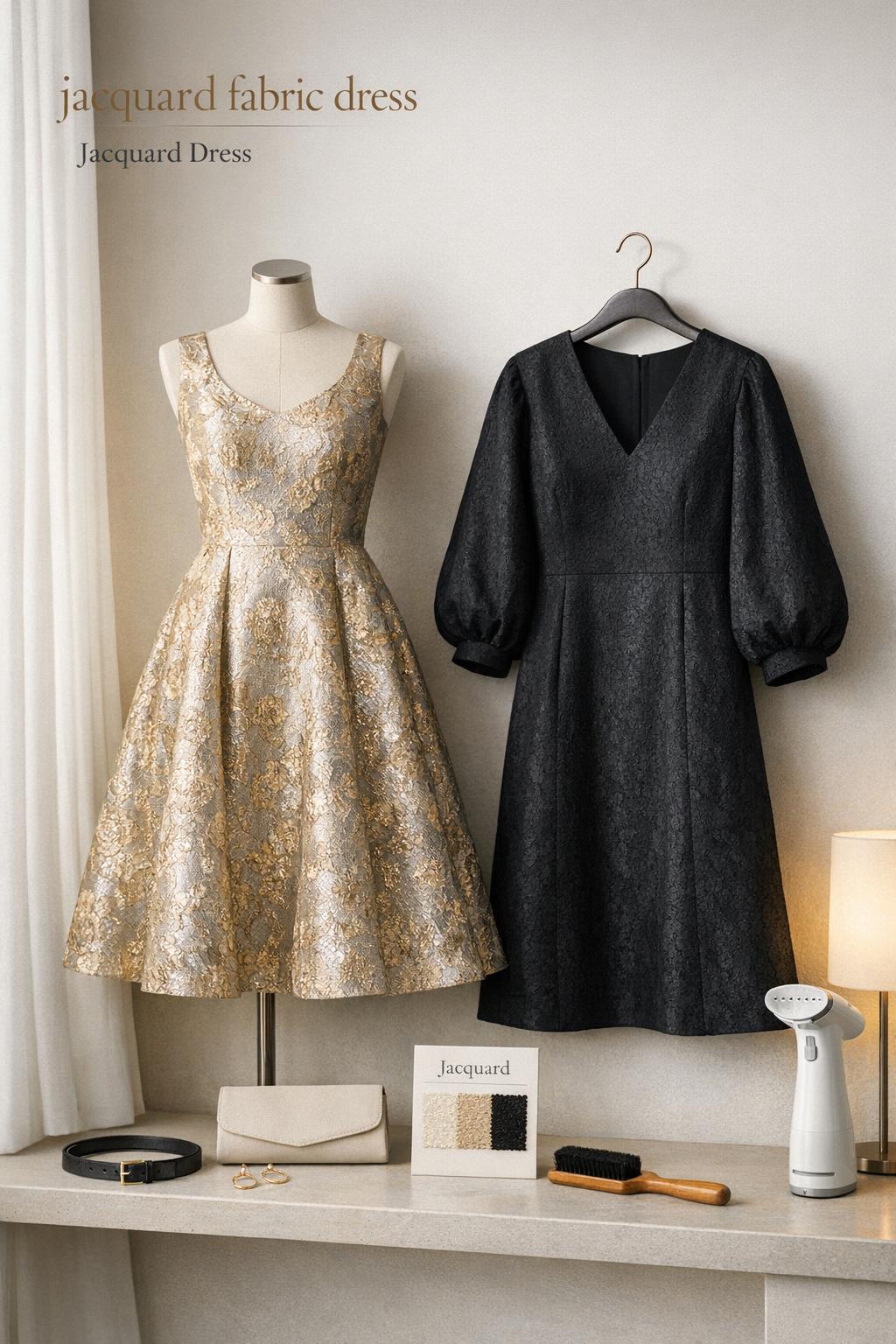
By the end, you’ll be able to read a jacquard dress quickly: which fabric variant you’re looking at (including metallic thread and lurex jacquard), how the weave affects drape and formality, and why brands as different as Max Mara, H&M, Karen Millen, Saint + Sofia, eShakti, Cedar & Bouclé, JJ’s House, FRAQAIR, and Raas The Global Desi land on different styling “rules” even when the dress category looks similar at first glance.
Style overview: pattern-forward jacquard (floral, embroidered, metallic, lurex)
Pattern-forward jacquard prioritizes surface design as the visual anchor. Florals, monogram-like repeats, and embroidery-adjacent detailing are the point—the outfit is built around the fabric’s message. This is where “floral jacquard fabric dress” becomes more than a search phrase; it’s a styling directive: keep the silhouette supportive and let the textile do the talking.
Found the dress? Keep the rest in one place.
Zarellea brings guest details, vendors, timelines, and every next step together — so your wedding plan feels as good as your look.
Typical silhouettes here include A-line shapes and midis that provide structure without competing with the motif. The presence of metallic accents or lurex threads increases perceived formality and demands more deliberate balancing—especially in daylight. eShakti’s floral lurex jacquard A-line dress concept sits squarely in this lane, where shimmer and motif create instant occasion energy while the A-line keeps movement practical.
The mood is expressive and event-ready, but not automatically “formal.” The same floral jacquard can read festive for evening or bold for daytime depending on sleeve volume, neckline shape, and whether the fabric includes shine (metallic thread or lurex) versus matte texture.
- Defining characteristics: visible motif, tactile surface interest, embroidery or shimmer cues
- Typical silhouettes: A-line, midi, fit-and-flare, occasion-oriented shapes
- Color and finish: high-contrast patterns or black-based jacquard; metallic/lurex options read brighter under light
- Texture logic: the fabric is the “statement piece,” so styling gets quieter elsewhere
Style overview: silhouette-forward jacquard (minimal pattern, maximum shape)
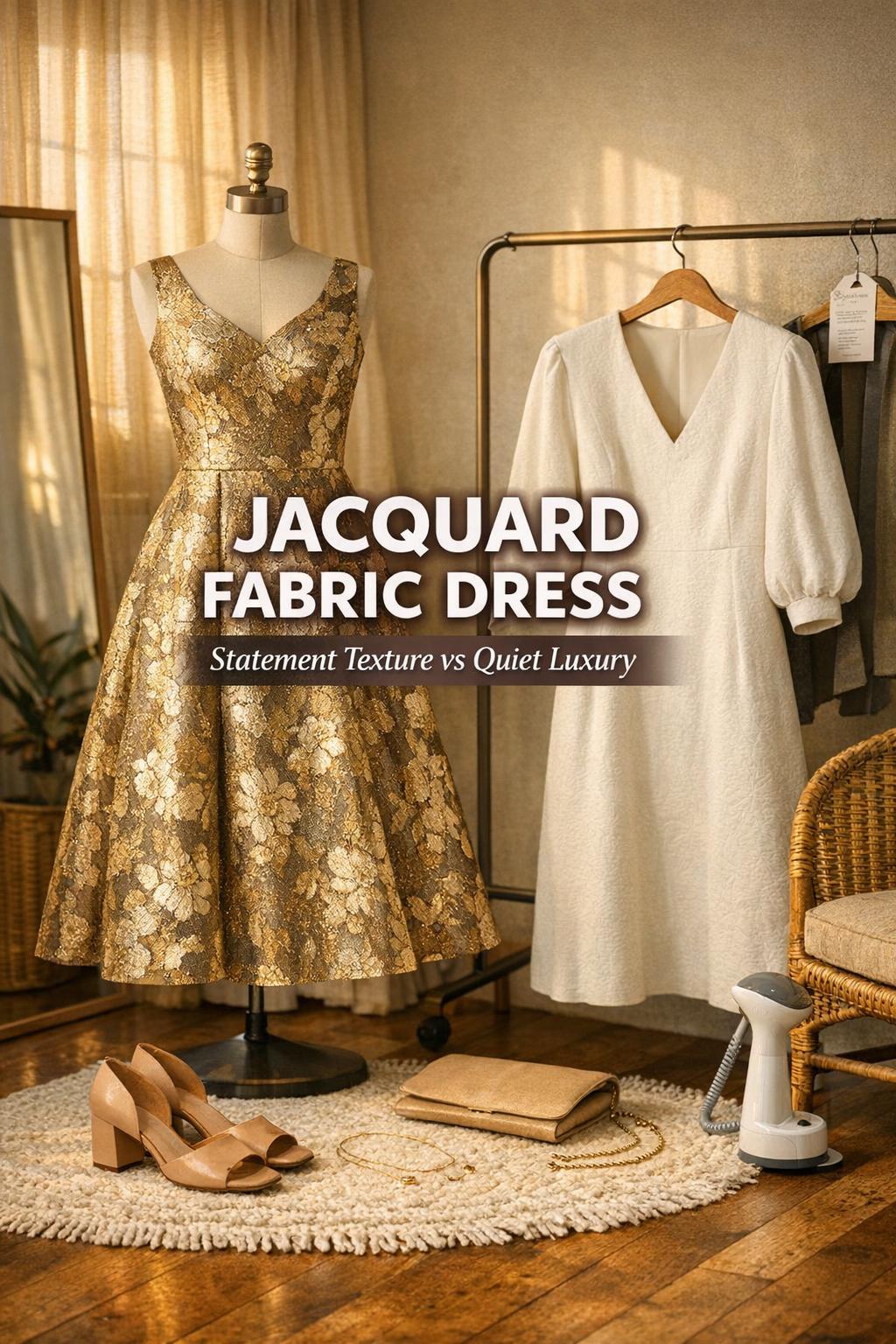
Silhouette-forward jacquard treats the weave as a refinement tool rather than a headline. The pattern may still exist—jacquard is inherently patterned by technique—but the styling intention is cleaner: emphasize proportion play, neckline geometry, and sleeve shape, while the fabric reads as depth rather than print.
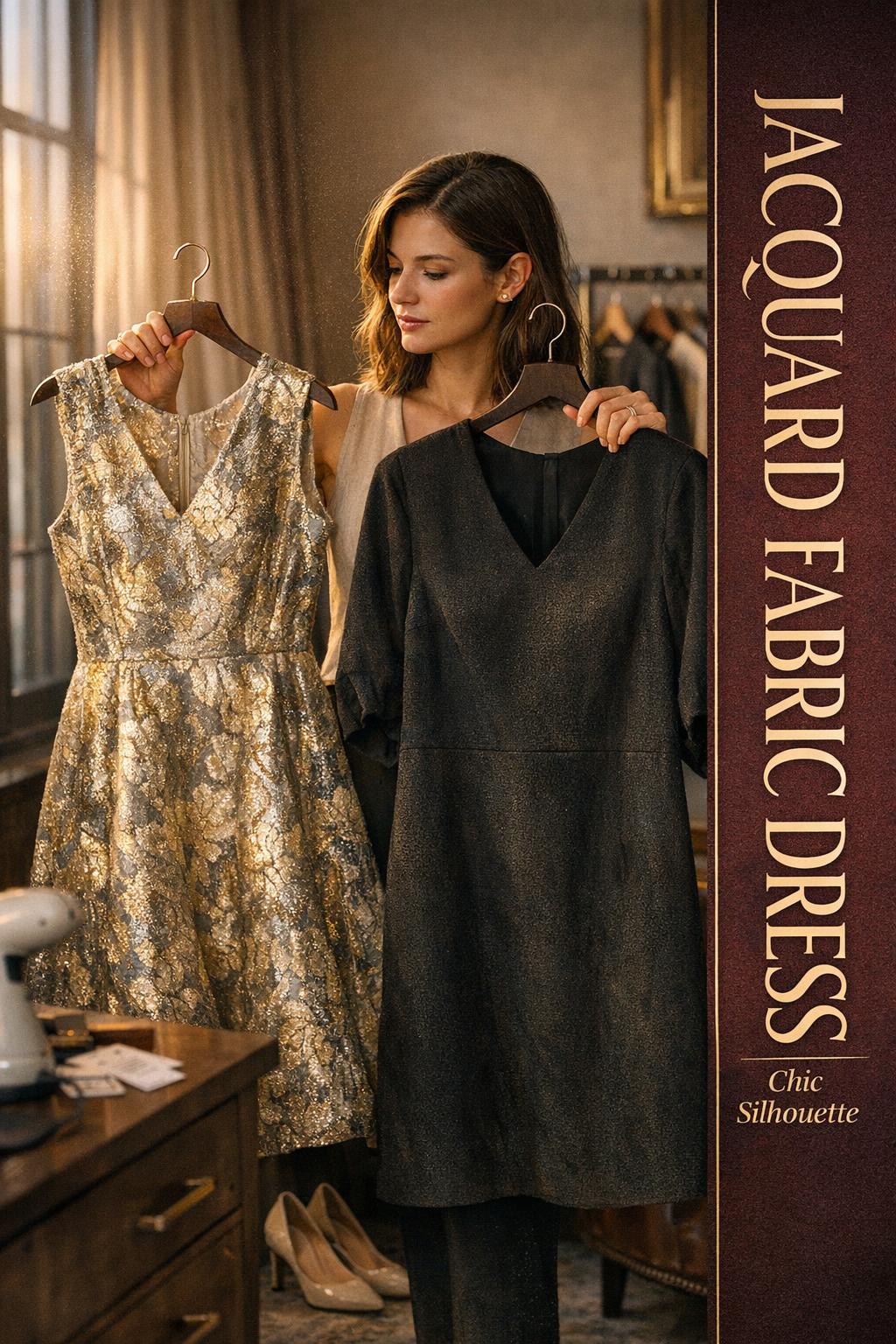
This is where the phrase “chic silhouette” becomes operational. Saint + Sofia’s Allegra V-neck dress in black jacquard signals this approach: a darker base color lets jacquard texture register as quiet dimension, while design features like neckline and sleeve volume (balloon sleeves are directly in this orbit) carry the styling weight. Karen Millen’s ivory jacquard woven midi dress concept also fits the silhouette-first lane: a midi length plus woven texture produces polish that’s easy to make office-appropriate or event-ready depending on accessories.
The mood is controlled and modern. When you want “elevated without being loud,” jacquard becomes a substitute for heavy embellishment. It’s still textured, still special, but it behaves like a neutral—especially in black or ivory jacquard where the weave catches light softly rather than sparkling.
- Defining characteristics: restrained motif, emphasis on neckline and sleeve architecture, clean outfit composition
- Typical silhouettes: midi-focused, tailored or intentionally oversized shapes, streamlined dress lines
- Color and finish: black jacquard, ivory jacquard, subtle monogram-style texture
- Texture logic: jacquard adds depth so the overall look can stay minimal
What “jacquard” signals in a dress—before you even talk style
Across brands, “jacquard” consistently appears as a weave identifier tied to patterning and texture. Max Mara positions jacquard dresses as a category where texture and couture-like surface interest define the offering—sometimes calling out specific jacquard textures (including cloque) and pattern directions like monogram. H&M’s jacquard-weave dress framing emphasizes the fabric as a defining feature alongside silhouette details and care instructions, reinforcing that jacquard isn’t a minor detail; it changes how the dress looks and wears.
At a practical level, jacquard tends to look more “built” than flat fabrics because the pattern is woven into the structure. That affects how it holds a sleeve shape (like balloon sleeves), how a midi skirt sits away from the body versus drapes, and how quickly the dress reads as day or evening once you add a metallic accent, embroidery effect, or a dark base color.
Even when a product title is simple—“jacquard woven midi dress” or “jacquard embroidered midi dress”—the weave implies intentional design. It’s why jacquard dresses appear across a spectrum: from accessible retail like H&M to premium positioning like Max Mara, and from customizable offerings like eShakti to boutique fabric-origin storytelling like Cedar & Bouclé with Italian jacquard references tied to Piedmont, Italy.
Key differences: pattern energy vs shape discipline
Silhouette and structure
Pattern-forward jacquard often benefits from silhouettes that stabilize the motif. An A-line or structured midi keeps a floral jacquard fabric dress from becoming visually chaotic, especially when lurex or metallic thread is in play. Silhouette-forward jacquard does the opposite: it uses jacquard as a texture layer that strengthens a clean line, so details like a V-neck, round neckline, balloon sleeves, or an oversized silhouette become the main design narrative.
Color palette and light behavior
Metallic accents and lurex jacquard shift the dress into a more reflective category; the fabric responds to light in a way matte jacquard doesn’t. That’s why shimmer versions tend to feel more evening-coded and “festive.” In contrast, black jacquard or ivory jacquard woven textures read as controlled: the weave is visible, but the finish stays refined. This difference is less about the label and more about how the surface behaves in daylight, indoor lighting, and photos.
Level of formality (and how quickly it changes)
Pattern-forward jacquard is high-impact by default, so it can become formal quickly with minimal accessory input. A jacquard embroidered midi dress naturally leans occasion-ready because embroidery signals craft and detail even before you add jewelry. Silhouette-forward jacquard is more flexible: the dress can stay work-appropriate or minimalist with restrained styling, then pivot toward evening with sharper accessories and more deliberate footwear.
Styling philosophy: “anchor the fabric” vs “let the fabric elevate”
Pattern-forward styling treats jacquard as the statement piece that needs anchoring. You build a quiet supporting cast around it. Silhouette-forward styling treats jacquard as a built-in elevation layer—meaning you can keep the outfit composition clean, and the fabric will prevent the look from feeling flat or underdressed.
Visual style breakdown: how the two aesthetics read in real outfits
Layering approach and outfit balance
Pattern-forward jacquard doesn’t like competition. If the motif is floral, monogram-like, or embroidered, the cleanest outcome usually comes from minimal layering and simple outer lines. Silhouette-forward jacquard can tolerate more layering because the pattern is quieter; the dress can act like a textured neutral under a coat or as a standalone midi where shape and sleeve architecture provide the interest.
Garment proportions: sleeves, neckline, and hemline
Volume is a deciding factor. A jacquard-weave dress with balloon sleeves and an oversized silhouette reads intentionally fashion-forward when the surface pattern stays controlled (a common logic seen in black jacquard approaches). Put that same sleeve volume on a high-contrast floral lurex jacquard and the outfit can tip from editorial to overwhelming—unless the rest of the silhouette is restrained and the neckline is clean.
Accessories and footwear as “noise control”
Accessories do different jobs in each style. In pattern-forward jacquard, accessories are primarily noise control: they keep attention on the fabric and prevent visual clutter. In silhouette-forward jacquard, accessories are often the switch that changes context—taking a jacquard woven midi from daytime polish to evening precision without changing the base dress.
Fabric variants that change the styling rules
Jacquard with metallic thread or lurex: the spotlight effect
Metallic accents and lurex jacquard are not just decorative—they change how the dress occupies space. Light-catching threads amplify the weave’s texture, which means the dress “reads” bolder from a distance and in motion. This is why a lurex jacquard A-line can feel instantly event-appropriate: the fabric itself performs like an accessory. The trade-off is versatility; shimmer requires more consideration in daytime settings where it can feel too festive if paired with equally bold extras.
Embroidery-forward jacquard: craft-first, festive-leaning
A jacquard embroidered midi dress brings two surface languages together: woven patterning plus embroidery effect. The result often skews celebratory and detail-rich, which aligns with styling that’s more intentional—clean hair-and-makeup energy, controlled accessories, and a silhouette that doesn’t fight the fabric. Raas The Global Desi’s jacquard embroidered midi dress concept sits in this lane, where texture and motif support a festive or evening-wear direction.
Stretch blends: jacquard plus spandex for movement
Some jacquard dresses are built for comfort and fit adaptability through blends like jacquard with spandex. JJ’s House positions a jacquard spandex midi dress as a practical, body-friendly option within a dressier category. The styling implication is simple: stretch can make a textured dress feel less rigid over long wear, but it also changes the visual—often reading sleeker and closer to the body, which can shift the dress from “architectural” to “streamlined.”
Italian jacquard and “made in Italy” storytelling: texture as provenance
Some labels foreground origin as part of the aesthetic. Cedar & Bouclé highlights Italian jacquard fabric with a specific geographic reference to Piedmont, Italy, and FRAQAIR positions jacquard dresses through a made in Italy lens. This doesn’t automatically dictate a single look, but it often correlates with a more premium styling mentality: fewer competing elements, more emphasis on fabric quality and finish, and a silhouette that lets the textile be legible.
Brand lens: how different labels translate the jacquard dress concept
Brands don’t just sell jacquard; they sell a way of wearing it. Seeing the same jacquard fabric dress idea across multiple labels clarifies why two dresses with similar names can style completely differently.
Runway-influenced texture and category depth: Max Mara
Max Mara treats jacquard dresses as a category where texture, motif variation (including monogram directions), and couture-adjacent surface interest justify exploration across silhouettes. This is the “fabric as fashion intelligence” approach: you choose based on pattern type and texture family (for example, cloque-like structure) as much as hemline.
Accessible statement with clear specs: H&M
H&M’s jacquard-weave dress framing emphasizes the wearable details—silhouette cues, potential metallic accents, and the practical information shoppers rely on like materials and care. The aesthetic can still be bold (especially with metallic patterning), but the value is clarity: you can predict how the dress will feel day-to-day because the product page structure focuses on fit and maintenance as much as the look.
Chic silhouette midis as a styling base: Karen Millen and Saint + Sofia
Karen Millen’s jacquard woven midi dress direction and Saint + Sofia’s Allegra V-neck dress in black jacquard both lean into a controlled, silhouette-first framework. These are dresses designed to be styled repeatedly—where texture keeps the look from reading plain, and features like neckline shape and sleeve volume provide the outfit’s structure.
Customization and motif control: eShakti
eShakti’s floral lurex jacquard A-line dress concept is built around two ideas: surface impact and adjustability through customization. That pairing matters for real wardrobes. A lurex jacquard is inherently attention-getting; customization increases the likelihood that the dress becomes a repeat-wear piece rather than a one-event purchase because the fit and proportions can be aligned with the wearer’s comfort and movement needs.
Boutique textile focus: Cedar & Bouclé, FRAQAIR, and Jacquard Dress
Cedar & Bouclé’s Italian jacquard messaging (including Piedmont, Italy) and FRAQAIR’s made in Italy emphasis align with a fabric-led wardrobe logic: provenance and textile character are central. Jacquard Dress (the brand/site identity) similarly centers Italian production and jacquard weave aesthetics across multiple silhouettes, reinforcing that “jacquard dress” can function as a focused wardrobe category rather than a one-off trend item.
How to choose a jacquard fabric dress without overthinking it
A jacquard dress purchase goes well when you decide what you want the dress to do: carry the outfit as a statement, or act as a polished base for styling. Most disappointments come from mixing those intentions—buying a metallic floral jacquard and expecting it to behave like a quiet day dress, or buying a subtle black jacquard midi and expecting it to read like a full event look without styling support.
Decision filter 1: occasion and lighting
Lighting is the hidden variable. Metallic accents and lurex jacquard intensify under indoor light and photography; matte jacquard textures stay more consistent across settings. If you need a dress that works from daytime into evening, a silhouette-forward jacquard (black jacquard or ivory jacquard woven) usually transitions more smoothly than a sparkle-forward floral lurex.
Decision filter 2: texture tolerance and comfort
Texture is sensory. Some jacquard fabrics feel more structured and “present,” which can be ideal for a chic silhouette that holds shape, but less ideal for long sitting or travel days. If comfort is a priority, blends like jacquard with spandex can improve movement and reduce that rigid feeling while maintaining a dressed-up look.
Decision filter 3: silhouette strategy (midi, A-line, oversized)
Midi lengths dominate the jacquard space across multiple brands, and for good reason: midi silhouettes balance texture and proportion without requiring extreme styling. A-line shapes stabilize pattern-forward fabrics, while oversized silhouettes and balloon sleeves tend to work best when the jacquard pattern is subtle enough to keep the overall outfit composition intentional rather than noisy.
Tips: making jacquard look modern, not costume
Jacquard has a reputation for feeling “formal” or “old-world” when it’s styled with too many competing signals. The simplest way to modernize it is to decide what the visual anchor is—either the weave/pattern or the dress architecture—and let everything else support that choice.
For a pattern-forward floral jacquard fabric dress, keep the supporting elements streamlined. A clean neckline, controlled sleeve volume, and minimal accessory strategy allow the woven motif to read intentional rather than busy. This is especially important with lurex jacquard; shimmer already functions like decoration.
For a silhouette-forward jacquard woven midi, sharpen the outfit with one decisive element: a neckline emphasis (V-neck or round neckline), a sleeve statement (balloon sleeves), or a deliberate proportion like an oversized silhouette. The jacquard texture will do the subtle work of making the look feel elevated even when the palette stays restrained.
- Use jacquard texture as your “finish” and avoid piling on extra surface detail in the same outfit.
- If the dress has metallic thread or lurex, treat jewelry and other reflective elements as optional, not mandatory.
- When the pattern is subtle (black jacquard, ivory jacquard), lean into shape: sleeves, neckline, and hemline create the outfit’s structure.
- If the dress is embroidered jacquard, keep the silhouette clean so the craft reads premium rather than heavy.
Outfit logic comparisons: the same scenario, two different jacquard aesthetics
Scenario: daytime event where you’ll be photographed
Pattern-forward approach: choose a floral jacquard fabric dress with a stable A-line or midi shape so the motif reads clearly in photos without distorting with movement. If the fabric includes metallic accents or lurex, keep the rest of the styling controlled—your goal is to let the fabric register as the statement without adding visual noise.
Silhouette-forward approach: choose a black jacquard or ivory jacquard woven midi where the texture is visible up close but doesn’t dominate in wide shots. Then use one architectural detail—like a V-neck or sleeve volume—to create a focal point that reads polished in photos even when accessories are minimal.
Scenario: work-to-evening transition
Pattern-forward approach: an embroidered jacquard midi can work if the pattern is not overly reflective; otherwise it risks feeling too festive for daytime. Keep the silhouette streamlined and avoid excessive sleeve volume so the dress stays in the “polished” lane rather than the “occasion” lane.
Silhouette-forward approach: this is the natural terrain for a jacquard woven midi. The dress stays office-appropriate because the jacquard reads as texture, then pivots to evening by tightening the outfit composition—more deliberate accessories and footwear choices—without changing the base.
Scenario: long wear (sitting, walking, commuting)
Pattern-forward approach: prioritize comfort in the structure. If you love the statement of floral jacquard but need mobility, an A-line silhouette provides ease through the hips and stride, and it maintains pattern integrity because the fabric doesn’t pull tightly across the body.
Silhouette-forward approach: consider jacquard blends that support movement—like jacquard with spandex—especially in a midi that you’ll wear for hours. The trade-off is a sleeker, closer-to-body read, which can be a benefit if you want the silhouette to feel controlled.
When to choose each style (and why it matters in a real wardrobe)
Choosing between pattern-forward and silhouette-forward jacquard isn’t about which is “better.” It’s about where you want the visual energy to live and how often you want to rewear the piece without feeling over-styled.
Choose pattern-forward jacquard when
You want the dress to do most of the work. Floral motifs, metallic thread, lurex jacquard, and jacquard embroidery deliver built-in occasion presence. This lane is ideal for events where you want texture and pattern to read instantly, and you’re comfortable keeping everything else more restrained to protect the outfit balance.
Choose silhouette-forward jacquard when
You want repeat-wear versatility. A jacquard woven midi in black or ivory can become a wardrobe anchor because it’s adaptable: it can look clean and minimal, yet never flat. It’s also a strong choice when you prefer structure—neckline definition, sleeve architecture, or an intentionally oversized silhouette—over high-impact pattern.
Common styling mistakes with jacquard dresses (and the quick fixes)
Jacquard is forgiving in quality perception—texture reads premium—but less forgiving in outfit composition. The mistakes usually come from stacking too many focal points or ignoring how the weave behaves in motion and light.
- Mistake: treating lurex or metallic jacquard like a basic day fabric. Fix: reduce competing shine and let the fabric be the single reflective element.
- Mistake: combining heavy motif with heavy silhouette volume. Fix: if the pattern is bold (floral, embroidered), keep the silhouette cleaner; if the silhouette is bold (balloon sleeves, oversized), keep the pattern quieter.
- Mistake: expecting every jacquard fabric dress to drape softly. Fix: choose silhouette based on fabric behavior—structured jacquard loves midi lines and A-line shapes that benefit from body.
- Mistake: over-accessorizing an already textured dress. Fix: simplify; jacquard texture is already visual detail.
Care and longevity: keep the weave looking intentional
Care matters more with jacquard than with flat fabrics because surface texture is the point. Many jacquard dress pages emphasize care instructions alongside fabric composition and fit, and that’s not filler: the wrong cleaning approach can dull texture, flatten relief, or reduce the crispness that makes jacquard look elevated in the first place.
Tips: care decisions that protect texture
Start with the care label logic the product pages highlight—especially for jacquard-weave dresses with metallic accents or lurex. Shimmer threads and embroidered effects can be less forgiving than matte jacquard. If the dress is a blend (including spandex), treat heat and aggressive washing cautiously to preserve recovery and surface integrity. When in doubt, prioritize gentler cleaning choices that maintain the fabric’s dimensional look.
Storage and preservation: shape and surface protection
Jacquard holds memory: fold lines and pressure points can show more clearly on textured surfaces. Storage choices should protect the dress shape and prevent crushing the weave—particularly for midis with structured skirts or statement sleeves. A garment bag approach is often used as a protective layer to keep the surface from snagging and to help preserve the dress as a repeat-wear option across seasons.
Context-specific style notes: the “Italy factor” and why it changes the outfit mentality
When a brand emphasizes made in Italy or calls out Italian jacquard—like Cedar & Bouclé referencing Piedmont, Italy, or FRAQAIR positioning jacquard dresses through Italian production—it signals a styling mindset as much as a sourcing note. The outfit tends to work best when you treat the fabric as a hero material: fewer competing details, cleaner lines, and a focus on silhouette balance rather than trend stacking.
This doesn’t mean the look has to be minimal. It means the visual anchor stays coherent: either the motif is the statement (floral jacquard) or the cut is the statement (a chic silhouette midi in textured jacquard). That coherence is what makes jacquard feel modern—whether you’re wearing a boutique Italian jacquard dress, a brand-forward category piece from Max Mara, or an accessible jacquard-weave dress chosen for its specific sleeve and neckline features.
FAQ
What is a jacquard fabric dress, and why does it look more elevated than a printed dress?
A jacquard fabric dress uses a jacquard weave to create pattern and texture within the fabric itself, so the design reads as dimensional rather than simply printed on the surface. That built-in texture often makes the dress look more structured and polished, even with simple styling.
How do I choose between a floral jacquard fabric dress and a subtle black jacquard midi?
A floral jacquard fabric dress is typically pattern-forward and works best when you want the fabric to be the statement, while a subtle black jacquard midi is usually silhouette-forward and easier to rewear across settings. Decide whether you want maximum pattern energy or a chic silhouette that you can style up or down.
What’s the difference between jacquard with lurex or metallic thread and regular jacquard?
Lurex jacquard or jacquard with metallic thread reflects more light, so it reads dressier and more attention-grabbing in photos and evening lighting. Regular jacquard can be matte and more versatile, with texture that’s visible without the sparkle effect.
Are jacquard dresses comfortable for all-day wear?
Comfort depends on the fabric blend and silhouette. More structured jacquard can feel crisp and less drapey, while jacquard blended with spandex can improve movement and fit flexibility, especially in midi lengths designed for long wear.
Do jacquard dresses work for daytime, or are they only for events?
They can work for daytime, but the styling approach matters. Matte jacquard in black or ivory and clean jacquard woven midis tend to translate well to daytime polish, while embroidered, metallic, or lurex jacquard versions skew more festive and are easier to wear in evening or occasion settings.
What silhouettes are most common for jacquard dresses?
Midi silhouettes are especially common, and A-line shapes are frequent in pattern-forward designs because they balance texture and provide ease of movement. You’ll also see statement sleeves like balloon sleeves and occasionally oversized silhouettes where the jacquard texture supports the garment’s structure.
How should I style a jacquard embroidered midi dress so it doesn’t feel overdone?
Keep the outfit composition clean and let the embroidery-texture be the hero. A streamlined silhouette and restrained accessories usually work best because the dress already carries surface detail through both woven patterning and embroidery effects.
Why do some jacquard dress brands emphasize Italy or Piedmont?
Some labels frame jacquard through fabric origin and craftsmanship, highlighting Italian production or regions like Piedmont, Italy, as part of the dress identity. In styling terms, that often aligns with a fabric-first approach where texture and finish are meant to be clearly visible, supported by a controlled, well-balanced silhouette.
What’s the simplest way to make a jacquard weave dress look modern?
Choose one focal point: either the pattern/texture (floral, metallic, embroidered) or the shape (a chic silhouette with neckline and sleeve architecture), then keep everything else restrained. Jacquard already provides visual depth, so simplifying the rest of the look is usually what makes it feel current.